
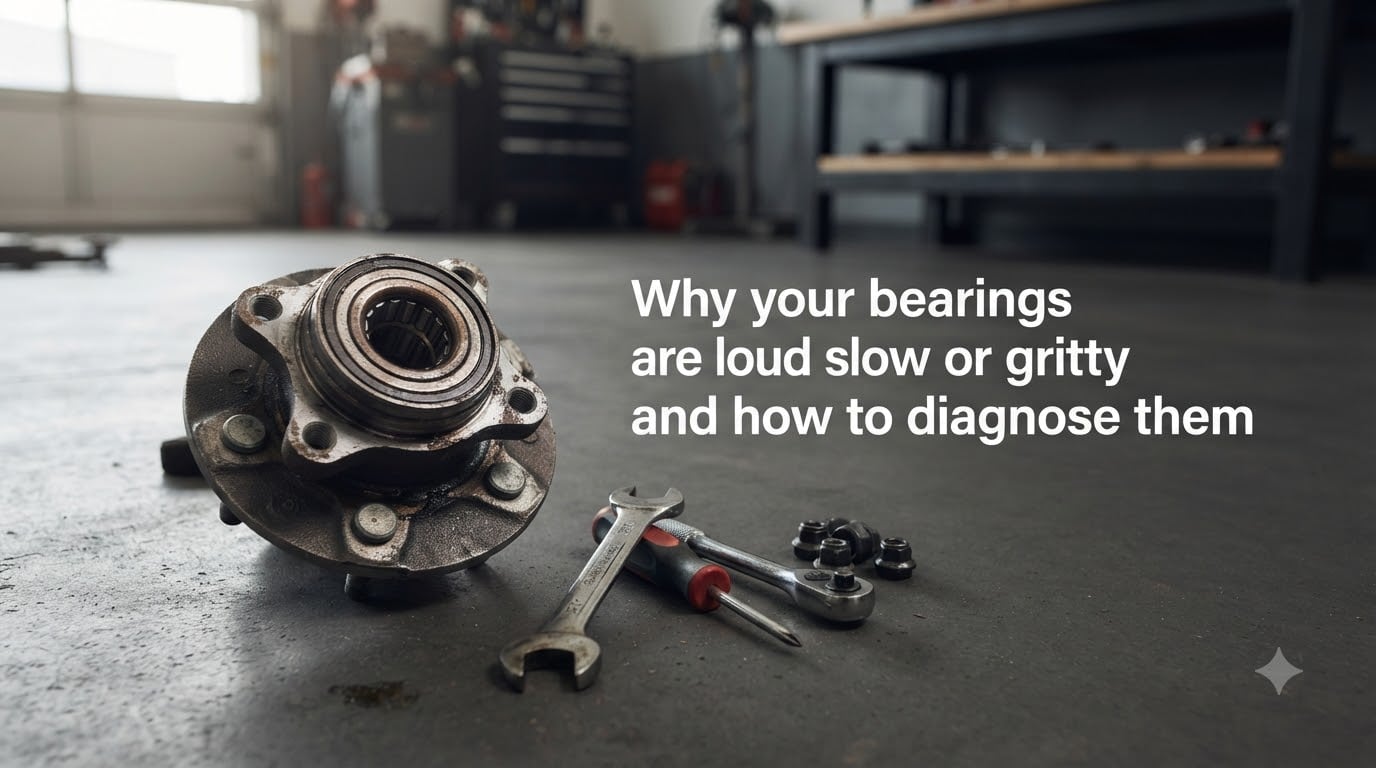
That humming noise creeping into your cabin at 50 mph is not something to ignore. If your vehicle sounds like a small airplane on the highway or grinds when you take a corner, you may be dealing with a failing wheel bearing. Wheel bearing diagnosis comes down to recognizing the right sounds, running a couple of simple tests, and knowing what else could be causing the noise.
I have spent years under vehicles chasing down mystery sounds, and I can tell you that wheel bearings have a language all their own. The good news is that once you learn the patterns, pinpointing the problem becomes surprisingly straightforward.
In this guide, we will cover what wheel bearings actually do, why they fail, the seven warning signs you should never ignore, and step-by-step diagnostic tests you can run in your driveway. We will also sort out what can be mistaken for bearing noise so you do not throw parts at the wrong problem.
Table of Contents
What Is a Wheel Bearing?
A wheel bearing is a set of steel balls (or tapered rollers) held together inside a metal ring called a race. That assembly sits inside the hub, where it lets the wheel spin freely with minimal friction while carrying the full weight of the vehicle on that corner.
Most modern cars use sealed hub assemblies that combine the bearing, hub, and sometimes the ABS wheel speed sensor into one bolt-on unit. Older vehicles and many trucks still use serviceable tapered roller bearings that can be cleaned, repacked with grease, and adjusted.
Because they carry hundreds or thousands of pounds and spin at highway speeds, bearings operate under extreme stress. When the internal surfaces start to break down, friction increases and the noise begins.
Why Wheel Bearings Become Loud, Slow, or Gritty?
Bearings fail for a handful of predictable reasons. Understanding the cause helps you confirm the diagnosis and prevent the next one from going out prematurely.
Normal Wear and Mileage
Every bearing has a finite lifespan. Heat cycles, constant loading, and miles of rotation gradually break down the grease and pit the race surfaces. Most wheel bearings last between 85,000 and 100,000 miles, though some fail much sooner and others run well past 150,000.
Potholes, Curbs, and Impact Damage
A single hard hit from a pothole, curb, or deep road crater can dent or brinell the bearing race. The damage may not make noise immediately, but within a few thousand miles the dented surface creates a noticeable growl.
Water and Contaminant Intrusion
Sealed bearings rely on rubber or metal seals to keep grease in and water out. Driving through deep water, flooded roads, or repeated pressure washing can compromise those seals. Once moisture and road grit enter the race, the lubricant breaks down and the surfaces begin grinding.
Poor Installation and Over-Torquing
An improperly torqued axle nut or a bearing pressed in crooked will fail early. If a bearing was replaced recently and the noise returned within weeks, installation error is the prime suspect.
EV-Specific Bearing Stress
Electric vehicles put unique demands on wheel bearings. The instant, high torque from electric motors slams the bearing surfaces harder than a gradual gas-engine build-up. EVs also sit heavier due to battery packs, and regenerative braking shifts load patterns differently than traditional brakes. Some manufacturers now use ceramic balls or conductive grease to fight electrical erosion through the bearing, a problem unique to electric drivetrains.
Signs Your Wheel Bearing Is Going Out
Here are the seven most common symptoms of a failing wheel bearing. If you notice two or more of these together, the odds point strongly to a bearing problem.
Humming or rumbling that grows with speed. This is the classic sign. The noise starts faint and gets louder as you accelerate, often described as a “wub wub wub” sound that matches wheel speed rather than engine speed.
Growling or grinding that intensifies on turns. Turning shifts vehicle weight onto the outside bearing. If the noise gets louder in a left turn, the right-side bearing is likely the culprit, and vice versa.
Clicking or popping from the front. A clicking sound during sharp turns at low speed can indicate a bearing with excessive play, though it can also point to a CV joint (we will cover how to tell the difference below).
Steering wheel vibration. As the bearing loses its smooth surface, it sends vibrations up through the suspension and into the steering wheel. At highway speeds this can feel like an out-of-balance tire.
Loose or wandering steering. Excess bearing play creates slack in the hub, making the steering feel vague or causing the vehicle to wander on straight roads.
Uneven tire wear. A wobbling hub chews through the tire on that corner unevenly. If one tire is wearing noticeably differently from the rest, check the bearing.
ABS or traction control warning light. Many hub assemblies house the ABS tone ring or wheel speed sensor. A bearing that has loosened enough can disrupt that signal and trigger a dashboard warning.
How to Diagnose a Bad Wheel Bearing?
This is where wheel bearing diagnosis gets practical. These three tests work together to confirm the problem and pinpoint which corner of the vehicle is affected.
The Left-Right Turn Test
This is the single most reliable driveway test. Find a quiet, empty road and drive at a steady 40 to 50 mph.
Sweep the steering wheel gently to the left in a lane-change arc. Then do the same to the right. Listen carefully for volume changes.
When you turn left, vehicle weight transfers to the right side and loads the right bearings while unloading the left. If the noise gets louder turning left, the right-side bearing is bad. If the noise gets louder turning right, the left-side bearing is the problem.
This test works because a bad bearing screams under load and goes quiet when unloaded. It is the same principle shops use on every test drive.
The Lift and Spin Test
Jack up the suspect corner of the vehicle and support it safely on a jack stand. Grab the tire at the 12 and 6 o’clock positions and push-pull firmly. Any knocking or play means the bearing has excessive clearance.
Next, spin the wheel by hand as fast as you can and listen. A healthy bearing is nearly silent. A failing one produces a rough, grinding, or rumbling sound. Place a mechanics stethoscope (or even a long screwdriver with the handle against your ear) on the hub while spinning to amplify the noise.
Speed Correlation Check
Wheel bearing noise tracks with wheel speed, not engine speed. To confirm, get up to the speed where the noise is loudest, then shift into neutral and let the engine idle. If the noise continues unchanged, it is tied to vehicle speed and points to a bearing, tire, or driveline issue rather than the engine or transmission.
Most bad bearing noise becomes noticeable around 30 to 40 mph and grows steadily louder as speed increases. At highway speeds it can become a loud drone that drowns out the radio.
What Can Be Mistaken for Wheel Bearing Noise
One of the biggest frustrations drivers share on mechanic forums is paying for a bearing replacement only to find the noise is still there. Several other problems mimic bearing noise closely enough to fool even experienced ears.
Wheel Bearing vs CV Joint Noise
A bad CV joint clicks or pops during sharp, low-speed turns and often comes with a torn rubber CV boot leaking grease. A wheel bearing growls at speed and changes with vehicle loading during gentle turns, not sharp parking-lot maneuvers.
Wheel Bearing vs Tire Noise
Cupped or chopped tires produce a roaring sound that closely matches bearing noise. The difference: tire noise often changes on different road surfaces, while bearing noise stays consistent. If the noise disappears momentarily on fresh asphalt, suspect the tires.
Other Imposters
Differential noise changes with acceleration and deceleration and comes from the center of the vehicle, not a single corner.
Brake drag creates heat and smell near one wheel and a grinding sound that stops when you tap the brake pedal.
Exhaust leaks can mimic a bearing tick but change with engine RPM, not wheel speed.
If you are unsure, the lift and spin test combined with the turn test will usually separate a real bearing problem from an imposter.
Is It Safe to Drive With a Bad Wheel Bearing?
The short answer is: only as far as the nearest shop. A moderately noisy bearing may last weeks or months, but you cannot predict when it will cross from annoying to dangerous.
A severely worn bearing can seize. If that happens at speed, the wheel can lock up or in the worst case separate from the vehicle entirely. Even short of catastrophic failure, excess play damages the hub, axle, brakes, and ABS components, turning a $200 repair into a $1,000 one.
If you hear grinding, feel significant play, or notice the steering behaving erratically, tow the vehicle rather than drive it.
Wheel Bearing Replacement: Repair vs Replace
Most modern vehicles use sealed hub units that cannot be serviced. The bearing and hub come as one bolt-on assembly, making replacement straightforward for a shop. You cannot repack or adjust a sealed bearing.
Older vehicles with tapered roller bearings can sometimes be serviced by cleaning, inspecting, and repacking with fresh high-temperature wheel bearing grease. However, if the race is pitted or the rollers are scored, replacement is the only correct fix.
Labor time typically runs one to two hours per corner on most cars and trucks. Expect the total job to vary based on whether the hub is bolt-on or press-in, since press-in hubs require more labor to remove and install.
Always replace bearings in matched pairs per axle if both sides have high mileage. Replacing only the failed side while the other is near the end of its life guarantees a return visit for the same repair.
Frequently Asked Questions
What can be mistaken for wheel bearing noise?
The most common imposters are cupped or chopped tires, bad CV joints, differential noise, and brake drag. Tire noise often changes on different road surfaces while bearing noise stays constant. CV joints click during sharp low-speed turns, while bearings growl at highway speeds.
What is one of the first signs of bearing failure?
The earliest sign is usually a faint humming or rumbling noise that appears at around 30 to 40 mph and grows louder with speed. It often changes pitch when turning left or right as vehicle weight shifts onto and off the failing bearing.
Why are my bearings so loud?
Bearings get loud when the internal surfaces break down from normal wear, impact damage from potholes, water contamination through failed seals, or poor installation. As the race and rollers pit and score, friction increases and produces the humming, growling, or grinding noise you hear.
At what speed do you hear a bad wheel bearing?
Most bad wheel bearings first become noticeable around 30 to 40 mph and get progressively louder as speed increases. By highway speeds the noise can become a loud drone. The sound tracks with wheel speed, not engine RPM, which helps distinguish it from engine or exhaust noise.
Wrapping Up
Wheel bearing diagnosis comes down to three things: recognizing the noise, running the turn test, and ruling out imposters like tires and CV joints. If your vehicle is humming, growling, or grinding in a way that builds with speed, a bearing is the prime suspect.
Start with the left-right turn test on a quiet road. Confirm your findings with the lift and spin test using a stethoscope or screwdriver against the hub. If both point to the same corner, you have your answer.
Do not put off the repair. A noisy bearing will only get louder, and waiting too long risks hub, axle, and ABS damage, or worse, a wheel that locks up at speed. Get it checked, get it fixed, and get back to a quiet cabin.