
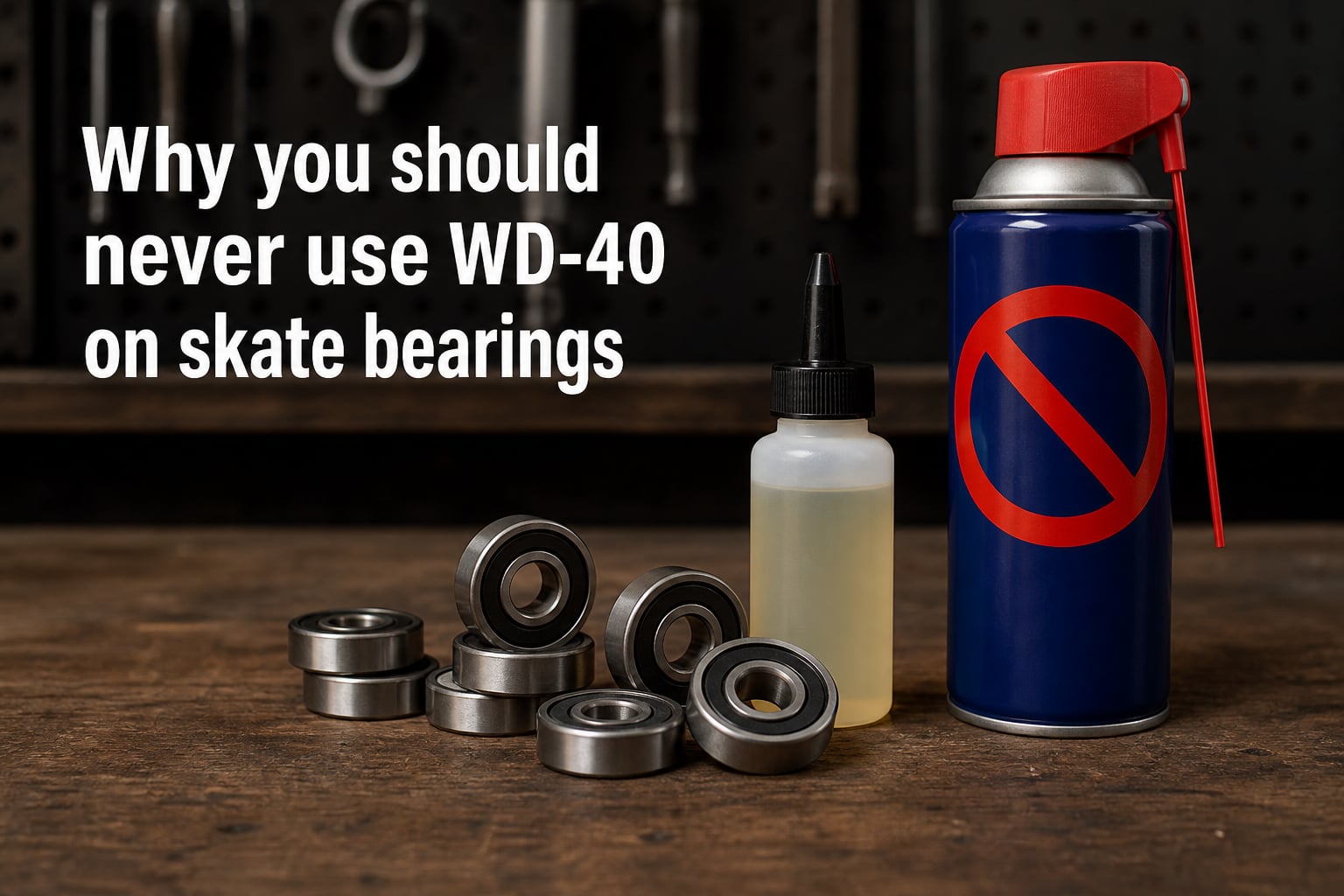
WD-40 is a water-displacing solvent, not a lubricant. If you spray it on your skate bearings, they will feel fast for a day or two and then seize up harder than before. I have seen this happen dozens of times in skate communities, and the fix is never as simple as wiping it off.
In this guide, I will break down exactly why WD-40 destroys skate bearings, what happens inside the bearing when you use it, and what you should use instead. I will also walk you through a step-by-step rescue process if you have already made this mistake.
Whether you ride a skateboard, longboard, or roller skates, the science is the same. Your bearings deserve better than a blue-and-yellow can.
Table of Contents
What WD-40 Actually Is (The Big Misconception)
WD-40 stands for “Water Displacement, 40th formula.” Norm Larsen developed it in 1953 to prevent corrosion on Atlas missile parts by displacing moisture from metal surfaces. That is its primary job, and it does that job well.
What WD-40 is not, however, is a bearing lubricant. It is a low-viscosity solvent blend made mostly of light petroleum distillates. When you spray it on a surface, the carrier solvents evaporate rapidly, leaving behind a thin, sticky film.
That thin film is what tricks people. For the first few hours after application, your bearings feel noticeably faster. The solvent has flushed out old grease and the leftover film creates a temporary slick surface. This is not lubrication. It is residue.
A proper bearing lubricant needs staying power. It needs to cling to the ball bearings and raceways under high-speed rotation without evaporating. WD-40’s petroleum base has such low viscosity that it cannot maintain a lubricating film under mechanical load. It evaporates, it drips out, and it takes whatever factory grease was left down with it.
The marketing on the can does not help. WD-40 lists “lubricates” among its many uses, which leads new skaters to assume it works for precision mechanical parts. It does not. It lubricates door hinges and stubborn zippers, not 608 bearings spinning at thousands of RPM.
Why You Should Never Use WD-40 on Skate Bearings
Here is the short answer: WD-40 strips out factory lubricant, evaporates quickly, and leaves a sticky residue that turns your bearings into dirt magnets. Within days, your bearings will attract grime, build up friction, and potentially seize completely.
Let me break down the specific damage mechanisms:
It dissolves your factory grease. WD-40 is a solvent first. When it contacts the factory lubricant packed inside a new bearing, it breaks that grease down and flushes it out. You are left with dry steel rubbing against dry steel.
It evaporates and leaves nothing behind. Because WD-40 is petroleum-based with low viscosity, the liquid portion evaporates within hours. No protective film remains on the ball bearings or raceways.
The leftover residue attracts grime. That sticky film WD-40 leaves behind acts like flypaper for dust, dirt, and grit. Every particle that enters your bearing sticks instead of passing through.
It damages rubber seals and shields. WD-40 degrades the rubber or nylon seals that keep contamination out of your bearings. Once those seals warp or crack, your bearings are permanently exposed to dirt.
It causes bearings to seize. As grime builds up inside the bearing cage, the rolling resistance increases until the bearing locks up entirely. I have seen Reddit posts from skaters whose wheels would not even spin freely after a week of WD-40 use.
The irony is that WD-40 makes bearings feel faster at first. That initial speed boost is the solvent flushing out old grease. Once that solvent evaporates, you are worse off than before you started.
One forum skater put it perfectly: “WD-40 will work for a few days, but the amount of grime that develops afterward will cause your bearings to seize up.” This is not an exaggeration. It is the natural physics of solvent-based sprays on precision components.
There is also an environmental angle worth mentioning. WD-40 contains chemicals including perfluorooctanoic acid (PFOA) traces in some formulations. These are persistent environmental contaminants. Spraying them on parts that will eventually end up in landfills is not great for the planet, and breathing the aerosol mist while doing bearing maintenance is not great for your lungs either.
Anatomy of a Skate Bearing (608 Standard)
Nearly every skateboard, longboard, roller skate, and inline skate uses the same bearing: the 608. This standardized bearing measures 22mm outer diameter, 8mm inner diameter, and 7mm width. Understanding its parts helps explain why lubrication matters so much.
Inside a 608 bearing you will find seven steel (or ceramic) balls held in place by a cage, rolling between an inner race and an outer race. These surfaces are precision-machined to tolerances measured in microns. The balls roll along polished steel tracks called raceways.
The factory grease packed inside a new bearing serves two jobs. First, it reduces friction between the balls and raceways. Second, it creates a barrier that slows down contamination from outside dirt. When you dissolve that grease with WD-40, you lose both protections.
The bearing also has shields or seals on the outside. These are usually rubber (designated RS or 2RS) or metal (designated ZZ or 2Z). Rubber seals do a better job of keeping dirt out but create slightly more rolling resistance. Metal shields let bearings spin freer but offer less protection.
WD-40 attacks rubber seals over time. The solvents soften and warp the rubber, creating gaps where dirt enters freely. Once those seals are compromised, no amount of lubricant will save the bearing from contamination.
Signs Your Bearings Have Been Damaged by WD-40
If you have already used WD-40 on your bearings, here are the warning signs to watch for:
Noisy spinning. A healthy bearing spins silently. If you hear grinding, rattling, or a rough sandpaper sound, the internals are contaminated.
Slow spin test. Hold your wheel by the axle and flick it hard. A clean, lubricated bearing should spin freely for 10 to 15 seconds. If it stops in 2 or 3 seconds, something is wrong.
Visible grime. Look at the bearing shields. If you see a dark, sticky buildup around the edges, that is the WD-40 residue attracting dirt.
Rough feeling when rolling. When you ride, the wheels should feel smooth. A grinding or vibrating sensation through the deck means the bearing internals are damaged.
Seized bearings. The worst case. The wheel will not spin at all, or only with heavy resistance. The grime buildup has locked the balls inside the cage.
Catching the damage early matters. If your bearings still spin but sound rough, you can usually rescue them with a proper cleaning. If they are seized solid, replacement may be your only option.
What to Use Instead: Proper Skate Bearing Lubricants
The gold standard for skate bearing lubrication is Bones Speed Cream. It is a light oil specifically formulated for skate bearings, and it is what most professional skaters use. A single small bottle lasts years because you only need a drop per bearing.
The key question is whether to use oil or grease. Here is how to decide:
Bearing oil (like Bones Speed Cream or Tri-Flow) is thin and designed for speed. It reduces rolling resistance to nearly nothing and makes your bearings spin fast. The trade-off is that you need to reapply it more frequently, roughly every few months depending on how often you ride. Oil also does not protect against contamination as well as grease.
Bearing grease is thicker and lasts longer between applications. It provides better protection against water and dirt but creates slightly more rolling resistance. Grease is the better choice if you ride in wet, dusty, or dirty conditions and do not want to service your bearings often.
Some good options beyond Bones Speed Cream include Tri-Flow Superior Lubricant, Liberty Oil (designed for small precision bearings), and any synthetic bearing grease from a skate or bearing brand. What matters most is that the product is specifically designed for bearings, not a multi-purpose household spray.
Avoid motor oil, cooking oil, silicone spray, and 3-in-One oil. These are either too thick, too thin, or break down under the high RPM that skate bearings reach. Stick with products made for the job.
How to Rescue Bearings After Using WD-40
If you already sprayed WD-40 on your bearings, do not panic. You can often save them if you act before they seize up completely. Here is the step-by-step rescue process our team recommends:
Step 1: Remove the bearings from the wheels. Use a bearing puller or the axle of your truck to pop each bearing out carefully. Do not pry against the shields or you will bend them.
Step 2: Remove the shields or seals. For rubber seals (RS), use a pushpin or small flathead to gently pop the seal out from the inner ring. For metal shields (ZZ), they are usually crimped in place and harder to remove. If you cannot remove them cleanly, you can clean around them, but results will not be as thorough.
Step 3: Soak the bearings in a solvent. Use isopropyl alcohol (90 percent or higher), acetone, or a dedicated citrus-based bearing degreaser. Drop the bearings in a small jar, cover them with solvent, and let them soak for 10 to 15 minutes. Give the jar a shake every few minutes.
Step 4: Agitate and rinse. Spin each bearing by hand while it is submerged to work the solvent through the internals. Pour out the dirty solvent and repeat with fresh solvent until the liquid stays clear.
Step 5: Dry completely. This step is critical. Spin the bearings in a clean towel to remove excess solvent, then let them air dry for at least 30 minutes. You can also use compressed air (wear safety glasses) to blow them dry. Do not skip drying or trapped solvent will dilute your new lubricant.
Step 6: Apply proper lubricant. Once the bearings are bone dry, add one or two drops of Bones Speed Cream (or your chosen bearing oil) to each bearing. Spin the bearing to distribute the oil evenly. For grease, use a small dab about the size of a grain of rice per bearing.
Step 7: Reinstall the shields and bearings. Press the seals back into place gently. Make sure they seat flat. Reinstall the bearings into your wheels with the shielded side facing outward.
After this process, your bearings should spin freely again. If they still feel rough or grind after cleaning, the internal surfaces may be permanently scored. At that point, replacement is the only real fix.
How to Properly Clean and Lubricate Skate Bearings (Step by Step)
Once your bearings are rescued (or if you are starting fresh), proper maintenance keeps them running smoothly for months. Here is the routine I follow:
Frequency: Clean and relubricate your bearings every 2 to 3 months if you ride regularly. If you skate in rain, dirt, or sand, service them monthly. Bearings that sound rough or fail the spin test need attention regardless of the schedule.
The cleaning process follows the same steps as the rescue method above. Remove the bearings, take off the shields, soak in isopropyl alcohol, agitate, rinse with fresh solvent, and dry completely.
For lubrication, less is more. Over-oiling is just as bad as under-oiling because excess lubricant flings out onto the shields and attracts dirt. One drop of oil per bearing is plenty. If using grease, a small smear across the balls is enough.
Storage tip: If you are swapping out wheels or storing bearings, keep them in a sealed container with a few drops of oil to prevent the internal surfaces from oxidizing. Dry steel rusts, and rust kills bearings faster than anything else.
Frequently Asked Questions
Should I put WD-40 on my skateboard bearings?
No. WD-40 is a water-displacing solvent, not a lubricant. It will strip out factory grease, evaporate within hours, and leave a sticky residue that attracts dirt. Your bearings will seize up faster than if you did nothing at all.
What is the best lubricant for skate bearings?
Bones Speed Cream is the most popular choice among skaters. It is a light oil formulated specifically for skate bearings and provides excellent speed with low rolling resistance. Other good options include Tri-Flow Superior Lubricant, Liberty Oil, and dedicated skate bearing grease for riders in wet or dirty conditions.
Can I use rubbing alcohol to clean my bearings?
Yes. Isopropyl alcohol at 90 percent concentration or higher is one of the best bearing cleaners. Soak your bearings for 10 to 15 minutes, agitate them to work the solvent through, then dry completely before relubricating. Acetone and citrus-based degreasers also work well.
Can WD-40 clean skateboard bearings?
WD-40 can remove grease and grime because it is a solvent, but it is a poor choice for cleaning bearings. The residue it leaves behind attracts more dirt than you removed. Use isopropyl alcohol or a dedicated bearing cleaner instead, then lubricate with a proper bearing oil.
What happens if bearings seize up from WD-40?
Seized bearings have so much grime buildup inside the cage that the balls cannot roll freely. You can try rescuing them by soaking in isopropyl alcohol, scrubbing out the contamination, drying fully, and relubricating with bearing oil. If they still grind after a thorough clean, the internal surfaces are permanently damaged and the bearings need replacement.
How often should I lubricate my skate bearings?
Clean and relubricate every 2 to 3 months for regular riding. If you skate in rain, dirt, or sand, service them monthly. Any time your bearings sound rough, feel gritty, or fail a spin test (should spin freely for 10 to 15 seconds when flicked), it is time to clean and relubricate regardless of schedule.
Conclusion
The bottom line on why you should never use WD-40 on skate bearings is simple: it is a solvent, not a lubricant. It strips your factory grease, evaporates, leaves a sticky dirt-attracting residue, and damages your seals. The temporary speed boost costs you permanently seized bearings.
Instead, invest a few dollars in Bones Speed Cream or a dedicated bearing lubricant. Clean your bearings with isopropyl alcohol, dry them thoroughly, and apply a single drop of proper oil. Your bearings will last longer, spin faster, and save you money in the long run.
If you have already made the WD-40 mistake, follow the rescue steps above before tossing your bearings. You can usually bring them back to life with a proper solvent soak and fresh lubricant. Treat your 608 bearings right, and they will keep you rolling smooth for months between services.