
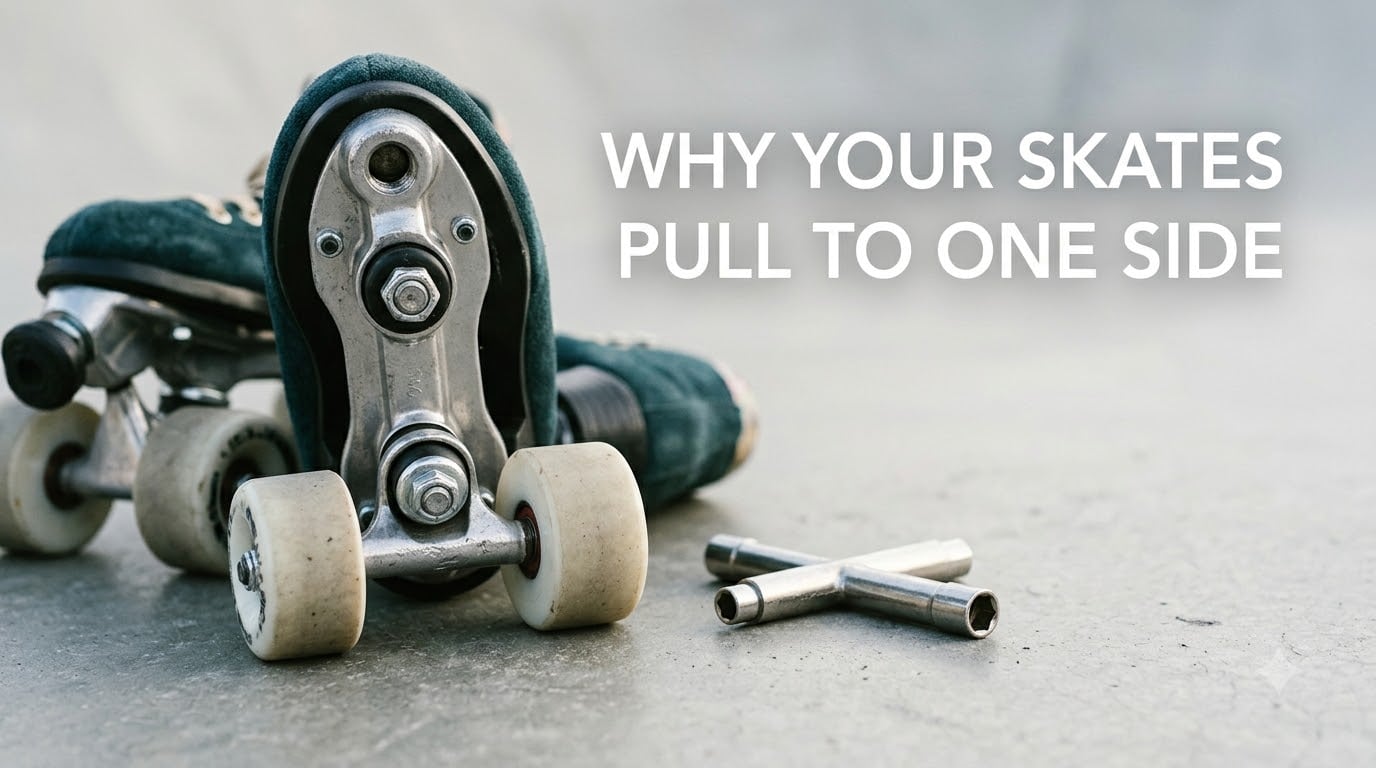
If you have ever laced up your roller skates only to find yourself constantly drifting left or right, you are not alone. Skates pulling to one side is one of the most common complaints I hear from new and experienced skaters alike, and the frustration is real. The good news is that why your skates pull to one side almost always comes down to a short list of equipment and technique factors that you can diagnose and fix at home.
Our team has spent years troubleshooting this exact issue on quad skates, inline skates, and skateboards, and the causes overlap more than most people realize. In this guide I will walk you through every common cause, a simple diagnostic checklist you can run in ten minutes, and the fixes for each one. By the end you should know exactly which skate has the problem, what is causing it, and whether you can solve it yourself or need a shop.
One quick note before we start: it is completely normal to suspect your own skating first. Many skaters blame their balance when the real culprit is a worn pivot cup or uneven truck tension. We will sort out the difference as we go.
Table of Contents
Quick Answer: Why Skates Pull to One Side?
Skates pull to one side when one truck, wheel, or component creates more turning force than the other. The most frequent causes are uneven truck tension, worn or compressed bushings, missing pivot cups, uneven wheel wear, bent axles, plate misalignment, or asymmetric weight distribution from the skater.
In most cases the fix is straightforward: tighten or loosen one truck to match the other, rotate or replace worn wheels, swap bushings, or reseat a missing pivot cup. We cover every fix in detail below.
Common Causes of Skates Pulling to One Side
Before you grab a skate tool, it helps to know what you are looking for. The causes below are listed roughly in order of how often I see them in the wild. Start at the top and work your way down.
Each cause has a distinct symptom, which is why the diagnostic checklist later in this article is so useful. You will rarely need to fix more than one or two items to get your skates tracking straight again.
Uneven Truck Tension
The number one reason roller skates veer to one side is uneven truck tension. Your trucks are the metal axles that pivot beneath your plate, and the kingpin nut controls how easily they turn. If one truck is tighter than the other, that side resists turning while the looser side turns more freely.
The result is a pull toward the tighter side, because the looser truck leans and steers more under your weight. I have seen skaters chase this for weeks, blaming their boots or wheels, when a half-turn of the kingpin nut on one truck solved it instantly.
This is also why new skates sometimes pull: factory tension is rarely matched left to right. A quick check with a skate tool takes thirty seconds and should always be your first stop.
Worn or Compressed Bushings
Bushings, also called cushions on quad skates, are the rubber or urethane rings that sit around the kingpin. They give your truck its resistance and let it return to center after a turn. Over time they compress, crack, or take a permanent set in one direction.
When one bushing compresses more than the other, that truck starts favoring one turn direction. This produces a steady pull that gets worse the longer you skate, because the bushing heats up and softens under load.
Older skates and second-hand pairs are especially prone to this. If your bushings look flattened, cracked, or visibly squished to one side, replacement is cheap and takes about ten minutes per truck.
Damaged or Missing Pivot Cups
Pivot cups are small rubber or plastic cups that seat the pivot of each truck. They are easy to overlook because they are hidden inside the plate, but a worn or missing pivot cup is a massive culprit for pulling.
When a pivot cup wears down, the truck pivot can shift and wobble inside the plate. This creates slop that lets the truck twist unevenly, pulling your skate toward that side. The fix forum skaters recommend most often for sudden pulling is checking the pivot cups first.
Flip your skate over and look inside the plate near the pivot. If the cup is cracked, flattened, or gone entirely, replacing it will often cure the pull immediately. Pivot cups cost only a few dollars and are one of the highest-impact fixes you can make.
Uneven Wheel Wear and Bearing Issues
Wheel wear is another frequent contributor to drift. If your wheels wear unevenly, the smaller wheel has a smaller contact patch and rolls faster, while a larger wheel grips more and resists. This creates an imbalance that pulls the skate toward the worn side.
Regular wheel rotation prevents this, but if you have been skating for months without rotating, you may already have coned wheels. Coning is when one edge of the wheel wears down faster than the other, giving it a slanted profile.
Bearings matter too. A dirty or rusted bearing on one wheel adds drag that subtly pulls the skate toward that side. Spin each wheel by hand. If one stops noticeably faster than the others, it needs cleaning or replacement.
Bent Axles and Hardware Problems
A bent axle is less common but absolutely causes pulling. Axles bend from hard impacts, jumping, or from being over-tightened against a wheel nut. Even a slight bend changes the wheel angle relative to the ground.
Check this by removing the wheels and rolling the axle across a flat surface like a glass table. If it wobbles, it is bent and the truck needs replacing. You cannot straighten a bent axle reliably at home.
Loose mounting hardware is a related issue. If the bolts holding your plate to the boot are loose, the plate can shift under load and steer the skate off center. Check every bolt with the correct Allen key and make sure nothing has backed out.
Plate Mounting Misalignment
This is the cause most troubleshooting guides skip, and it is a real problem for quad skaters. The plate is mounted to the bottom of the boot with screws, and if it is offset even a few millimeters left or right of the boot centerline, the skate will steer in that direction.
Factory mounting is usually accurate, but second-hand skates, custom builds, and re-mounts after a plate swap are common sources of misalignment. You can sight down the boot from heel to toe and check whether the plate sits symmetrically beneath it.
If the plate is off, this is one of the few fixes I recommend taking to a professional shop. Re-drilling and re-mounting a plate at home risks ruining the boot if you do not have the jigs and experience.
Weight Distribution and Skating Technique
Not every pull is the equipment. Beginners especially tend to favor their strong leg, which means they push, glide, and weight one side more than the other. This is the answer experienced skaters on r/Rollerskating give most often to newcomers.
If you consistently glide more on one foot, that side develops more control while the weaker side feels wobbly. The result feels like a pull, but it is really asymmetry in your own body. Building strength on the weak side through one-foot glides and balance drills usually corrects it.
Pushing mongo, leaning to steer instead of using both edges equally, and looking down at your feet can all amplify a small equipment pull into a major one. Technique and setup faults compound, which is why fixing the hardware first is so useful.
How to Diagnose Why Your Skates Pull to One Side?
Use this checklist to pinpoint the cause in about ten minutes. You need a skate tool, a flat surface, and somewhere quiet to roll a few feet.
Step 1: Identify which skate pulls. Skate on a smooth flat surface, lift one foot, and let the other roll. Repeat on the other foot. Whichever skate turns on its own is the culprit.
Step 2: Check truck tension. With the skate tool, compare how far each kingpin nut sits and how each truck feels when you push it side to side by hand. They should feel roughly equal.
Step 3: Inspect the bushings. Look for cracks, compression, or a bushing squished to one side. Compare left and right trucks.
Step 4: Inspect the pivot cups. Look inside the plate near each pivot. Make sure the cup is present, intact, and seated.
Step 5: Spin every wheel. Note any wheel that stops significantly faster than the others, which signals a bearing problem.
Step 6: Check wheel wear. Look down the side of each wheel for coning or uneven diameter. Compare left and right skates.
Step 7: Sight down the plate. Check that it sits centered under the boot from heel to toe.
Step 8: Tighten every mounting bolt. Loose hardware can shift the plate and mimic a pull.
How to Fix Skates That Pull to One Side?
Once you have run the diagnostic checklist, the fix is usually obvious. Here are the matching solutions for each common cause.
To fix uneven truck tension, use your skate tool to turn the kingpin nut on the tighter side about a quarter-turn looser, or tighten the looser side a quarter-turn. Re-test on a flat surface and adjust in small increments until both trucks feel equal.
To fix worn bushings, remove the kingpin nut and upper washer, slide off the old bushings, and install new ones of the same durometer. Reassemble and re-tune the tension. New bushings take a few sessions to break in, so expect a brief adjustment period.
To fix a missing or damaged pivot cup, pop out the old cup with a pick or small screwdriver, clean the seat inside the plate, and press in a new cup. This single fix resolves a surprising number of pulling complaints.
To fix uneven wheel wear, rotate your wheels following a standard cross pattern. Move the most worn wheels to the least worn positions and flip them to even out the coning. Replace any wheel that is severely coned or below the wear line.
To fix a slow bearing, remove it, wipe it clean, and re-lubricate with skate bearing oil. If it still drags after cleaning, replace it. Always replace bearings in matched pairs per wheel at minimum.
To fix loose mounting hardware, tighten every plate bolt and wheel nut to snug. Do not over-tighten wheel nuts, or you will bind the bearings.
To fix a bent axle or misaligned plate, take the skate to a shop. These are not casual home fixes, and trying them yourself can cause more damage than the original pull.
Why New Skates Sometimes Pull/
A common forum complaint is buying a fresh pair of skates and noticing one pulls left right out of the box. This is more normal than you might think, and it is rarely a defect.
Factory truck tension is set for shipping and is rarely matched between left and right skates. New bushings are also stiff and may compress unevenly during the break-in period of roughly five to ten sessions.
If your new skates pull, do the truck tension check first. Most new-skate pulls disappear after a quick re-tune and a few hours of break-in skating. If the pull persists after that, run the full diagnostic checklist above.
When to Seek Professional Help?
Most pulling issues are fixable at home with a skate tool and a few dollars of parts. But some problems need a shop.
Take your skates in if you find a bent axle, a cracked plate, a misaligned plate mount, or if the pull remains after you have addressed every item on the diagnostic checklist. A reputable skate shop can also re-mount a plate, replace a truck, and true your wheels on a lathe.
Maintenance Tips to Prevent Pulling
The best fix is preventing the pull in the first place. A simple routine keeps your skates tracking straight.
Rotate your wheels every four to six sessions using a cross pattern. This evens out wear before it becomes a problem.
Check truck tension monthly and re-tune as bushings break in. A quarter-turn here and there is all it takes.
Inspect pivot cups and bushings every few months. Replace them at the first sign of cracking or compression.
Clean and re-oil your bearings every few months, or more often if you skate outdoors in dust or rain.
Check mounting hardware before every session. A loose bolt takes seconds to find and seconds to fix.
Frequently Asked Questions
Should my skates be tight or loose?
Skates should be tight enough to give you control but loose enough to turn smoothly. A good test is that you should be able to lean into a turn without the truck feeling stuck, and the truck should return to center on its own when you stand upright. For most skaters, somewhere in the middle of the adjustment range works best, and the left and right trucks should feel equal to each other.
How do I know if my roller skate trucks are too loose?
Signs your trucks are too loose include speed wobble at higher speeds, the wheels rubbing the plate or boot when you lean, a floppy or unstable feel, and the truck not returning to center on its own. Trucks that are too loose are a common cause of skates pulling and feeling unpredictable.
Is it normal for new skates to pull to one side?
Yes, it is fairly common for new skates to pull slightly for the first few sessions. Factory truck tension is rarely matched left to right, and new bushings compress unevenly during break-in. If the pull persists after re-tuning the trucks and a few hours of skating, run the diagnostic checklist in this guide.
How do I stop my roller skates from pulling to one side?
Start by checking truck tension on both skates and matching them. Then inspect the bushings, pivot cups, wheels, and bearings for wear or damage. Most pulls are fixed by re-tuning trucks, replacing worn bushings or pivot cups, and rotating wheels. If the cause is technique, build strength on your weaker leg with one-foot glides.
Can worn wheels cause skates to pull?
Yes. Unevenly worn or coned wheels create different contact patches and roll speeds, which pulls the skate toward the more worn side. Regular wheel rotation prevents this, and replacing severely coned wheels fixes it. A slow or dirty bearing on one wheel can also cause a similar pull.
Conclusion
Understanding why your skates pull to one side comes down to a short list of equipment and technique factors: uneven truck tension, worn bushings, missing pivot cups, wheel and bearing issues, bent axles, plate misalignment, and weight distribution. Run the diagnostic checklist, apply the matching fix, and the vast majority of pulls disappear at home.
If your pull persists after every fix on the list, take the skates to a reputable shop. Otherwise, keep your trucks tuned, rotate your wheels, and inspect your bushings and pivot cups regularly. A few minutes of maintenance per month will keep your skates tracking straight for years.