
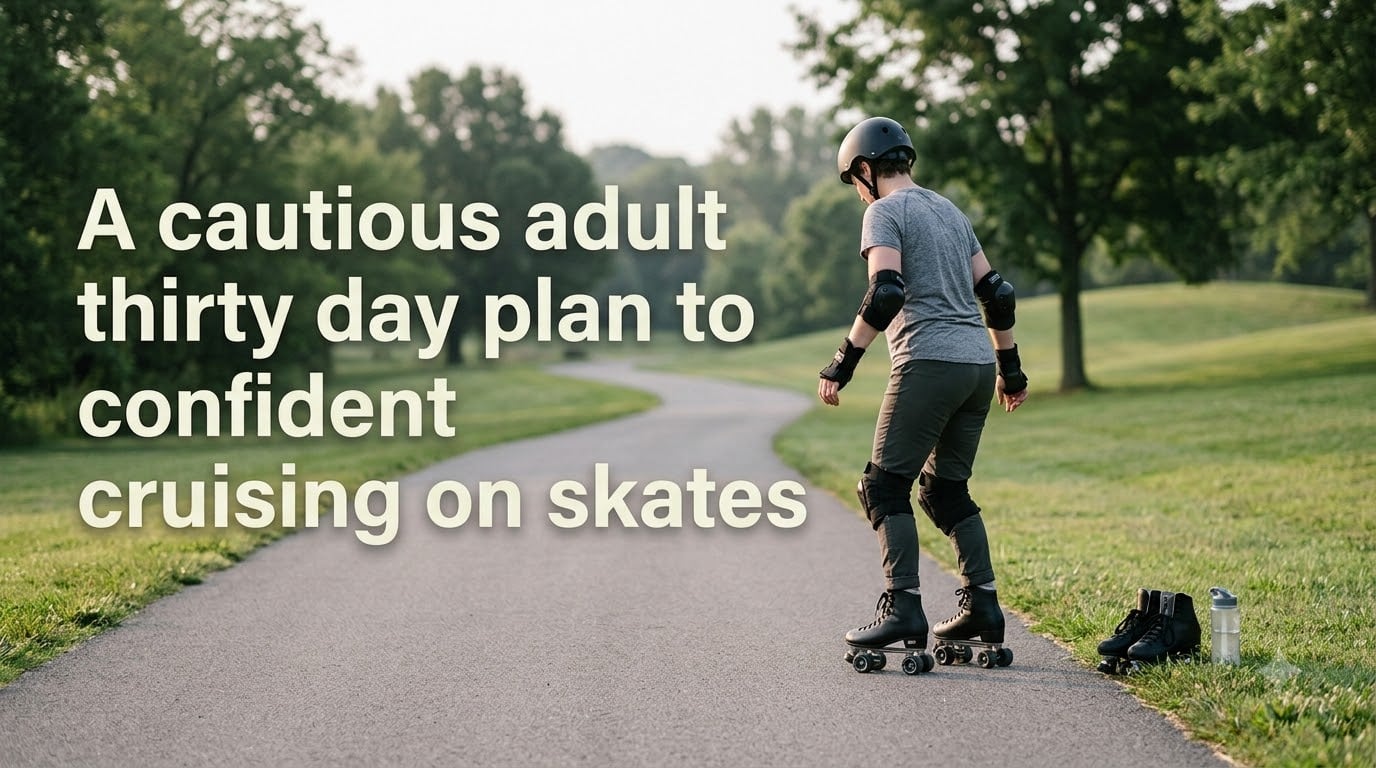
If the idea of strapping on roller skates as an adult makes your stomach flip, you are not alone. I hear the same worry from readers every week: “What if I fall?” “What if people stare?” “Am I too old for this?” I built this guide for you.
This is a cautious adult thirty day plan to confident cruising on skates. It is not a generic “just get out there” pep talk. It is a structured four-week roadmap built around home practice first, low-pressure environments, and very specific daily goals. Whether you are 30 or 50, the plan meets you exactly where you are, on the floor, holding onto a chair, wobbling in socks.
Before we dive in, make sure you have gear you trust. I recommend browsing our guide to the best inline skates for adult beginners if you already know which style you want, or keep reading and decide later.
Table of Contents
What You Need Before You Start (Day Zero Prep)?
Skating confidence begins before you ever roll a single wheel. Set up your environment, your gear, and your expectations so that Day 1 feels safe, not stressful.
Choosing Protective Gear Without Overthinking
You need four pieces: a helmet, wrist guards, knee pads, and elbow pads. That is it. Do not spend weeks researching brands.
A CPSC-certified helmet protects against the most common beginner injury: the back-of-head bounce. Wrist guards prevent fractures when you instinctively reach out to break a fall. Knee and elbow pads let you practice falling safely, which means you will practice more often.
Picking Safe Practice Locations
Your first ten days happen at home or in a quiet garage. After that, scout a smooth, flat, low-traffic spot. Empty parking lots at dawn, residential cul-de-sacs on weekday mornings, and indoor rinks during adult-skate sessions all work well.
Avoid grass, gravel, and cracked sidewalks. Rough surfaces mask real progress and train bad balance habits.
Setting Realistic Expectations
Most cautious adults start feeling steadier within two weeks of consistent practice. “Confident cruising” usually lands by the end of week four. That is fast, by adult-learning standards, if you put in roughly 30 to 45 minutes per day, five days a week.
If you are picking out quad skates for the first time, our list of the best quad roller skates for beginners breaks down what to look for in a starter pair.
Week 1: Building Your Foundation on Skates
The goal of week one is not to move anywhere. It is to feel safe standing on your skates, then slowly introduce balance drills without the fear of rolling. Spend 30 to 45 minutes per day, five days a week. Rest on the other two days so your ankles recover.
Day 1 to 2: Just Standing in Skates
Put your skates on while sitting on a couch or bed.
Stand up next to a stable surface (kitchen counter, sturdy table).
Place feet shoulder-width apart, knees soft, weight centered.
Hold for 60 seconds. Sit down. Repeat three times.
That is the entire workout. It sounds small. It is not. You are teaching your ankles what “ready” feels like.
Day 3 to 4: The Knee Bend and Center of Gravity
Stand in your skates near a wall, fingertips touching for balance.
Bend your knees until they sit directly over your toes.
Hold for 10 seconds, then straighten. Repeat 8 times.
The knee bend is the most important move in adult skating. It drops your center of gravity, stabilizes your ankles, and prepares you for every future skill. If you only learn one thing this week, learn this.
Day 5 to 7: Quiet Home Balance Drills
Toe-to-heel rocking: shift weight from front wheels to back wheels, 12 reps.
Heel-toe tapping: lift one toe stop at a time, alternating, 20 reps.
Single-foot balance hold (skates on, both feet flat): 15 seconds each side.
For a full library of home drills, our page on home practice drills for early weeks pairs nicely with this section.
Week 2: First Movement and Gentle Pushing
Week two introduces actual rolling, but only in short, controlled bursts. You will still hold onto something for most drills. By the end of the week, you should be able to glide a few feet on your own.
Day 8 to 9: Marching in Place and Weight Shifting
Stand near a counter. Lift one skate a few inches, set it down. Lift the other. Repeat 20 times.
Gradually march forward while holding the counter, five steps each way.
Practice shifting weight from one foot to the other without lifting either fully.
Day 10 to 11: The Small Push
With skates on, push one skate out at a 30-degree angle, then return.
Alternate feet, eight reps per side. No forward motion yet, just the motion.
Now try one push-and-glide forward, still holding the counter.
Day 12 to 14: First Short Glides
Find a clear stretch of floor or smooth driveway.
Push once, glide for three seconds, stop by gently pressing toe stops down.
Repeat 6 to 8 times. Celebrate every glide that does not end in grabbing the wall.
Week 3: Building Confidence With Longer Glides and Turns
By week three, you should feel a real shift. Glides extend to 10 or 15 seconds, and you start exploring direction changes. Stopping practice begins in earnest.
Day 15 to 17: Sustained Forward Gliding
Practice gliding in a straight line across a 30-foot stretch.
Count your glide length in seconds. Track it in a simple journal.
Aim for one second more per day by week’s end.
Day 18 to 21: Turning Basics (Weight Transfer)
Glide forward, then shift weight to one heel to curve slightly.
Practice gentle “S” curves across your practice space.
Avoid sudden edge changes; slow weight transfer is safer.
Day 22 to 24: Stopping Practice (Plow Stop)
Build a small forward glide, then angle one skate slightly outward.
Press down on both inside edges while keeping knees bent.
Hold until you stop. Repeat five times. Wobbles are normal.
Week 4: Confident Cruising on Skates
Week four ties everything together. You move outdoors, choose routes, and cruise in flowing laps or circuits. Stopping, turning, and gliding now feel like one continuous skill.
Day 25 to 27: Quiet Outdoor Practice
Pick a smooth parking lot or cul-de-sac at off-peak hours.
Cruise the perimeter at a relaxed pace for 15 minutes.
Practice stopping and restarting from full glide three times per session.
Day 28 to 30: Cruising With Flow
Skate a longer loop, aiming for five uninterrupted minutes of cruising.
Add one gentle turn per lap to keep things interesting.
Try a small uphill (gentle grade) and a controlled downhill stop.
By day 30, “confident cruising” means you can move at a comfortable pace, change direction, and stop on command, without the white-knuckle grip you had two weeks ago.
Common Mistakes That Keep Adults Wobbly on Skates
I see the same five stumbling blocks across every adult beginner I have worked with. Avoid these and you will progress much faster.
Standing Too Upright
Locking your knees raises your center of gravity and amplifies every wobble. Bend the knees. Always. This single fix helps most readers within a session.
Looking Down Instead of Forward
Your balance system uses your eyes. Looking at your feet throws it off. Pick a focal point about 15 feet ahead and trust it.
Practicing on Grass or Rough Surfaces
Grass hides the real feel of rolling. You cannot learn proper push mechanics on a surface that fights your wheels. Smooth, flat surfaces only.
Skipping Protective Gear
Adults often skip pads because they feel silly. Wrist injuries do not care how silly you feel. Gear up, every session.
Not Learning to Fall
Falling is part of skating. Our guide on how to fall safely on skates covers the technique that keeps beginner falls from turning into ER visits.
Tracking Progress Without an Audience
Confidence grows when you can see improvement. Adults learning alone often feel progress is invisible. A simple tracking habit fixes that.
Journal Template
Each practice day, write three lines:
Date and total minutes
One thing that felt easier than last week
One thing to try next session
Video Recording at Home
Film your stance and glides from the side once per week. Watching yourself progress is motivating in a way that mirrors never are.
Benchmark Milestones
Track these specific wins:
First 5-second glide without holding anything
First controlled stop from a glide
First 10-minute outdoor cruise
Reddit skaters often mention that “consistency matters more than intensity” and that “5 hours a week is a good target.” That tracks with what I have seen across hundreds of adult beginners.
Frequently Asked Questions
How long does it take an adult to learn to roller skate?
Most cautious adults reach confident cruising within 30 days of consistent practice (30 to 45 minutes per day, five days a week). You will usually feel steadier within two weeks, with full cruising fluency by the end of week four.
Can I learn to roller skate as an adult?
Yes. Adults can absolutely learn to roller skate. Coordination is trainable at any age, and adult learners often develop cleaner technique because they follow instructions carefully. Many skaters in their 30s, 40s, and beyond progress faster than they expected.
Is 30 too late to start skating?
Not at all. 30 is a very common age to start skating. One Reddit beginner shared that they started at 36 and now feel more stable than lifelong skaters. Your body learns new movement patterns throughout adulthood, and skating is a low-impact, joint-friendly activity.
How do I stop feeling wobbly on skates?
Bend your knees more, drop your center of gravity, look forward instead of down, and practice toe-to-heel rocking at home. Wobbliness almost always traces back to standing too tall. Most adults feel steadier within their first three home practice sessions once they fix their knee bend.
What should I practice first as a beginner skater?
Start with three things: standing in skates near a counter, knee bends, and toe-to-heel rocking. Spend five to seven days on these before any forward movement. Building ankle stability at home prevents bad habits from forming in public.
Where can adults practice skating without feeling watched?
Quiet home spaces, empty parking lots during off-peak hours, residential cul-de-sacs in the morning, and indoor rinks during adult-only sessions are all good options. Avoid grass and gravel; smooth, low-traffic pavement is best.
Your 30 Days Start the Next Time You Lace Up
This cautious adult thirty day plan to confident cruising on skates is built to lower your stress, not raise it. You start at home, hold onto a counter as long as you need, and only move outdoors when your body says it is ready. That is the whole secret.
You will not be a perfect skater in 30 days, but you will cruise with flow, stop when you choose, and walk off the rink feeling proud instead of wobbly. If you ever skated as a kid and feel like you are returning to skating as an adult, the same plan works exactly the same way.
Lace up today, set a timer for 30 minutes, and trust the weeks to do their work. See you on day 30.