
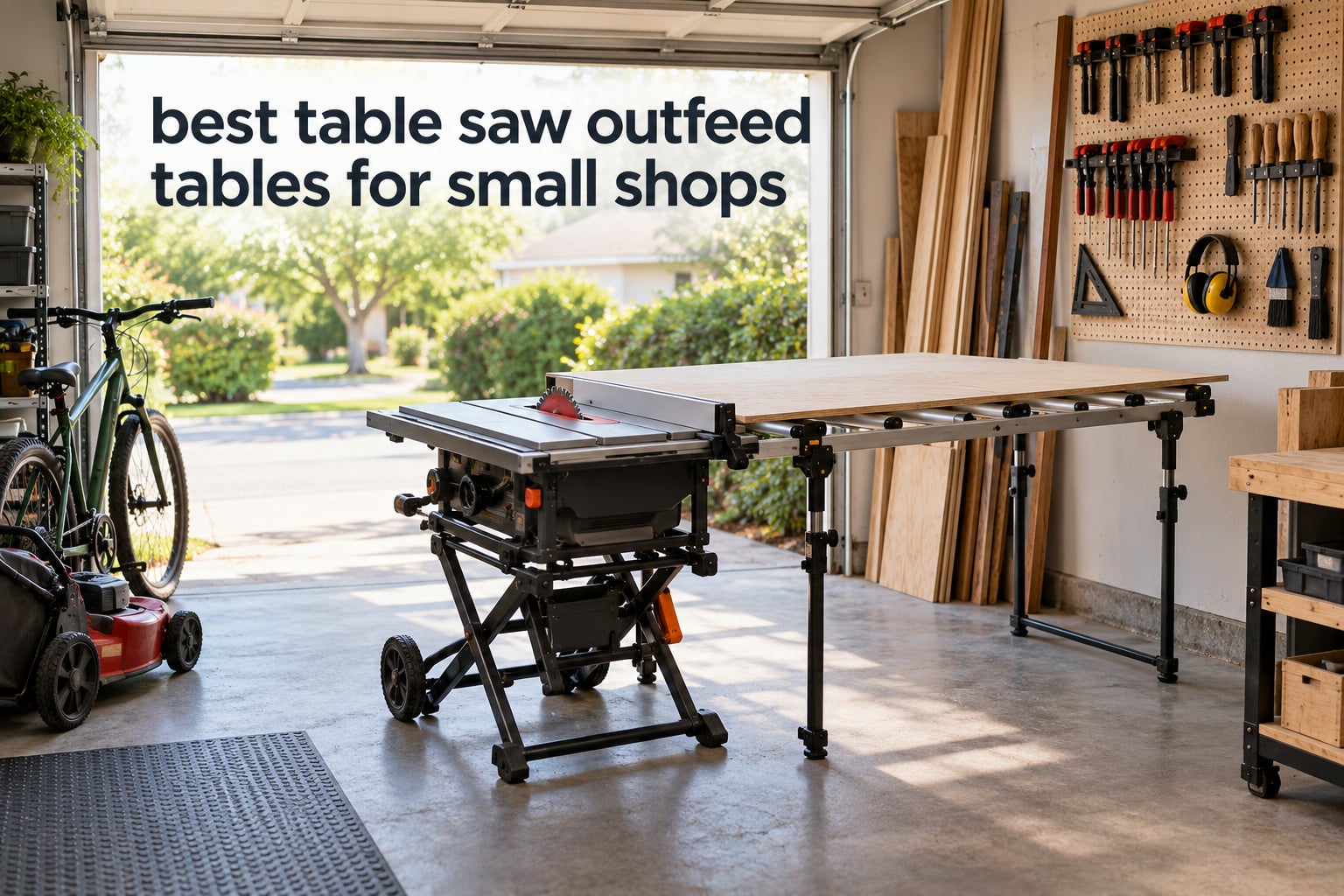
A full sheet of 4×8 plywood weighs roughly 50 to 70 pounds, and only about three feet of it ever sits on your saw. Without support behind the blade the tail drops, pulls the sheet off line, and turns a routine rip into a kickback hazard. That is the whole reason a table saw outfeed table exists, and finding the right one for a small shop comes down to a single stubborn question: how much floor space can you give back the rest of the week?
Our answer after working through ten of the most reviewed stands in the category: the BORA Adjustable Conveyor Roller Stand is the best table saw outfeed table for small shops in 2026. It is the only pick in this group that folds down to a genuinely stackable slab, extends behind the blade to 50 inches, and rates 4.4 stars across 284 reviews. If you want a cheaper starting point, the WORKPRO folding pair is the one most small shops end up with.
Everything below is judged on footprint first, then on whether the rollers stay coplanar under load, because those two things decide whether a small shop keeps the stand or pushes it into a corner permanently. A few other shop-fitting guides worth having open are our wheel balancer picks for small shops and our compact table guide for tight rooms, both of which run on the same space-over-features logic we use here.
Short answer:
Best overall: the BORA Adjustable Conveyor Roller Stand, because it collapses flat and still spans a full sheet.
Top rated: the WORKPRO folding roller stand pair, the highest-reviewed option in the group with 4.6 stars and 1888 reviews.
Budget pick: the BORA PM-5090 pedestal roller stand, 4.6 stars, a single wide ball-bearing roller and a fold-flat frame.
Best for the tightest shops: the SHALL folding pair, 27.8 to 43 inches of telescoping height in a flat-folding frame that leans against a wall.
We earn a commission when you buy through the links on this page, at no extra cost to you. That never changes which stand sits at the top.
Table of Contents
Top 3 Outfeed Tables for Small Shops in 2026

BORA Adjustable Conveyor Roller Stand
- Extends 14-50 inches
- Height 23-36 inches
- 300 lb capacity
- Fourteen wide rollers

WORKPRO Folding Roller Stand 2-Pack
- Height 27-43 inches
- 250 lb per stand
- Edge guides
- Folding wings
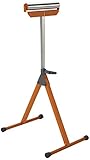
BORA PM-5090 Roller Stand
- Height 27-43.75 inches
- 200 lb capacity
- 11.25 inch ball bearing roller
- Folds flat
10 Best Table Saw Outfeed Tables for Small Shops (October 2026)
Every stand below is listed with the specification that actually decides small-shop fit: how small it becomes when you are not using it, and how far it reaches behind the blade. Load capacity matters less than most listings imply, because the real load is a sheet of plywood sliding across, not a slab parked on top.
| Product | Specs | Action |
|---|---|---|
| BORA Adjustable Conveyor Roller Stand |
|
Check Latest Price |
| WORKPRO Folding Roller Stand 2-Pack |
|
Check Latest Price |
| BORA PM-5090 Roller Stand |
|
Check Latest Price |
 SHALL Folding Roller Stand 2-Pack SHALL Folding Roller Stand 2-Pack |
|
Check Latest Price |
 WORKESS 4 in 1 Roller Stand WORKESS 4 in 1 Roller Stand |
|
Check Latest Price |
 VEVOR 2500 lb Tripod Roller Stand VEVOR 2500 lb Tripod Roller Stand |
|
Check Latest Price |
 VEVOR 2-Pack Roller Stands 135 lb VEVOR 2-Pack Roller Stands 135 lb |
|
Check Latest Price |
 VEVOR 4-in-1 Roller Stand 440 lb VEVOR 4-in-1 Roller Stand 440 lb |
|
Check Latest Price |
 KASTFORCE 300 lb 3-in-1 Roller Stand KASTFORCE 300 lb 3-in-1 Roller Stand |
|
Check Latest Price |
 Bosch TS1002 Rear Outfeed Extension Bosch TS1002 Rear Outfeed Extension |
|
Check Latest Price |
1. BORA Adjustable Conveyor Roller Stand – Best Overall and Best for Full Sheet Breakdown
BORA Adjustable Conveyor Roller Stand for Table Saw Outfeed Extension
Height: 23-36 inch
Load: 300 lb
Extends: 14-50 inch
Rollers: 14 wide
Pros
- Collapses to a stackable slab
- Extends to 50 inches for full sheets
- Fourteen wide rollers for smooth flow
- Locking swivel casters for mobility
- Independently adjustable legs for leveling
Cons
- 36 inch maximum height is short for saws on a mobile base
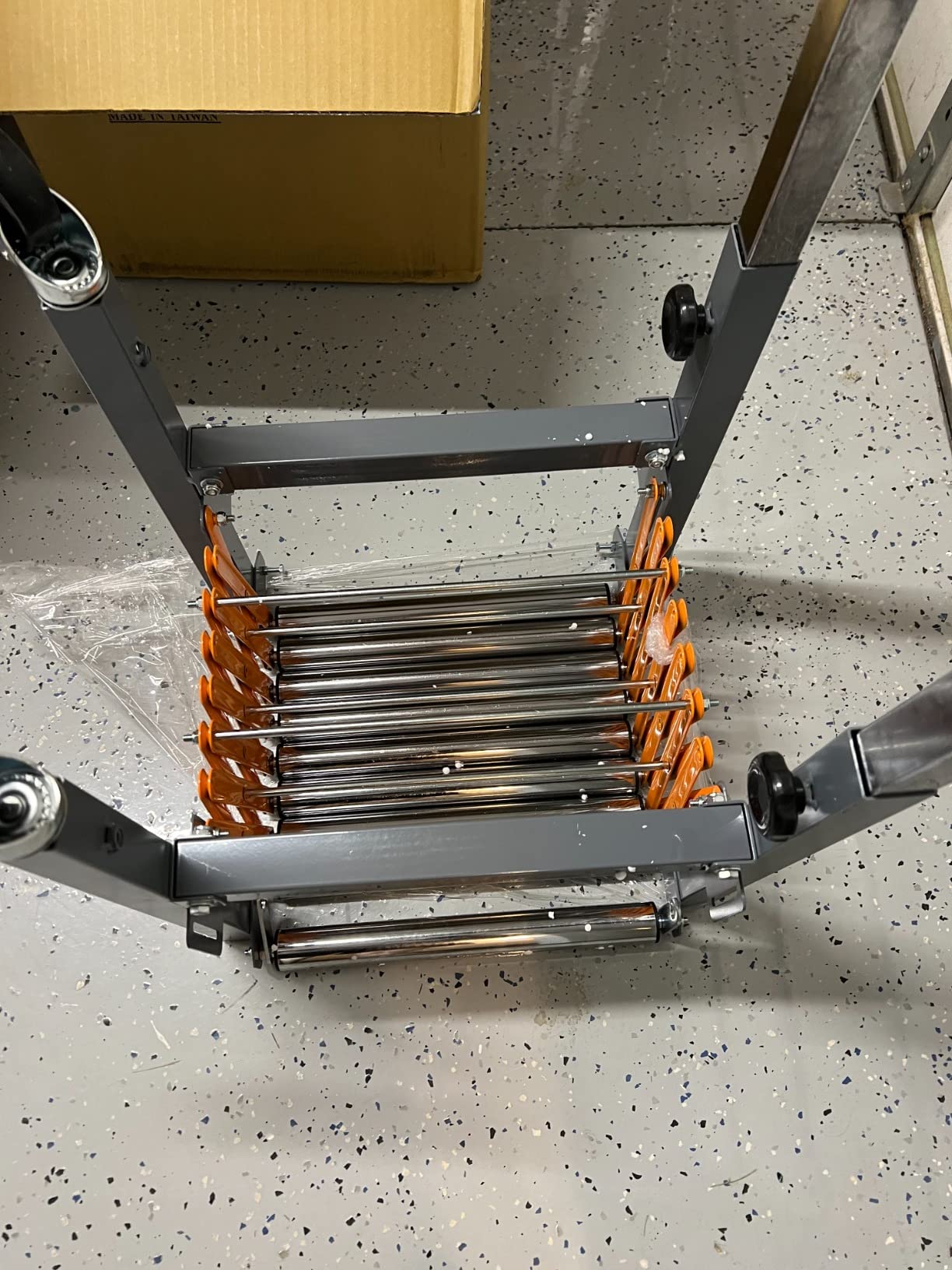
- Rollers sit about 1/8 inch out of plane at full extension
- Unscaled height markers on the legs
This is the stand we kept reaching for in a shop that has roughly 20 square feet to spare behind the saw. It expands from 14 to 50 inches, which is the only thing on this list that genuinely covers a full 4×8 sheet without improvising a second support, and it does that while still fitting in a corner when the cut is done.
What sets it apart from the other conveyor-style stands is the set of fourteen wide rollers rather than one or three. Wide rollers spread the load of a sheet across a longer contact area, so the panel tracks straight instead of dipping between supports. Each leg adjusts on its own, which matters more than it sounds on a slab floor where one corner of the shop sits slightly lower than the others.
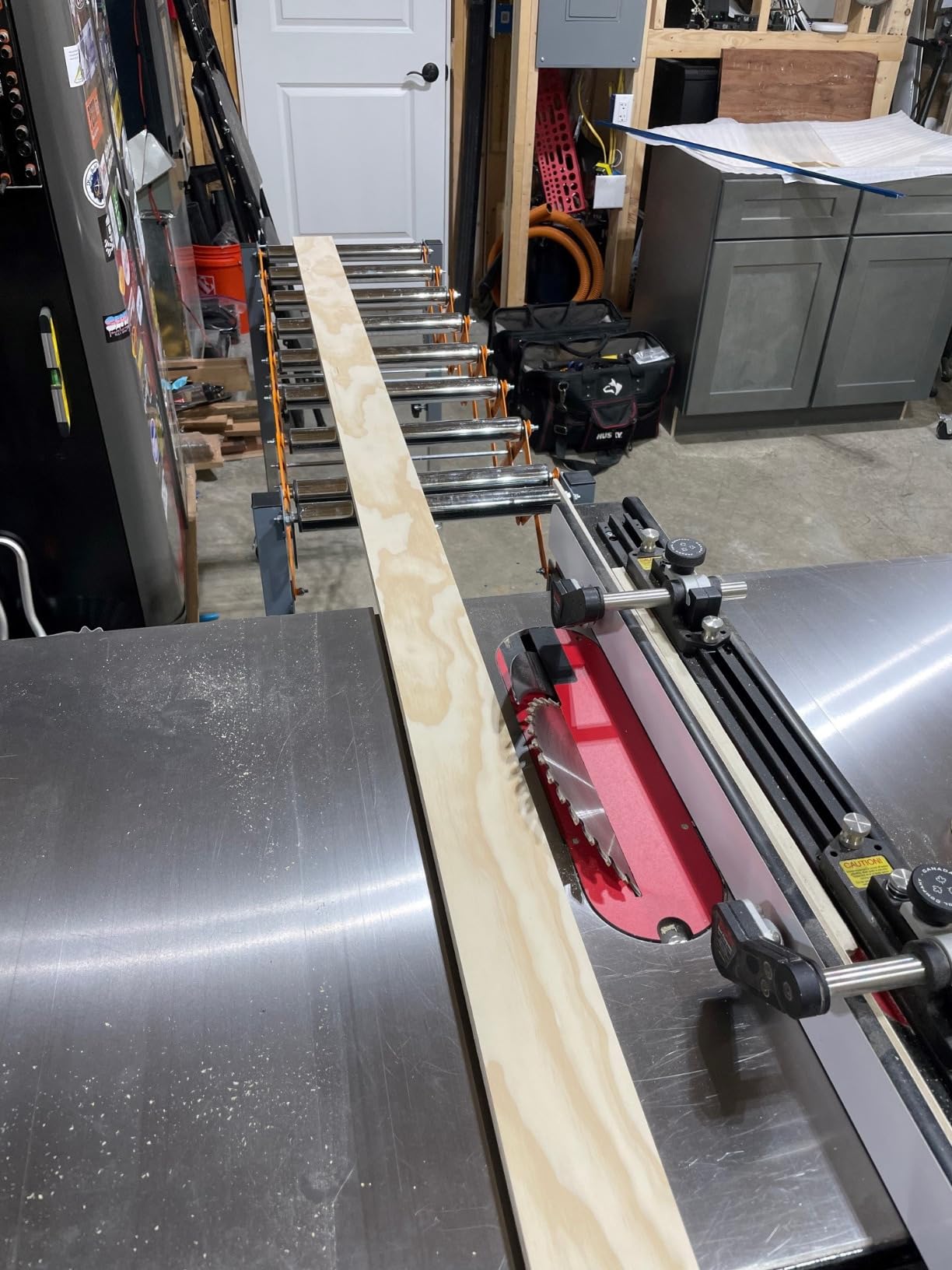
Reviewers repeatedly single out the weight and build quality, describing it as far more substantial than the stand category usually delivers. At 44.7 pounds it is genuinely portable with the casters, but heavy enough that a sheet of plywood will not walk it sideways mid-cut. The built-in hooks on the frame also mean you can gang it with a second unit and turn a corner if your layout demands it.
The honest catch is height. Twenty-three to 36 inches covers a benchtop or compact jobsite saw sitting on a low stand, and it is adjustable in fine increments, but the top of the range will not reach a saw mounted on a tall mobile base. Measure your saw table height before anything else, because that single number rules this stand in or out.
What tells you the support will stay flat under a full sheet
The second complaint worth planning around is that the rollers are not perfectly coplanar when the conveyor is fully extended, sitting roughly an eighth of an inch low at the far end. On a straight rip of dimensioned lumber you will never notice. On a crosscut of a full sheet, check the seam with a straightedge before you trust the cut, and set the stand slightly conservatively rather than chasing the number.
One more small thing: the leg height markers are printed but not scaled to the real finished height, so treat them as a rough reference and confirm with a tape measure. It is a 60-second fix that saves a lot of guessing.
Where it earns its floor space and where it does not
This is the pick for a shop where the saw shares space with a lawnmower, a bicycle, and a stack of sheet goods leaning on the wall. The folded form is a flat slab you can slide behind the saw or stand on end, and the casters let you roll it out for a cut then roll it back. That cycle is the whole value proposition.
Skip it if your saw is mounted high on a mobile base, or if you need to gang several stands together for a long conveyor run and the height range does not reach. The 71 percent five-star share across 284 reviews suggests most people are working with a saw low enough for it.
2. WORKPRO Folding Roller Stand 2-Pack – Top Rated and the Most Common Shop Setup
WORKPRO Folding Roller Stand Height Adjustable, Heavy Duty 250 LB Load Capacity, Outfeed Woodworking (Upgraded head), 2PCS
Height: 27-43 inch
Load: 250 lb each
Sold as: 2 pack
Folding wings
Pros
- Highest review count in the group at 1888
- Thick tube wall handles full plywood sheets
- Smooth stepless height adjustment
- Two-pack gives matched infeed and outfeed
- Folds flat for wall or shelf storage
Cons
- Bottom crossbar can loosen over time
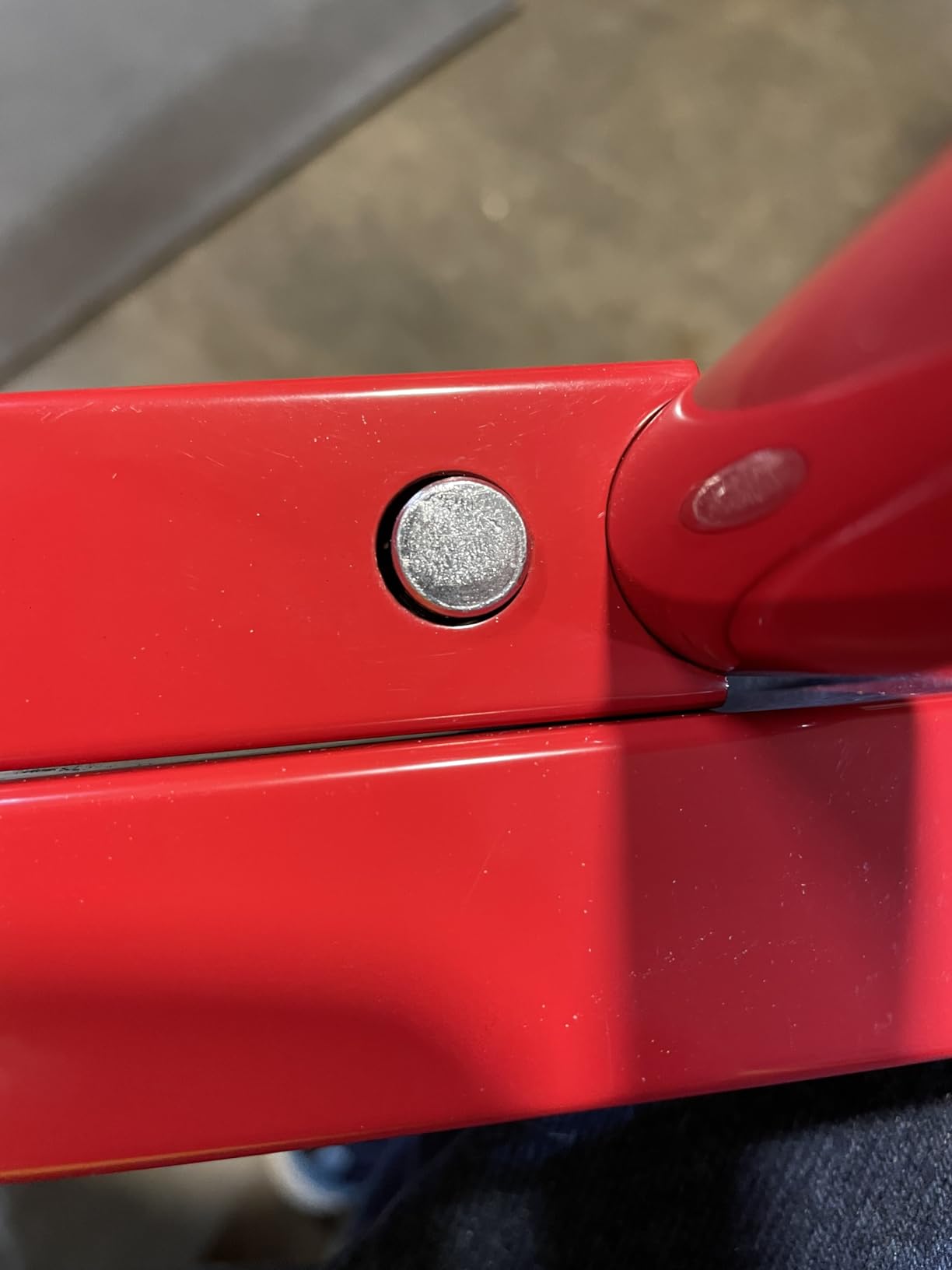
- Height screw bears on a plastic tab that wears
- No built-in hanging point for wall storage
If you only buy one thing from this roundup, there is a fair argument for this pair over everything else, because the review volume tells you how many small shops have already solved the problem with it. At 4.6 stars across 1888 reviews it is the most proven stand here, and the two-pack format solves the infeed question at the same time.
The 27 to 43 inch height range is wider than most competitors and covers the majority of contractor and portable saws without any spacer work. What reviewers like most is the continuous stepless adjustment through smooth bearings rather than a series of pin holes, which means you can dial the top to your saw table in fine increments and lock it there.
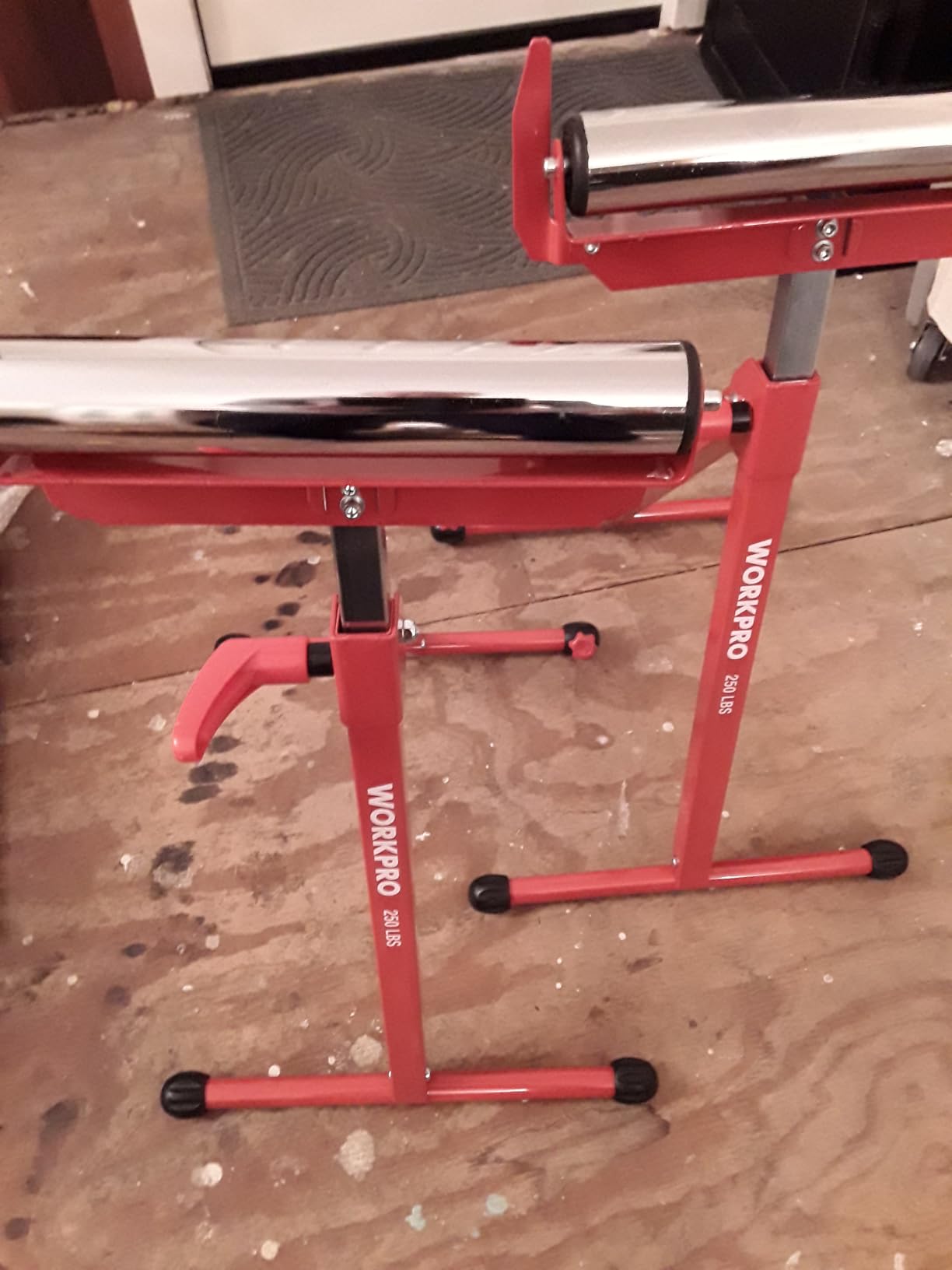
The folding wings are a small touch that matters more than expected. They flip up to keep narrow stock from wandering off the rollers, and on a 10-inch jobsite saw where the fence is doing the work, that is the difference between a clean cut and a scuffed edge. Thick tube wall construction is the other repeated point of praise, and owners handling full sheets report it holds without complaint.
This is also the answer to the most common complaint in small-shop woodworking forums, which is that a plain metal folding table works until it stops working because it is too low and stores nothing. This pair adjusts to saw height and then folds to a flat profile you can stand against a wall.
Whether the height adjustment will hold position under load
There is a real mechanical caveat here and it comes from the reviews rather than the listing. The adjustment screw bears on a flexible plastic tab, and owners report the stand slowly creeping down over months of use, particularly with a heavy slab resting on it. Marking your height with a paint pen and re-checking before each session costs nothing and catches the drift early.
The bottom crossbar loosening is the other recurring note. It is a straightforward fix with a wrench, not a design failure, but check it during the first few cuts rather than assuming it is still tight in month six.
What you give up with this pair
You give up any fine control over the roller surface. These are single wide rollers with edge guides, which handle sheet goods and dimensional lumber beautifully but offer nothing special for round stock or heavy timbers. If you cut a lot of pipe or very thick hardwood, the multi-head stands further down the list serve better.
There is also no hanging hardware, so folded storage means leaning it somewhere or building a shelf hook yourself. In a shop where the wall space is already spoken for, that is a real limitation of an otherwise very capable stand.
3. BORA PM-5090 Roller Stand – Budget Pick Single Pedestal Support
BORA Roller Stand Adjustable Height Support Stand For Table Saw & Miter Saw
Height: 27-43.75 inch
Load: 200 lb
Roller: 11.25 inch
Folds flat
Pros
- Widest single roller in the group at 11.25 inches
- Stepless taper bar adjusts in seconds
- Folds flat to a 5 inch deep slab
- Light at 9 pounds for easy repositioning
- Simple to assemble
Cons
- 200 lb capacity is the second lowest here
- Height handle can lose grip and creep down
- Vague instructions on assembly
One wide polished ball-bearing roller does something several narrow rollers cannot: it gives you an almost continuous surface with no gaps for a thin panel to drop into. For a shop that mostly rips dimensional lumber and occasionally breaks down a sheet, that is the feature that matters and it is why this stand holds a 4.6 rating across 484 reviews.
The taper-bar height adjustment is the second thing we like. It moves the stand through its full 27 to 43.75 inch range in a couple of seconds without unloading the top, which matters because you can find saw-table height while the board is still resting on the rollers. At 9 pounds it is also the easiest stand here to carry between the saw and a miter saw station.
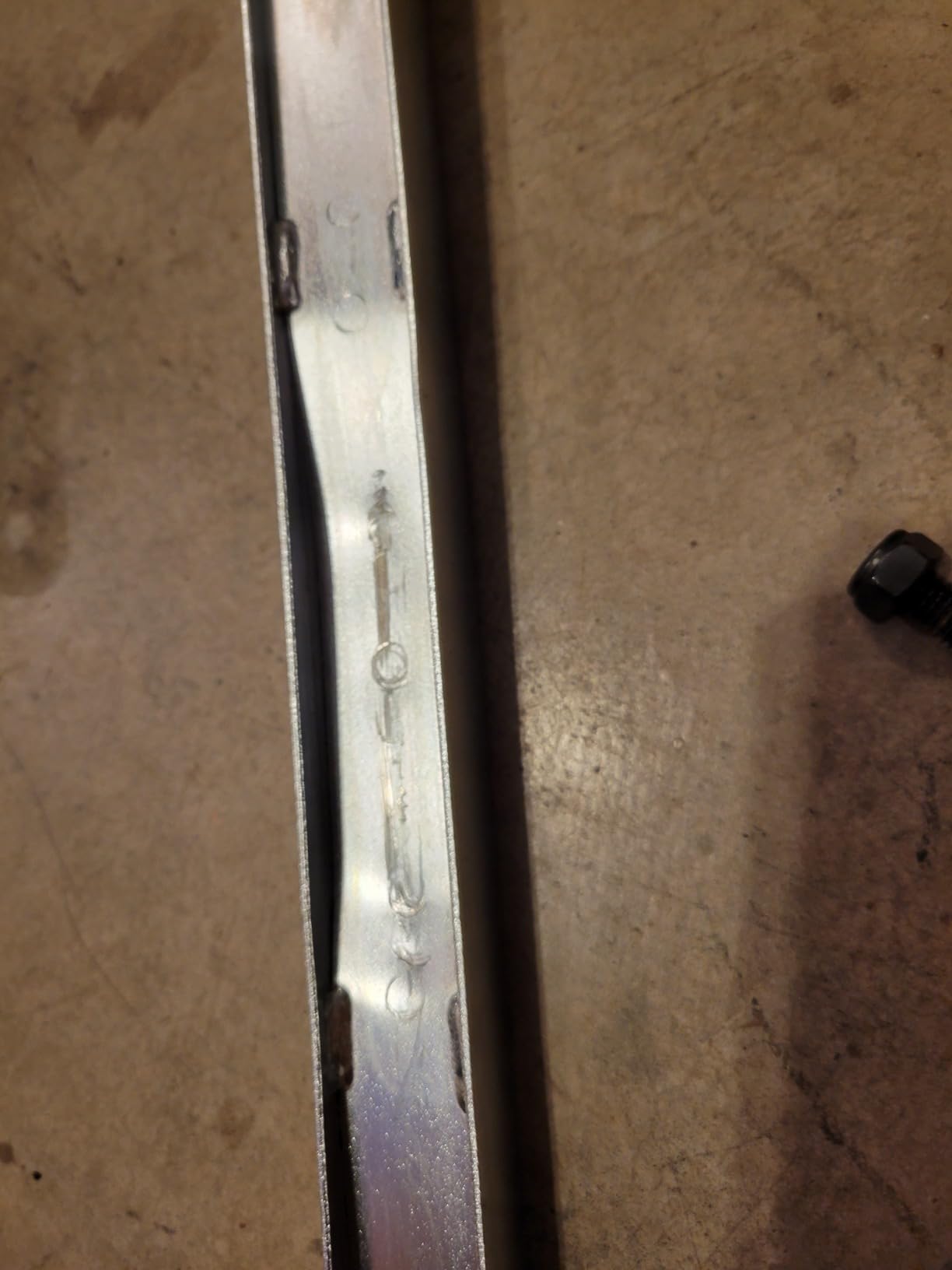
One early quality complaint about a failed weld on the adjustment nut drew a fast replacement from the vendor and a review update, which tells you something about the support behind the product. The recurring mechanical issue is the handle gradually losing grip, and the fix several owners adopted was to mark and pre-drill their set positions so the handle has something positive to bite on.
As a support table rather than a conveyor, it is also useful away from the saw entirely, which is how most owners end up using it. Ours spends a fair share of its life supporting long stock at the miter saw.
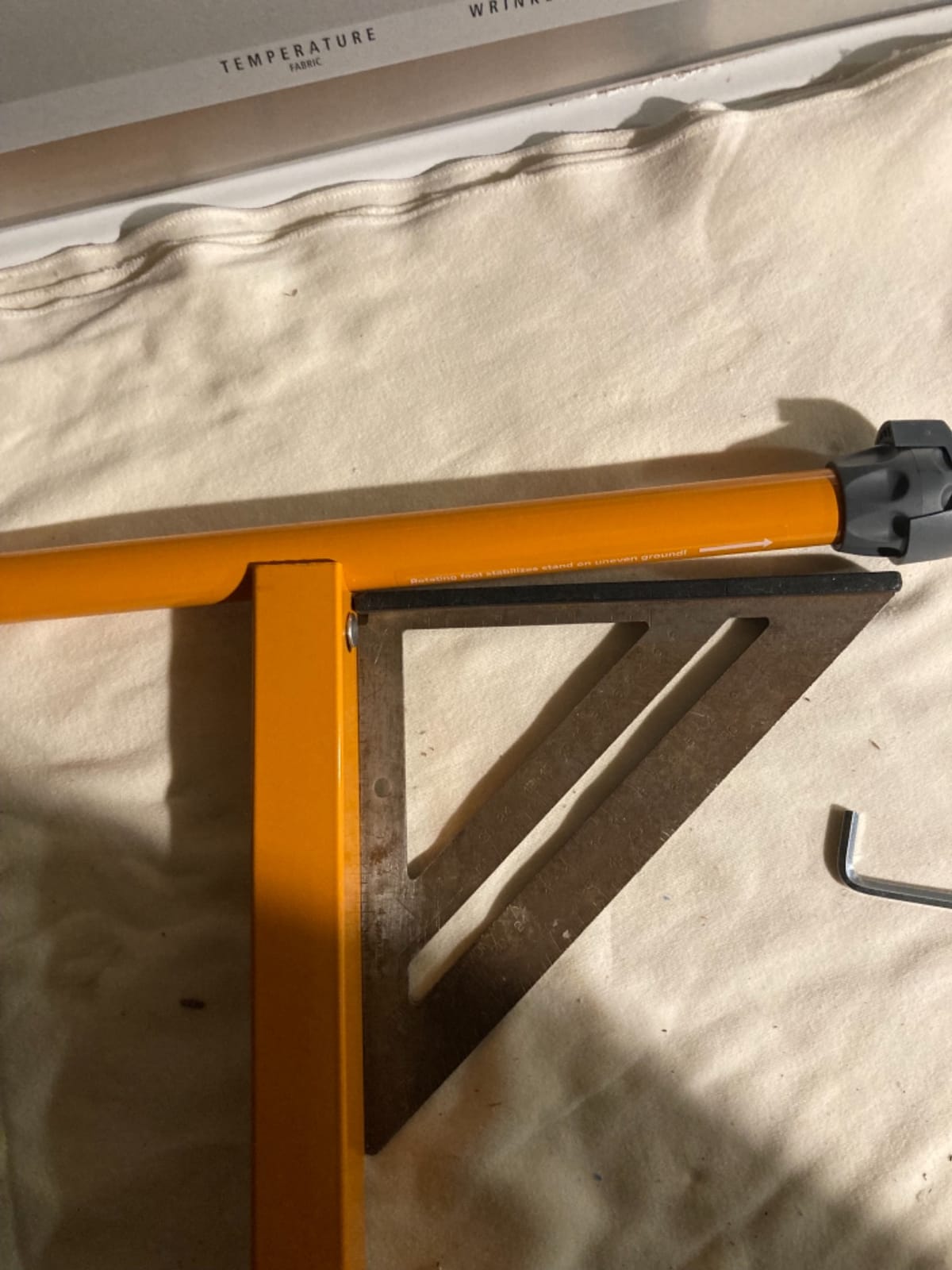
Whether 200 pounds is enough capacity for your work
For sheet goods, dimensional lumber, and long boards it is plenty, because the load is a moving sheet rather than a parked mass. It is not enough for stacked slabs or thick rough timber, and the frame flexes noticeably more than the heavy stands in this roundup when you load it heavily. Know which one you are before you buy.
The height creep under sustained load is worth planning for. If you leave the stand loaded overnight, re-tighten before your next cut rather than trusting Friday’s setting on Monday morning.
Where it wins and where it falls short
It wins on footprint and on adjustment speed. Folding flat to a 24 by 5 by 4 inch slab, it takes up about as much room as a broom handle leaning in a corner, and the tapered legs mean no casters are catching under a shelf.
It falls short on versatility. There is one roller position, no edge guides, and no way to convert it into a V-support or turn it on its side for side-of-saw support. If your outfeed needs change shape depending on the job, the four-in-one designs below handle that better.
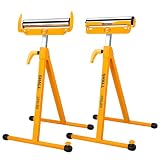
4. SHALL Folding Roller Stand 2-Pack – Best for the Tightest Shops
SHALL Roller Stand, Heavy-Duty Folding Roller Stands with 250 LBS Capacity
Height: 27.8-43 inch
Load: 250 lb each
Roller: 11.5 inch
Sold as: 2 pack
Pros
- Folds flat in seconds for corner or trailer storage
- 250 lb per stand handles bulky lumber
- 11.5 inch polished rollers roll freely
- Eccentric foot stabilizes on uneven floors
- Pre-labeled parts assemble under 10 minutes
Cons
- Two-pack format supplies an extra stand if you only need one
- Some units arrive with loose or missing hardware
- Add thread locker during assembly
This pair is the most direct answer to the small-shop problem we kept hearing about: a workbench that worked as an outfeed until it took over the whole shop. Folded, these stands occupy a narrow slot against a wall, and because they telescope from 27.8 to 43 inches they cover most portable saws without a riser.
Build quality is the story here. Chrome-plated steel, 11.5 inch polished rollers, and a frame that reviewers describe as solid for bulky lumber. The edge guides and eccentric foot are both small additions that show up in repeat use, particularly on a shop floor that is not flat.
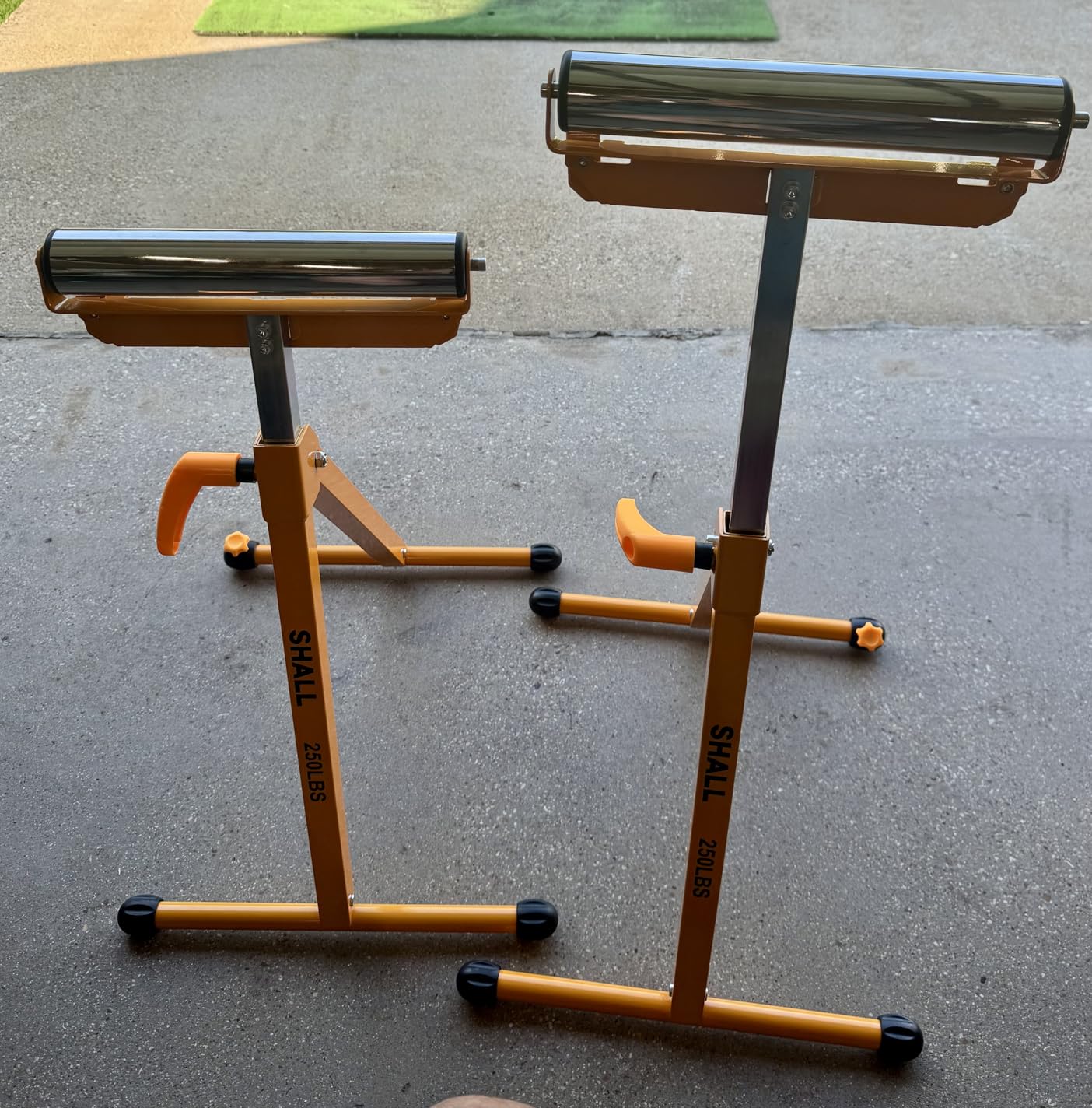
Assembly is the differentiator in a small shop. The parts are pre-labeled and the hardware is included, so owners report putting a stand together in under ten minutes without a manual. In a one-car garage where you set up and tear down the saw constantly, that is a genuine advantage over stands that need a half hour and a socket set.
The rating spread is worth noting honestly. A 4.5 overall sits alongside a 6 percent one-star bucket, and those negatives cluster on assembly quality control rather than the design, with loose or missing threaded hardware on arrival being the recurring theme.
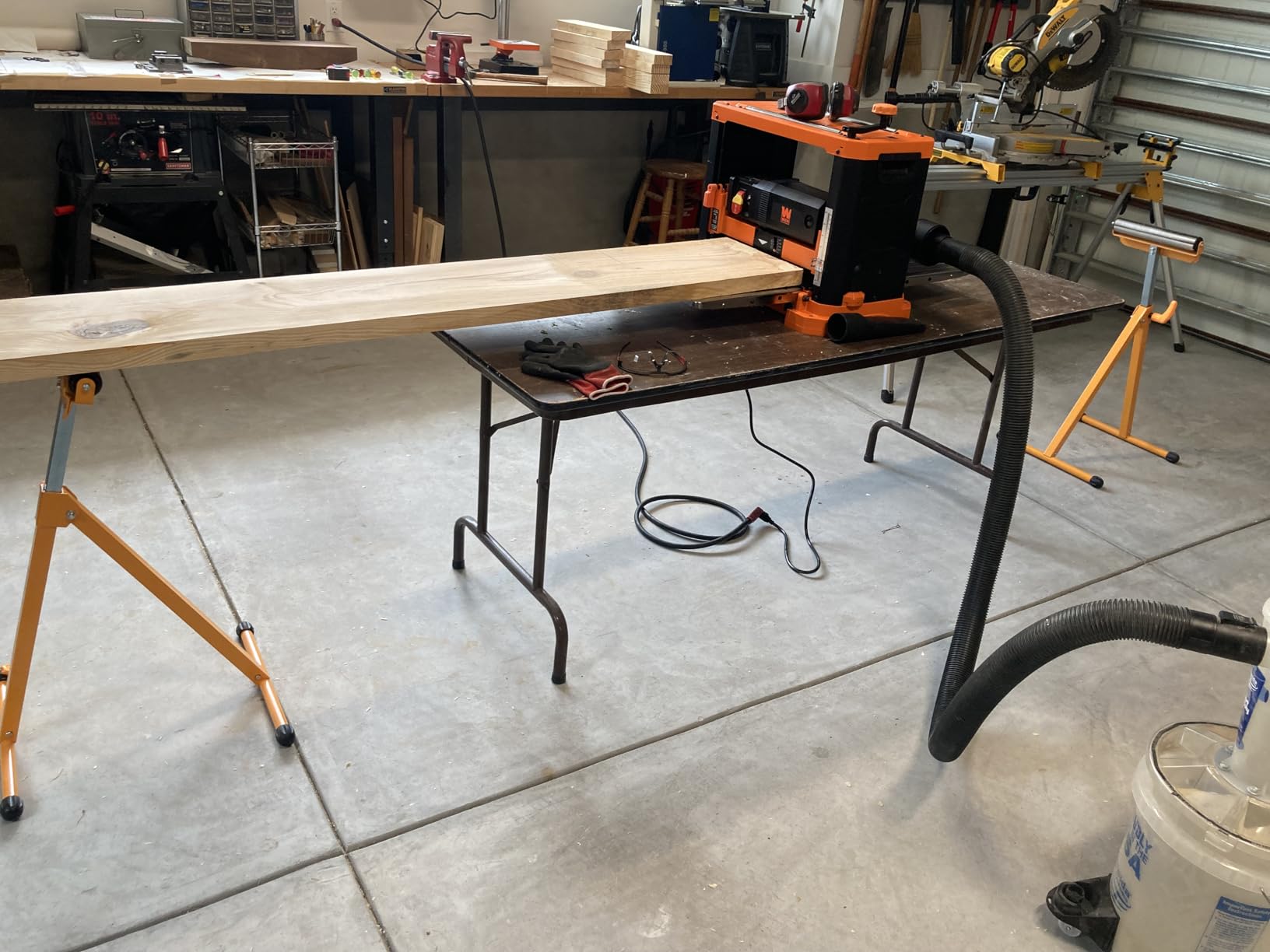
Whether you need two stands or one
Buying a two-pack when you only want an outfeed is the main catch, and it is a mild one because a second stand on the infeed side is genuinely useful for full sheet work. If you are certain you only need support behind the blade, count the extra stand as future cost rather than a mistake.
Thread locker on every fastener during the first assembly is the other practical tip. It takes two minutes and it removes the loosening complaints that show up in the reviews a year later.
What this pair is not for
It is not a support for very heavy timbers or a work platform. The rollers are single-width with guides, which is exactly what you want for guiding flat stock and precisely what you do not want for turning round stock or a heavy beam.
It is also not a conveyor. Unlike the BORA that opens up, this is a fixed-length stand, so covering a full 4×8 sheet means using both the infeed and outfeed stands together with the saw between them. Plan for that, and it handles sheets very well.
5. WORKESS 4 in 1 Roller Stand – Best for Heavy Beams and Rough Lumber
WORKESS 4 in 1 Roller Stand, Stable 440 Lbs Load Capacity with Saw Horses, V-Shaped, Multi-Directional Rollers & Outfeed Roller, Adjustable Height 33”- 50”, Folding for Woodworking
Height: 33-50 inch
Load: 440 lb
Head: 7 ball bearings
Weight: 26 lb
Pros
- 440 lb capacity over three times a standard stand
- Multi-directional ball bearing head
- Converts to saw horses and V rollers
- Folds in two steps for compact storage
- Non-slip rubber bases on every foot
Cons
- Height adjusts only in 2 inch pin increments
- Plastic-handled clamps break easily
- Switching to V rollers means unbolting the head
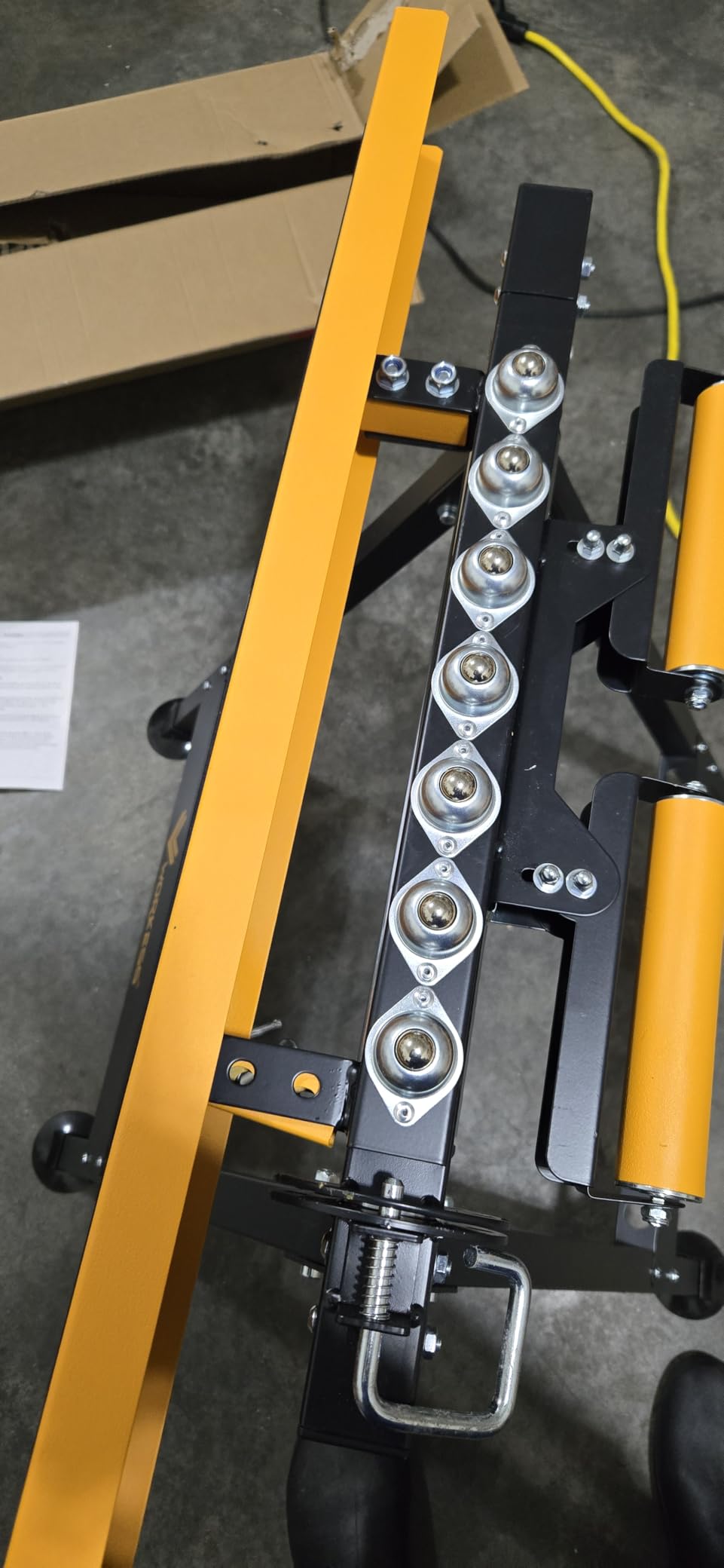
At 440 pounds of rated capacity and 26 pounds of actual steel, this is the stand for a shop that cuts rough dimensional lumber, heavy beams, and thick hardwood rather than sheet goods. The triangular structure with crossbeam fixing is what separates it from the light stands, and owners consistently describe it as far more stable under a big load.
The multi-directional ball-bearing head is the feature that changes how you work. Seven zinc-plated bearings let a long board be fed at an angle or turned, so the stand doubles as a support when you are ripping something that will not stay square on a simple roller. A 33 to 50 inch height range also reaches higher than most portable saws, which opens it up to mobile-base setups.
The folding design is genuinely good. Two folding motions take it down to a compact footprint, and because it is a single unit rather than a pair you are not storing dead weight. Buyers tend to describe it as a portable work center that happens to be an outfeed, which is a fair summary.
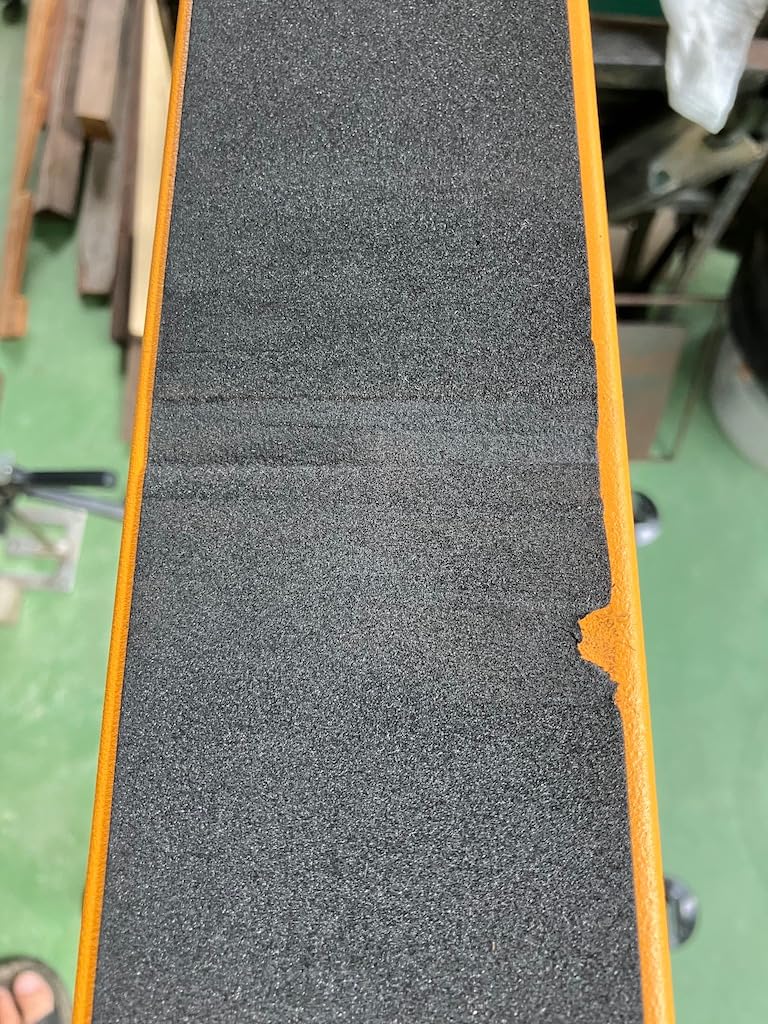
Where the rating drops is finish and hardware. At 4.3 with 332 reviews this carries the widest spread in the group, and the 4 percent one-star bucket is about loose hardware, missing threads on the lever adjusters, and bare support surfaces that wear quickly. None of that touches the core steel.
Whether 2 inch height steps are a problem for an outfeed
Sometimes, yes. The pin-based 10-step adjustment is coarse enough that you may not be able to land exactly on your saw table height, and a small step mismatch shows up as a bump when a sheet crosses the seam. The double locking lever and wedge lifting column do stop it sliding once set, so it will not drift mid-cut.
If your saw table sits at an unusual height, this is worth checking before you buy. For most saws the nearest pin step is close enough that a thin shim or a scrap of hardboard under one leg closes the gap.
What the multi-function design costs you
Converting between positions is not seamless. Changing to the V-shaped roller means unbolting the trestle head, and the instructions list the wrong spanner sizes, so plan a few extra minutes for the first setup and check the hardware torque before you trust it with a heavy beam.
The plastic-handled clamps are the part we would watch. They feel fragile relative to the steel frame, and reviewers report breakage. If your shop treats tools roughly, this is the one to inspect after the first few uses.
6. VEVOR 2500 lb Tripod Roller Stand – Best for Stability and Tall Saw Setups
VEVOR Heavy Duty Roller Stand for Woodworking Metalworking Outfeed
Height: 27.6-52 inch
Load: 2500 lb
Base: triangular
Weight: 29.1 lb
Pros
- 2500 lb capacity and a base that does not rock
- Worm screw adjusts finely and locks under load
- Reaches 52 inches for tall mobile base setups
- Triangular tripod resists rocking on uneven floors
- Folds for corner storage
Cons
- Roller head can swivel in the base under heavy load
- Set screws and keys reported to work poorly
- Listing implies stainless but roller arrives powder coated
The three-leg base is the argument for this stand. Around a table saw, where a heavy sheet is sliding across and the floor is a poured slab, a triangular footprint resists the twisting that makes light stands rock, and several reviewers in this group specifically single out the geometry as the right stability choice.
Capacity is the headline number and it is not close. 2500 pounds covers heavy slabs and industrial work that no other stand on this list approaches, and the 27.6 to 52 inch height range is the tallest here, which means it is one of the few that can reach a saw mounted on a tall mobile base. The worm screw gives fine adjustment and locks at both ends of its travel.
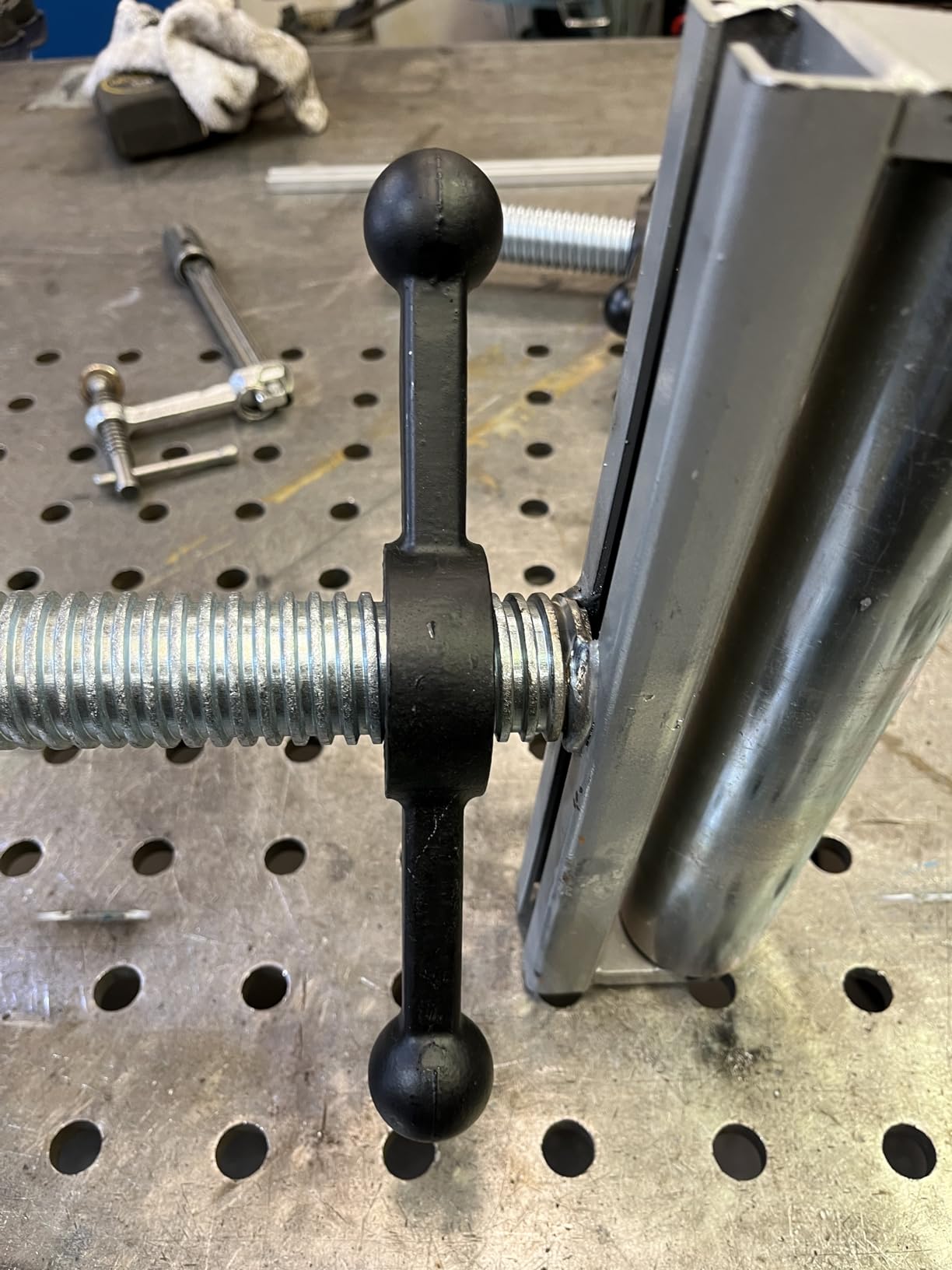
Two details justify the weight. The tripod base does not rock the way a square leg frame does, and the large handles are easy to grip with any hand, which is a real consideration when you are dialing in height with sheet stock resting on top. It also folds for corner storage, so the capacity does not have to cost you permanent floor space.
Buyers use it beyond the table saw, at planers, sanders, and with steel or pipe, and that general utility is part of why it holds a 4.4 across 201 reviews despite sitting at 29.1 pounds.
Whether the roller head swivel is a real safety issue
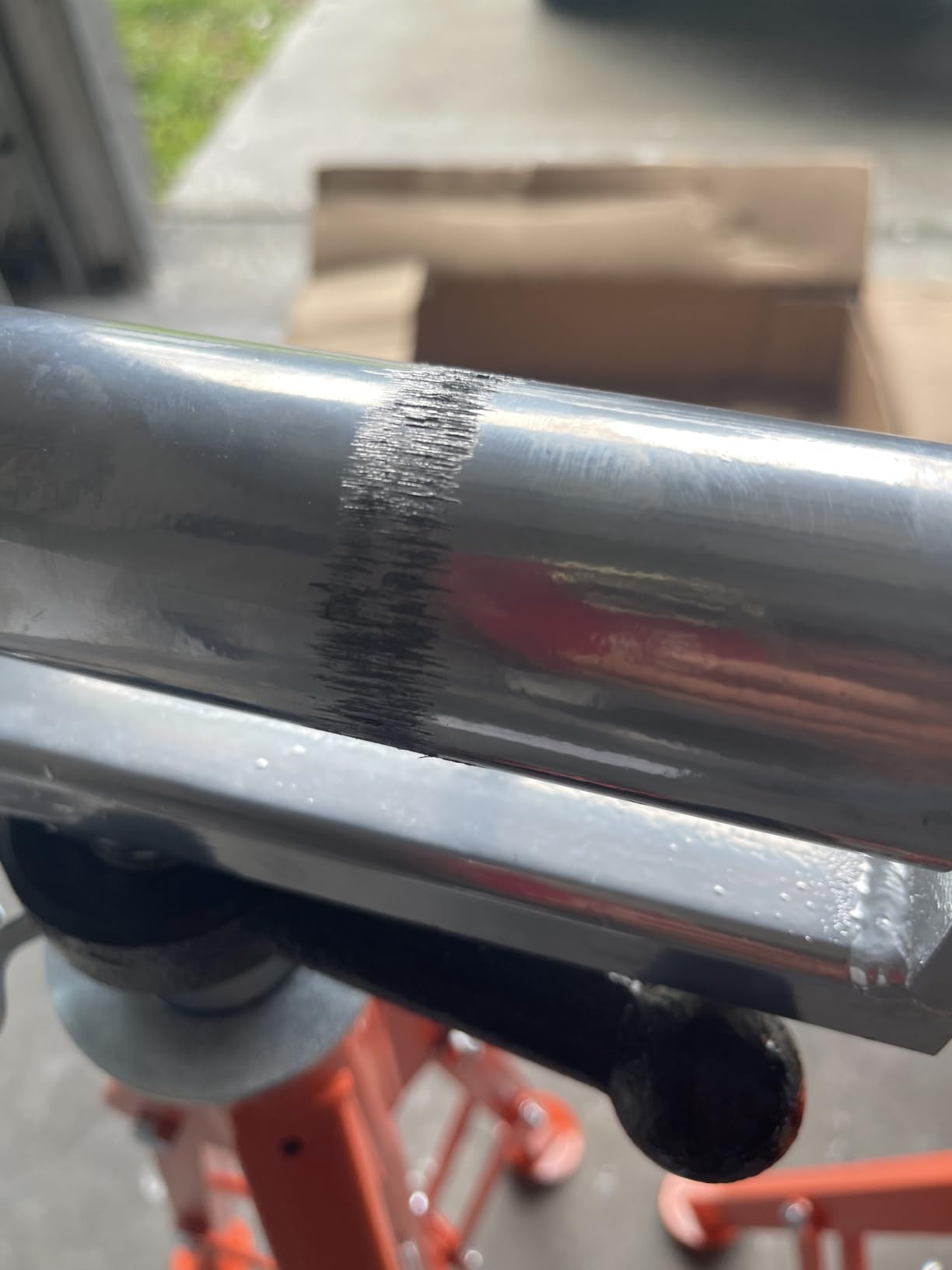
Several reviewers flag that the roller head can swivel in the base under load, and at least one owner noted it appears corrected in newer production. For ordinary sheet goods and dimensioned lumber we have not seen a problem, but if you are working near the stated capacity, check the head for play before the cut rather than after.
There is also a material discrepancy worth knowing. The listing implies stainless and some owners report receiving a powder-coated roller instead, which does not affect function but does affect expectations.
Where the excess capacity is wasted
In a small shop this stand is arguably overbuilt, and that is not an insult, it is a footprint observation. The triangular base occupies more floor area than a simple two-leg stand, so if your only job is supporting 4×8 plywood there is at least one cheaper option that does the same thing with a smaller base.
Where it is not wasted is if you cut thick slabs, turn dimensional lumber, or support a planer. If you do any of those, the stability is the feature you are buying and the capacity is simply the headroom that comes with it.
7. VEVOR 2-Pack Roller Stands 135 lb – Best Value for Sheet Goods on a Budget
VEVOR 2-Pack Roller Stands, 135 lb Load Capacity, 26.8-42.5” Adjustable Height, Folding Heavy Duty Design with 11.5 in Polished Steel Roller Head, for Table Saw Outfeed Woodworking Extension Support
Height: 26.8-42.5 inch
Load: 135 lb each
Roller: 11.5 inch
Sold as: 2 pack
Pros
- Two stands at a low entry cost
- Chrome-plated steel holds up for routine sheet work
- Telescoping rod gives repeatable height
- Folds flat for minimal storage
- Assembly is quick with labeled parts
Cons
- 135 lb capacity is the lowest in this roundup
- 42.5 inch maximum may not reach taller saw tables
- Two-pack is more than some buyers need
This pair covers the most common small-shop case at the lowest outlay: sheet goods and standard dimensioned lumber on a portable saw, with two stands so you can support both the infeed and the outfeed side while a full panel crosses the saw.
What you get is straightforward and clean. Chrome-plated steel, an 11.5 inch polished roller head, and a telescoping rod that gives repeatable height from 26.8 to 42.5 inches. The frame folds flat in a way that genuinely disappears into a corner, and with only 1 percent one-star reviews the field feedback is unusually clean for a budget item.
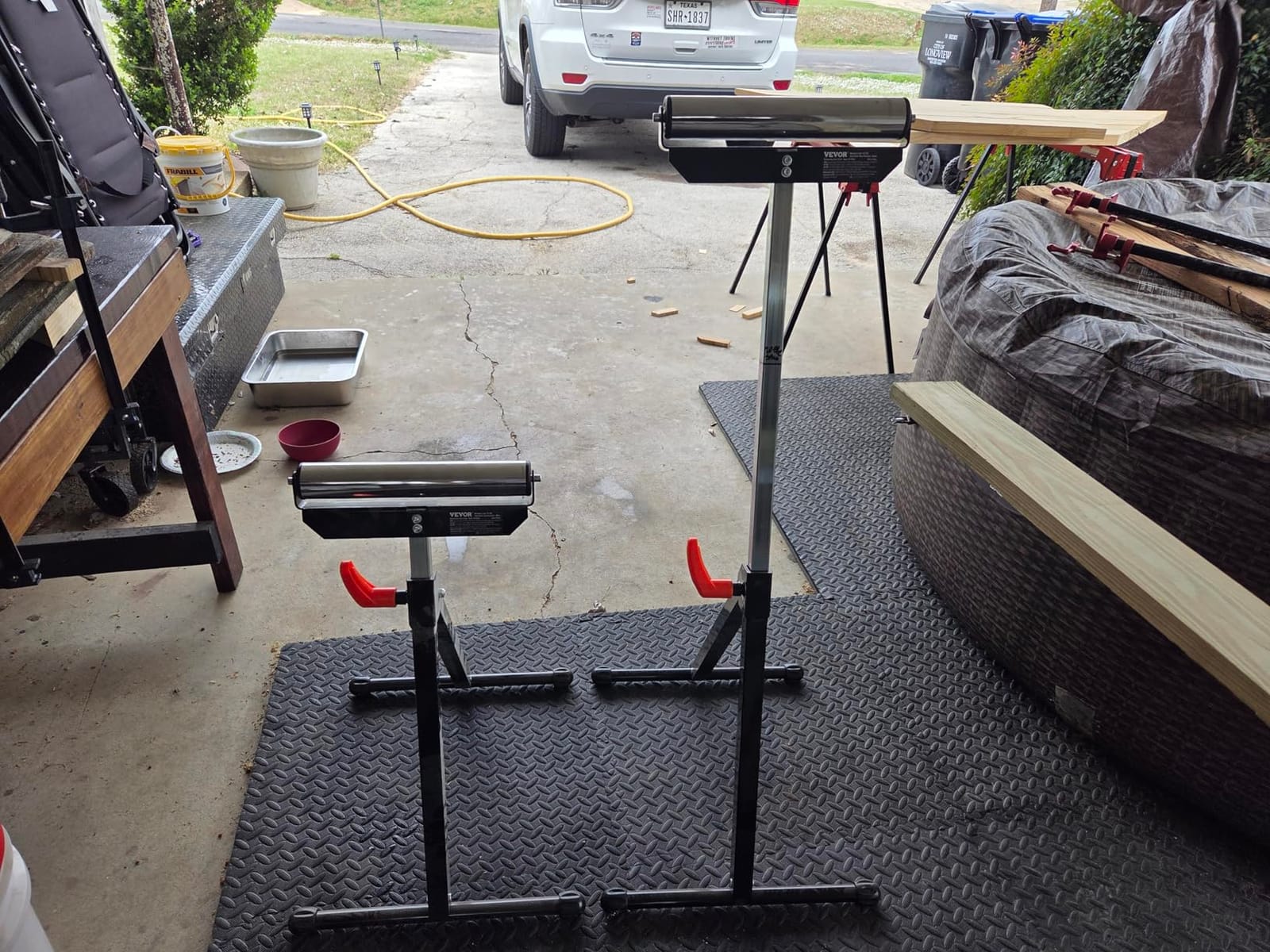
The 4.6 rating across 193 reviews is not an accident of a small sample. Owners credit the smooth chrome-plated rollers and a frame that folds flat without any awkwardness, and they treat it as a sensible two-pack rather than a compromise.
The real limit is capacity, and owners are clear about it. At 135 pounds per stand this suits sheet goods and standard lumber rather than thick slabs, and the 42.5 inch ceiling will not reach a taller saw table. Both limits are fine if your workload is panels, and both are disqualifying if it is not.
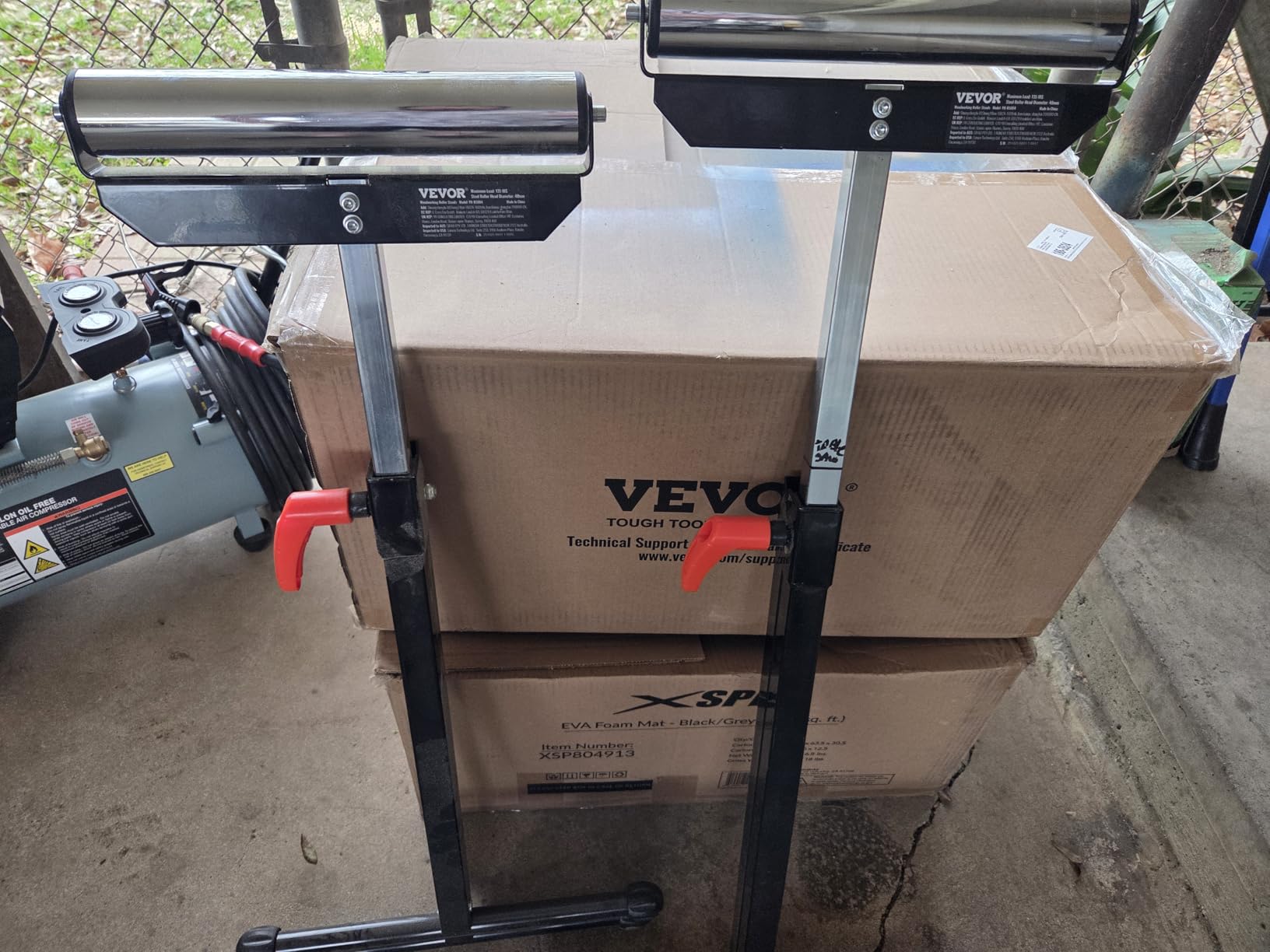
Whether the telescoping rod holds the same height every time
This is where budget stands usually give out, and here it holds. The telescoping rod adjustment repeats well, so you can mark your saw height once and get back to it quickly. That consistency is what makes the fold-flat routine practical, because you are not re-dialing the stand every time you pull it out of the corner.
Check the rod lock under a loaded sheet after the first few cuts anyway. Cheap hardware is the usual failure point in this category and it is cheap to inspect early.
Where a budget stand gives out
It gives out on capacity and on reach. A 135 pound rating means a thick slab is well past what the frame is designed for, and the 42.5 inch maximum will not match a saw on a tall stand. Neither matters for panel work, and both matter the moment you move up to hardwood.
You also get a second stand whether you want one or two. If you are certain you will only ever break down panels from the outfeed side, the single-pedestal option above does the same job with one stand and no wasted storage.
8. VEVOR 4-in-1 Roller Stand 440 lb – Best Multi-Function Head for Mixed Work
VEVOR 4-in-1 Roller Stand, 440 lb Load Capacity, 33-50 in Adjustable Height, Folding Heavy Duty with Rack & Polished Multi-Directional Roller Head, for Table Saw Outfeed Woodworking Extension Support
Height: 30-50 inch
Load: 440 lb
Head: multi-directional
Weight: 24.4 lb
Pros
- Combines roller rack log stand V rollers and tool storage
- 440 lb capacity in a folding frame
- Built-in telescoping rod simplifies height changes
- Polished multi-directional head handles boards and round stock
- Folds quickly for compact storage
Cons
- Only 97 reviews so less long-term field data
- 50 inch maximum does not cover every stand
- Some needed modification to get the V rollers vertical
If your outfeed doubles as general shop support, this is the one to look at. The head combines a roller rack, a log cutting stand, V-shaped rollers, multi-directional rollers, and a tool storage rack, which turns a single stand into several small-shop jobs without adding another piece of equipment to the floor.
Capacity is 440 pounds and the frame folds, so the combination is unusual. A stand heavy enough to take a beam and light enough to move in one hand sounds implausible until you notice the 30 to 50 inch telescoping rod is built into the upright, which removes the awkward collar and makes height changes straightforward.
The 4.6 rating is well earned in the sample it has, with 72 percent five-star and no one-star reviews at all. Buyers point to the same things: the head handling boards, round stock, and panels on one unit, and the fold-flat storage when the job is done.
The honest limitation is the size of the review base. At 97 reviews it has less field history than the WORKPRO, BORA, and SHALL stands here, and a rating with no one-star bucket is as much about a young listing as it is about quality. Treat it as promising rather than proven.
Whether the multi-directional head stays square to the saw
For a straight panel feed the polished multi-directional head works well and feeds smoothly. For a rip, the question is whether the head sits square to your fence, and a few owners needed small modifications to get the V rollers exactly vertical. Set it once, check it with a square, and it will stay there.
At 24.4 pounds this is a two-hand carry rather than a one-hand reposition, which is a reasonable trade for the capacity.
Where the extra functions are worth it and where they are clutter
They are worth it if you cut round stock, handle log-like material, or want a support table for parts finishing alongside the saw. The tool storage rack is a small bonus that costs nothing once the stand is there.
They are clutter if your shop only ever sees plywood. Every mode you will never use adds hardware and adjustment you will never touch, and a simpler two-roller stand does the same job with fewer places for a wobble to hide.
9. KASTFORCE 300 lb 3-in-1 Roller Stand – Best for Miter Saw and Side Support
KASTFORCE Heavy-Duty Roller Stand 300 Lbs 136kg Loading Capacity (3 in 1 Roller), Adjustable Miter Saw Extension, Folds Flat for Easy Storage, 2 Inch (50mm) Stainless Steel Roller KF3012
Height: 26-45 inch
Load: 300 lb
Roller: 11.25 inch stainless
3 head positions
Pros
- Ball-bearing top needs no alignment and will not pull work off a fence
- Can be turned upright to support either side of the saw
- Three head positions on one stand
- Gauge steel is thicker than most competing stands
- Folds flat for storage
Cons
- Switching between the three head positions is cumbersome
- No leveling feet on the base
- Tube can tilt if the locking screw is not fully tightened
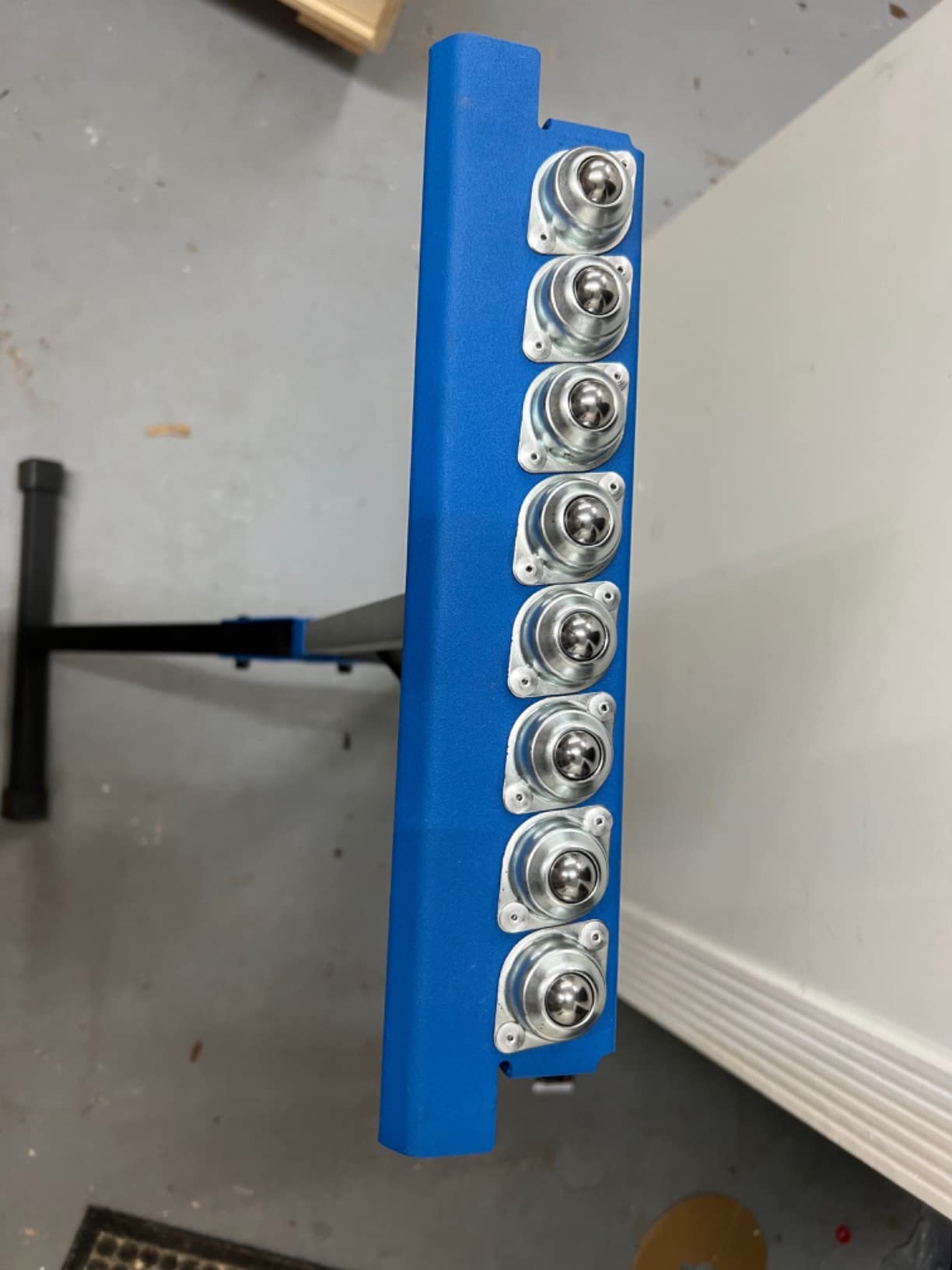
This is the pick if the outfeed is only half your problem and the miter saw station is the other half. A 3-in-1 design with a height range of 26 to 45 inches and a 300 pound rating means the same stand can support long stock at the miter saw, feed sheet goods at the table saw, and stand vertically to prop up one side of a long panel.
The ball-bearing top is the detail that separates it. Because there is no single roller to align, it will not pull work away from a fence the way a one-roller head can, which is the standard complaint about cheaper stands on a straight rip. Gauge steel is also thicker than most stands at this level, and the frame feels solid for the rating.
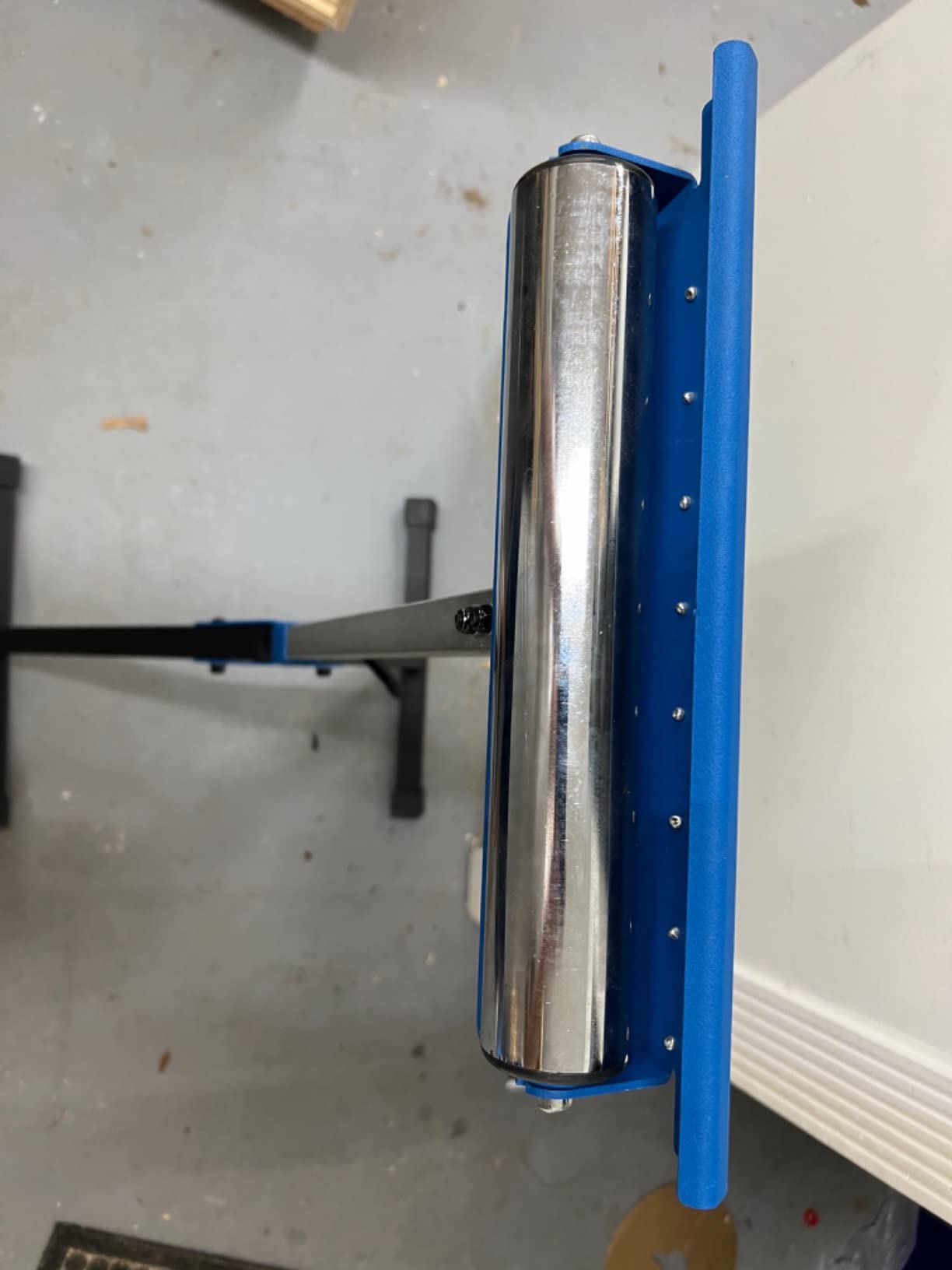
At 4.2 stars across 118 reviews it carries the lowest average in this group, and the reasons are consistent. Switching between the three head positions is awkward, the base has no leveling feet, and owners who want to fix the head wobble end up adding a printed bushing at the square-tube insert. None of those are structural failures, but they are real friction.
What compensates is the versatility. Being able to turn the stand upright for side-of-saw support is something none of the other folding stands here can do, and in a small shop that flexibility is worth something.
Whether the head wobble affects cut accuracy
It can, and it is worth addressing before you rely on the stand. The bushing at the height insert is the part responsible, and owners who printed a replacement report the wobble disappearing. Until then, tighten the locking screw fully and check the head by hand before every session.
The missing leveling feet are the other accuracy concern on an uneven floor. Adding a shim under a foot is a two-minute fix, but plan for it rather than discovering it mid-cut.
Where the 3-in-1 design earns and loses
It earns its keep if your shop genuinely moves between the table saw, a miter saw, and long panel work. Three configurations from one stand saves floor space in a way a dedicated stand for each task would not.
It loses when you need one job done perfectly. Cumbersome mode switching, no leveling feet, and a bushing that may need replacing make this the pick for a flexible shop rather than a shop with one dominant job.
10. Bosch TS1002 Rear Outfeed Extension – Best if Your Outfeed Cannot Take Floor Space
Bosch TS1002 Table Saw Rear Outfeed Support Extension
Extension: 18 inch
Use: Bosch 4000 and 4100
Weight: 8.63 lb
Warranty: 1 year
Pros
- Stores flush to the saw with no separate stand to move
- Slides out and locks with no adjustment
- Hardened metal and aluminum mounts
- Never drifts out of coplanarity
- Owners keep it for decades
Cons
- Only fits Bosch 4000 and 4100 10 inch saws
- Support sags at full extension
- Soft aluminum mounts wear and elongate over time
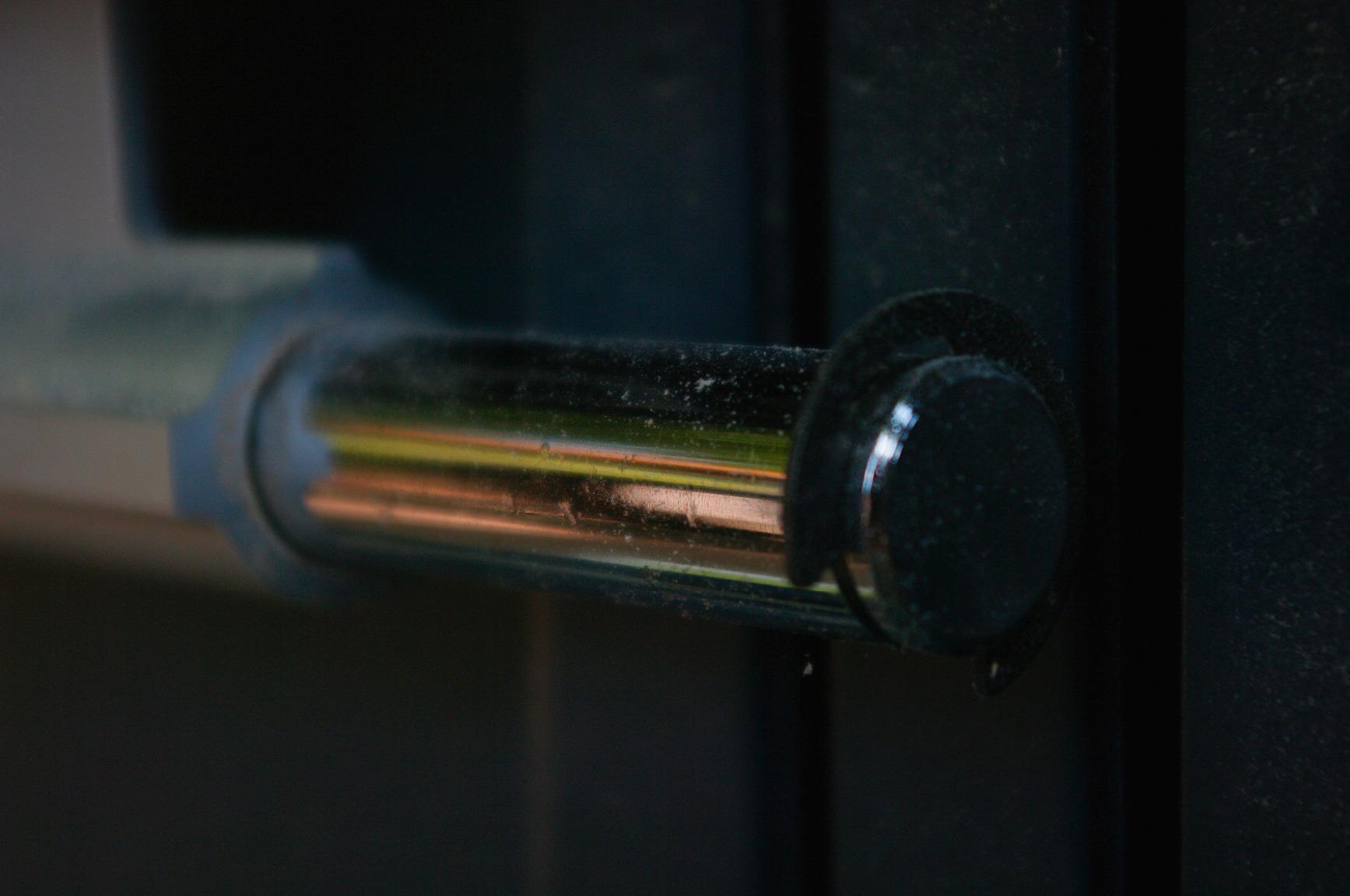
This is the one answer in the roundup that requires no floor space at all, because it lives on the saw. The Bosch TS1002 extends 18 inches behind the table and stores flush when you are done, which makes it the extreme answer to the small-shop footprint problem for anyone who owns the Bosch 4000 or 4100.
Because it is fixed to the saw, it never drifts out of coplanarity the way a portable stand can when you set it up in a hurry. Owners describe it as a durable installed design, and the 4.4 rating across 264 reviews on a product first listed in 2000 says something about how well it ages.
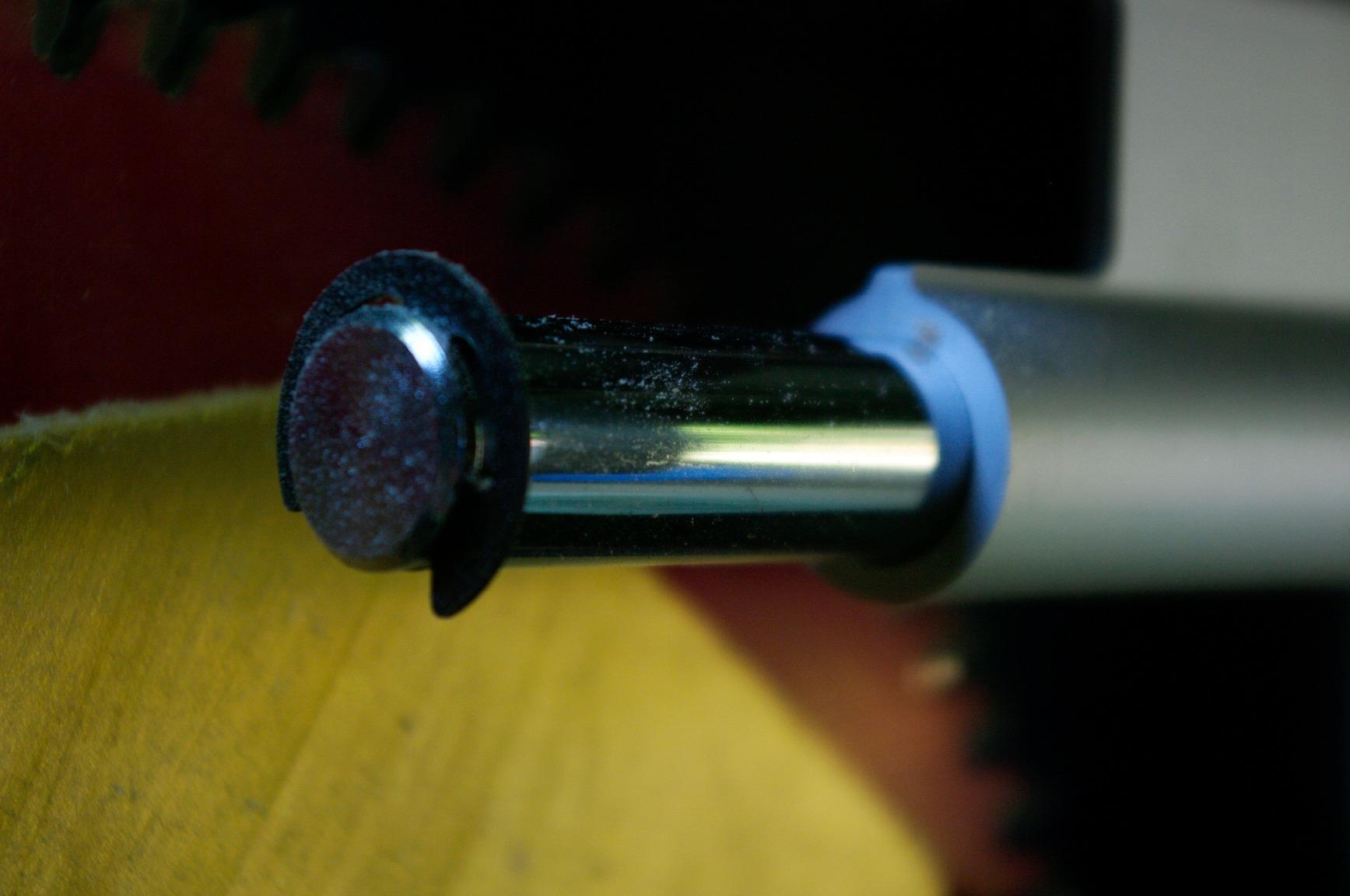
It also solves the storage question outright. There is no second stand to store, no casters to trip over, and no setup time, so a shop that sets up and tears down daily can treat the saw as one self-contained unit. The steel rods and aluminum mounts slide out and lock in a couple of seconds.
It also handles the solo-handling problem directly. Reviewers point out that extending the working depth lets one person cut long boards and plywood without a helper, which is the whole reason the outfeed exists in the first place.
Whether an 18 inch extension is enough for your material
For long boards and trim it is genuinely useful, and the fact that it stays with the saw removes an entire class of shop friction. For full 4×8 sheet breakdown, 18 inches is a partial support, and the sag at full extension is the practical limit, particularly with a heavy panel resting on the tip.
If your workload is mostly panels, this extends the saw but does not replace a real outfeed. If it is mostly dimensioned lumber, it may be all you need.
Where the design works against you
The compatibility wall is the big one. This fits Bosch 4000 and 4100 10 inch saws and nothing else, so if you ever change saws the entire investment becomes shelf weight. It also makes the saw about four inches wider, which is the point shoppers notice when carrying it through a doorway.
The soft cast aluminum mounts wear and elongate over time, letting the extension angle downward, and the instructions needed adjusting for the brackets to line up correctly. The real cost of this approach is flexibility: it is the best outfeed for one saw in one shop and useless anywhere else.
What Size Should an Outfeed Table Be?
Size an outfeed table by how far it reaches behind the blade, not by how wide it is. For full 4×8 sheet breakdown you want 50 inches or more of support behind the saw, plus matching infeed support, so a stand that extends 14 to 50 inches covers the job where a fixed 18 inch extension does not. For dimensioned lumber, 24 to 30 inches of reach is enough to keep a long board from tipping off the back.
The second measurement matters more than the first: how small the table becomes when you are not using it. Fold a stand flat, lean it against a wall, and measure the footprint in square feet. In a one-car garage of roughly 240 square feet, an outfeed that folds to about 6 square feet is invisible, while a fixed table of the same reach can eat a quarter of the walking space. Our coffee table guide for small living rooms applies the same footprint-first logic to a different corner of the house.
That second number is the one that decides purchases in a small shop. A larger saw setup with infeed and outfeed on both sides can claim around 60 square feet of the floor, while a jobsite saw on a stand with a single folding outfeed needs closer to 20 to 25. If your saw is already eating a quarter of the room, reach and folding matter more than capacity.
Folding, Flat-Pack or Roller Conveyor: Which Architecture Fits?
There are three architectures in this category and they solve the same problem very differently. A folding stand hinges or telescopes into a flat slab and takes a few seconds to deploy, which is why it dominates small shops. A knock-down or flat-pack kit takes longer to assemble but stores as loose panels. A roller conveyor extends and retracts, covering the most distance per square foot of stored size.
Folding stands are the answer for most small shops. Setup is fast enough that you can pull the stand out only for the cut, which is exactly the behavior that keeps a tiny shop usable on a weekend when you also need the floor for the mower.
Knock-down kits make sense if you already have the workbench and the assembly time, or if you plan to modify the top. They store as flat panels in a rack, which is efficient, but a table that takes 30 minutes to assemble will not get pulled out for a quick rip.
Roller conveyor tables cover the most distance when extended, which is what you need for full sheet work. The trade is weight and bulk, and the stands in this roundup at 44.7 pounds and up are noticeably harder to move around a small shop than a folding stand in the 9 to 26 pound range.
Height range is the tiebreaker after architecture. Anything topping out under 40 inches will not reach a saw on a tall mobile base, and anything starting above 28 inches will not sit low enough for a benchtop or compact jobsite saw. Measure your saw table height first, then filter the list.
How to Match Outfeed Height and Level to Your Saw Table
The outfeed top should sit level with your saw table, and the surface must be smooth with no obstructions that will stop the feeding process. A step, a lip, or a mismatched roller is the single most common cause of a snag mid-cut, and a snag is what turns a cut board into a lifted workpiece.
Start by measuring saw table height with a tape measure, then set the stand to match within a hair. Check the seam with a straightedge laid across both surfaces. Any break in the straight line is a hump your material will hit, and shimming a foot is usually faster than changing hardware.
Here is the detail forum builders repeat and product listings never mention: if your outfeed sits at the same height as the saw table, line grooves in the outfeed surface up with the miter slots. Otherwise a workpiece can catch on a slot lip it was never meant to cross. If you bought a stand with a solid top, you can add shallow grooves yourself with a straight bit and a guide block.
Then test it with something heavy before you cut anything you care about. Slide a sheet of scrap across the joint slowly. If it drops, tilts, or stops, the seam is not right and neither is the height. This takes two minutes and it is the difference between a clean cut and a ruined panel.
Finally, stand out of the line of any possible kickback, keep a push stick within reach, and treat the surface as if it will eventually be slick. The outfeed is what makes single-person sheet work possible, which also means it is what puts you closest to the failure when something goes wrong.
When You Do Not Need a Separate Outfeed Table
Some saws already solve this. Buyers in small-shop forums repeatedly pick saws whose fence rail extends well past the table, because a long rail acts as a built-in outfeed and costs no floor space at all. If your saw has that, a separate table may be solving a problem you do not have.
A track saw on a panel is the other case. If most of your work is breaking down sheet goods with a guide rail, you are already using a system with its own support ends and you do not need a table saw outfeed table for that workflow.
A dedicated miter saw station with roller supports is a third, and it only counts if you cut long dimensioned lumber more often than you break down panels. Roller stands at the miter saw are not a substitute for outfeed support behind a blade, but they solve a different problem without competing for the same floor.
What none of those cover is a full sheet crossing a spinning blade while you stand alone. If you rip panels, that is what you are buying, and no shortcut replaces it.
Frequently Asked Questions
What size should an outfeed table be?
Size it by reach behind the blade, not width. For full 4×8 sheet breakdown you want 50 inches or more of support behind the saw plus matching infeed support, so a stand that extends 14 to 50 inches covers the job. For dimensioned lumber, 24 to 30 inches of reach is enough. Measure your saw table height too, since anything under 40 inches will not reach a saw on a tall mobile base.
What is the best material for an outfeed table top?
For smooth, flat stock, a hard laminate or sealed MDF top gives the flattest surface. Multi-wide roller heads are best for sheet goods and heavy rough material because they carry a load across a wide contact area without dipping. Solid wood moves with humidity and is the least predictable. Whichever you pick, the surface must be smooth and free of obstructions that will stop the feeding process.
What is the best table saw for a small shop?
Most small shops settle on a portable or contractor saw with a folding stand, because that configuration needs roughly 20 to 25 square feet with infeed and outfeed support. A cabinet saw with support on both sides can claim around 60 square feet, which is a quarter of a one-car garage. Saw selection matters less than floor space, and a compact saw needs less outfeed support than a cabinet saw.
What type of saw is best for cutting in small spaces?
A portable or jobsite saw on a folding stand wins on footprint, and it needs a shorter outfeed because the table is smaller. A benchtop saw needs the least support of all, often just a folding stand set to saw table height. Cabinets give the most capacity but the least flexibility, so in a small space the saw class should follow the room, not the other way around.
What type of saw is best for small woodworking projects?
For typical small-shop projects, a portable saw on a folding stand paired with a folding roller outfeed is the simplest match. It covers panel breakdown and dimensioned lumber, sets up in minutes, and folds away when the project is done. You need an outfeed table far more than a larger saw, because the outfeed is what lets one person handle a full sheet safely.
Our Top Picks for Small Shops in 2026
After working through all ten, the BORA Adjustable Conveyor Roller Stand is our pick for the best table saw outfeed tables for small shops in 2026. It is the only one that extends to 50 inches for a real full-sheet breakdown and still collapses into a stackable slab you can push behind the saw when the weekend is over.
For a single pedestal support at the lowest sensible outlay, the BORA PM-5090 does the same job with one wide ball-bearing roller. For proven volume and a matched infeed, the WORKPRO pair is the pick most small shops end up with. If your saw sits high on a mobile base, skip all of those and look at the taller tripod. If you own a Bosch 4000 or 4100, the TS1002 extension needs no floor space at all.
Whatever you pick, measure your saw table height before you order, and check the seam with a straightedge before you trust it with a full sheet. That single habit prevents more ruined panels than any brand difference we found.