
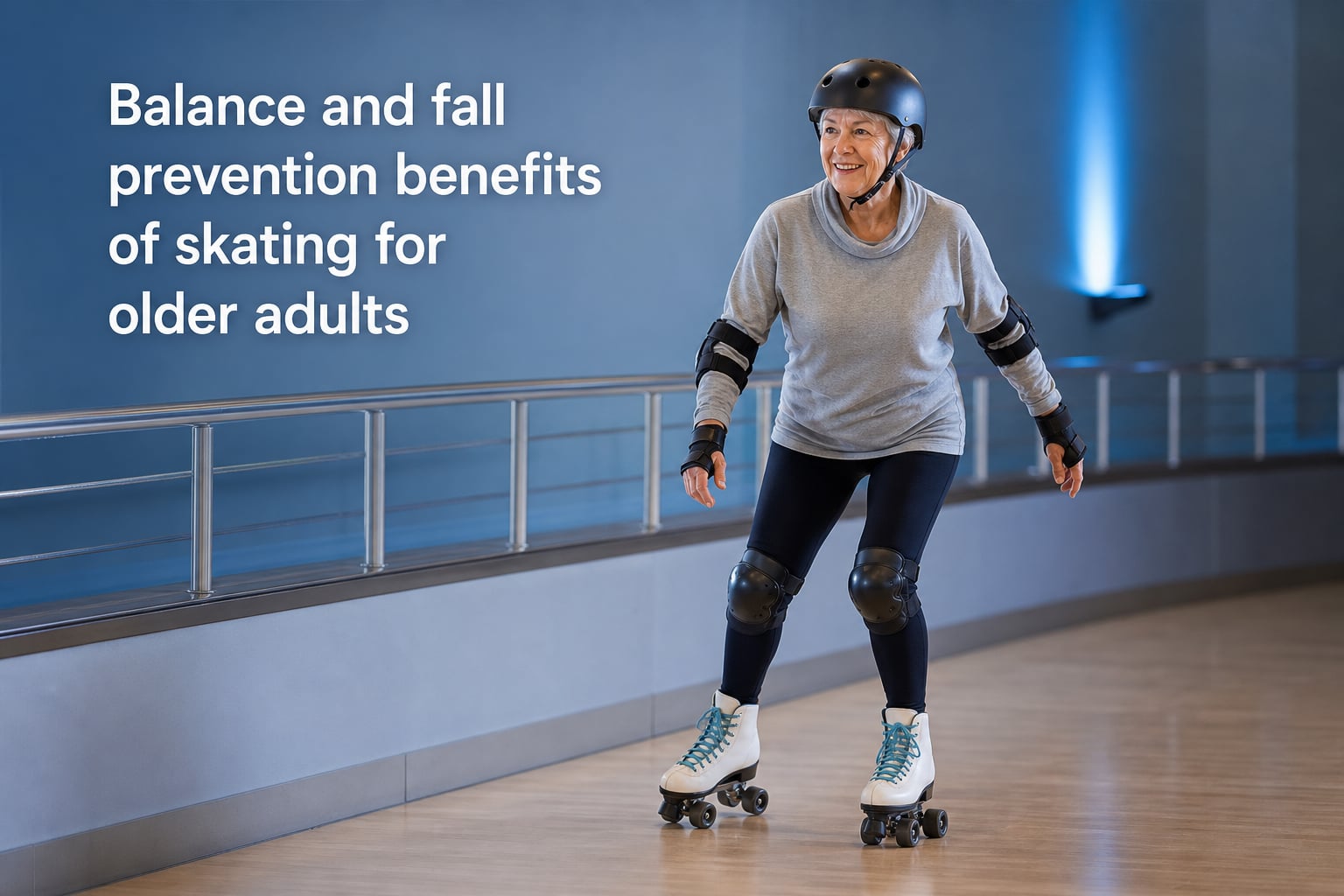
Every year, roughly one in three adults aged 65 and older takes a fall. Those falls lead to fractures, head injuries, hospital stays, and all too often a lasting fear of movement that accelerates physical decline. Our team has spent years watching older skaters build strength and stability on wheels and on ice, and the contrast with sedentary peers is striking.
The good news is that falls are not an inevitable part of aging. Balance is a trainable skill, and one of the most engaging ways to train it is skating. Whether that means lacing up roller skates at a local rink or stepping onto an ice rink on a Saturday morning, the constant micro-adjustments skating demands rebuild the systems that keep us upright.
This guide covers the balance benefits of skating for older adults, explains the science behind why it works, addresses the safety concerns that stop many people from trying, and lays out a step-by-step path for getting started after 60. It draws on peer-reviewed research, including the well-known Lamoth et al. (2012) study, plus real experiences shared by senior skaters in community forums.
By the end, readers will understand how skating compares to tai chi and other mainstream balance programs, what gear makes the difference, and how to take the first stride with confidence rather than fear.
Table of Contents
Why Balance Declines With Age and Why Falls Are So Dangerous?
Balance is a complex interplay between vision, the inner ear (vestibular system), and proprioception, the body’s ability to sense where each limb is in space. After about age 50, all three systems slowly lose sensitivity. Muscle mass also declines at roughly 1-2% per year once we pass that mark, especially in the legs and core that keep us steady.
The result is a measurable increase in postural sway, the small shifts the body makes to stay centered over its base of support. Larger sway means a higher chance that a sudden stumble, a slippery patch, or a turned ankle will turn into an actual fall.
The numbers make the stakes clear. Falls are the leading cause of both fatal and nonfatal injuries in adults over 65 in the United States. Hip fractures alone affect about 300,000 older Americans each year, and roughly half of those who break a hip never regain their previous level of mobility.
What worries doctors most is the psychological aftermath. A single fall often produces a fear of falling, which leads people to walk less, exercise less, and go out less. Within months, that inactivity shrinks muscle and dulls balance even further, raising the risk of the next fall.
This is why balance training matters so much. It is not only about preventing a single accident. It is about breaking the downward spiral of weakness and fear before it takes hold.
How Skating Improves Balance and Postural Control?
Skating is one of the most effective ways to retrain postural control because it constantly challenges the balance systems in a way walking simply does not. Standing still on skates requires active correction. Gliding forward demands continuous weight shifts. Turning, stopping, and recovering from a wobble all recruit the deep stabilizing muscles that aging quietly weakens.
The core mechanism is the gliding motion. On wheels or blades, the base of support is narrow and mobile, which forces the body to make tiny corrections dozens of times per second. That work trains proprioception in the ankles, knees, and hips, sharpens vestibular responses, and reconditions the brain’s map of where the body is in space.
Research backs this up directly. In a 2012 study published in the Journal of Electromyography and Kinesiology, Lamoth and colleagues compared older adults who had skated for years with inactive peers of the same age. The skaters had significantly better postural control, smaller sway, and faster corrective responses.
The authors concluded that activities like ice-skating appear beneficial for elderly people and may, at least partly, counteract the age-related changes that undermine balance.
That last phrase matters. The study suggests skating does not just halt decline. It can partially reverse it. The skaters in the study were not elite athletes. They were regular older adults who kept skating into their 60s and 70s, and they moved with a steadiness that matched people decades younger.
For anyone asking how skating improves balance in elderly bodies, the answer is simple. Skating rebuilds the exact balance systems that aging wears down. Postural control, proprioception, ankle stability, core engagement, and reaction speed all get a focused, repeatable workout every session.
The Core Strength and Coordination Benefits of Skating
Balance does not come from the feet alone. It comes from the deep muscles of the trunk, the hips, and the legs, the same muscles that physical therapists target in any fall-prevention program. Skating happens to engage all of them at once.
Every stride activates the glutes, quadriceps, hamstrings, and calf muscles. The abdominal and lower-back muscles work continuously to keep the torso stacked over the skates. Even the small stabilizers around the ankles and hips fire repeatedly to absorb the small jolts of each glide.
Adult skaters in community forums consistently report that skating strengthened their legs, backs, and cores in ways they did not expect. Several skaters in their 60s describe noticeable improvements in everyday tasks, from climbing stairs without a handrail to carrying groceries with a steadier gait.
Coordination improves alongside strength. Skating requires the brain to time movements precisely: push, glide, shift weight, brake. That timing work reinforces neural pathways between the brain and the muscles, which is exactly the neuromuscular adaptation that aging tends to erode.
Over weeks and months, that added coordination carries over into daily life. Stepping off a curb, recovering from a trip on a rug, or catching yourself on a wet floor all depend on the same fast, coordinated responses that skating sharpens.
Skating also offers a low-impact option for joints, especially roller skating on smooth rink surfaces or ice skating on a maintained rink. The gliding motion avoids the repeated jarring of running, which makes it friendlier for older knees and hips while still delivering real muscular and cardiovascular benefit.
Is Skating Safe for Older Adults? Key Safety Considerations
This is the question that comes up first in nearly every forum thread on senior skating. The honest answer is that skating can be safe for older adults when approached with the right preparation, gear, and environment. It is not risk-free, but neither is inactivity, and the fall risk of a sedentary lifestyle quietly dwarfs the risk of a well-prepared skating session.
The fear of falling is itself a barrier. Older adults who worry about falling often avoid the very activities that would protect them. The way to dissolve that fear is not by ignoring the risks but by managing them deliberately.
Here are the safety steps our team and senior skating instructors recommend.
Get medical clearance first. A quick conversation with a doctor is essential, especially for anyone with osteoporosis, recent joint replacement, balance disorders, or blood pressure concerns. A physician can flag specific precautions and confirm whether skating fits an individual’s health profile.
Wear full protective gear every single time. That means a properly fitted helmet, wrist guards, knee pads, and elbow pads. Wrist fractures are the most common skating injury across all ages, and a simple set of guards prevents most of them. There is no good reason to skip this step.
Start in a controlled environment. A smooth indoor rink with a railing, a flat supervised ice rink, or a quiet tennis court on a dry day are all good beginner surfaces. Avoid hills, rough sidewalks, traffic, and wet floors until balance and braking are solid.
Take at least one lesson. An instructor who has worked with adult beginners can teach the falling technique, the proper stance, and the braking skills that make the difference between a safe start and a discouraging one. Many rinks now offer adult-only beginner sessions.
Use the right skates. Stiff, supportive boots with good ankle support matter more for older skaters than for younger ones. Cheap, floppy rental skates undermine balance from the first stride. Investing in a supportive pair, fitted at a skate shop, changes the experience completely.
Skate with a buddy. A companion provides both a safety net and accountability. Most senior skaters in online communities say having a regular skate partner kept them coming back through the awkward early weeks.
Getting Started With Skating After 60: A Beginner Roadmap
Starting any new physical activity later in life feels intimidating, and skating carries a special kind of weight because of the falls. The path below, drawn from instructor advice and the experiences of older skaters, breaks the journey into manageable steps.
Step 1: Build basic balance off-skates first. Spend two to four weeks doing simple balance exercises at home: standing on one foot near a counter, heel-to-toe walking along a line, and gentle weight shifts. This work primes the same systems skating will demand and reduces the shock of the first rink session.
Step 2: Get fitted for supportive skates and full protective gear. Visit a skate shop, not a discount store. Look for a boot with firm ankle support, quality wheels or blades, and a snug fit. Buy the helmet and pads at the same time, so there is never a session where the gear is missing.
Step 3: Book a beginner lesson at a rink. Many rinks run adult beginner sessions during off-peak hours. Tell the instructor about any health concerns, joint replacements, or balance conditions. A good instructor will adapt the lesson accordingly.
Step 4: Learn to fall safely before learning to glide. The single most useful skill in skating is knowing how to go down without injury. Instructors teach falling forward onto pads rather than backward onto the tailbone, and how to tuck and roll. Practicing this on the carpet before stepping onto the rink floor takes the fear out of falling.
Step 5: Practice short, frequent sessions. Two or three 20-minute sessions a week beat one long exhausting outing. Fatigue is when falls happen, so stopping while still fresh keeps each session productive and safe.
Step 6: Track small wins. Standing unassisted for 10 seconds. Gliding a few feet without holding the rail. Braking gently from a slow roll. These are the milestones that signal real progress, and they tend to show up within the first month.
Step 7: Find a community. Local skate groups, adult skate nights, and online communities for older skaters provide encouragement, tips, and accountability. Skating with others turns a daunting solo project into a social habit that is far easier to sustain.
How Skating Compares to Other Balance Exercises for Seniors
Balanced exercise options for older adults are not in short supply. Tai chi, yoga, single-leg stands, heel-to-toe walking, and balance boards all have research behind them. So where does skating fit, and is it the right choice over those proven programs?
The answer depends on the person, but skating has a unique advantage that the others do not: it is fun. Tai chi and balance drills work, but they can feel repetitive. Skating, whether on wheels or on ice, has a playfulness and a sense of flow that keeps people coming back for years.
Consistency is the secret to fall prevention. Any exercise a person stops doing within six months produces limited benefit. Skating’s high engagement makes long-term adherence far more likely, which is the real reason it can deliver outsized results.
In terms of raw balance training, skating stacks up well. The narrow, mobile base of support forces continuous postural correction that few floor-based exercises can match. The Lamoth study found that long-term skaters had postural control comparable to much younger adults, an effect that routine balance drills rarely produce to the same degree.
Skating also builds cardiovascular fitness, leg strength, and joint mobility in one activity, which most balance-specific routines do not. Tai chi and yoga improve balance but do less for leg power. Strength training builds muscle but trains balance less dynamically. Skating threads several needles at once.
The trade-off is risk. Tai chi has a near-zero injury rate. Skating, done poorly or without gear, can cause wrist and knee injuries. That is why the safety steps above matter so much. A well-prepared senior skater takes on a modest, manageable risk in exchange for a richer, more sustainable balance workout.
For many older adults, the best answer is a combination: a tai chi or home balance routine for daily maintenance, plus one or two skating sessions a week for strength, coordination, and the joy of it. That hybrid approach delivers the steady gains that translate into real fall prevention.
Real Stories From Older Skaters Who Improved Their Balance
The research is compelling, but the stories of older skaters are what convinced our team that this conversation matters. Across skating forums, retirement communities, and rink parking lots, the same themes come up again and again.
Adult skaters in their 60s routinely report better balance than non-skating friends of the same age. Several describe catching themselves on uneven pavement without falling, an experience they credit directly to months of skating. Others say their doctors were surprised by improvements in gait and stability tests after a year of regular skating.
One skater who started at age 58 wrote that within six months she could stand on one foot to put on her shoes, something she had not done in years. Another, a 67-year-old who took up ice skating after a hip replacement (with clearance and an instructor), reported that her physical therapist saw measurable gains in hip strength and ankle stability.
Retirement-age skaters consistently mention that the benefits go beyond balance. Mobility improves, weight comes down, and several skaters with Type II diabetes report better blood sugar control after building skating into their weekly routine.
The psychological shift is just as important. Skaters who once feared falling describe a growing confidence on and off the rink. That confidence matters because confident older adults move more, walk more, and stay independent longer.
The community side of skating deserves a mention too. Adult skate nights, beginner meetups, and online groups give older adults a social outlet that fights isolation, which is itself a major health risk. Skating becomes a reason to leave the house, see friends, and stay in motion well past retirement.
Frequently Asked Questions
How can older adults prevent falls?
Older adults prevent falls through regular balance training, leg and core strengthening exercises, home safety modifications like removing loose rugs and adding grab bars, proper footwear, vision checks, medication reviews, and staying physically active. Activities such as skating, tai chi, and supervised strength training directly rebuild the balance systems that aging weakens.
Which exercise is most beneficial for improving balance in older adults?
No single exercise is best for everyone, but activities that challenge postural control dynamically, such as tai chi, skating, yoga, and supervised strength training, show strong evidence for reducing fall risk. Skating stands out because it forces continuous balance corrections on a narrow, mobile base, which research links to measurable gains in postural control.
Is skating good for older adults?
Yes, skating is good for older adults when approached with medical clearance, full protective gear, and proper instruction. Research from Lamoth et al. (2012) found that older adults who skated regularly had better postural control than inactive peers of the same age, suggesting skating can partly counteract age-related balance decline.
Can a 70 year old roller skate?
A 70 year old can roller skate safely with the right preparation: a doctor’s clearance, supportive skates, a helmet, wrist guards, knee and elbow pads, and at least one beginner lesson in a controlled environment like a flat rink. Many adults start skating in their 60s and 70s and report real improvements in balance, strength, and confidence.
What are some good balance exercises for skating?
Good off-skate balance exercises include single-leg stands near a counter, heel-to-toe walking along a line, weight shifts from one foot to the other, gentle squats for leg strength, and ankle circles for joint mobility. Practicing these for two to four weeks before stepping onto skates primes the proprioceptive and core systems that skating will demand.
Is 60 too old to start skating?
No, 60 is not too old to start skating. Many adults begin in their 60s and 70s and develop strong balance and skating skills. The keys are medical clearance, supportive gear, a qualified instructor, and short, consistent practice sessions. Age affects the learning curve but does not prevent progress, and the balance benefits begin within the first few weeks.
Final Thoughts: Skating as a Long-Term Balance Strategy
The balance benefits of skating for older adults are not a fringe claim. They are documented in peer-reviewed research, echoed by skating instructors, and confirmed again and again by the senior skaters who lace up week after week. Skating rebuilds postural control, sharpens proprioception, strengthens the core and legs, and produces a kind of confident movement that aging tends to quietly steal.
None of this means skating is right for every older adult, and no one should stride onto a rink without gear, clearance, and a plan. But for those who can take that first step, skating offers something rare: a balance workout that is genuinely enjoyable enough to keep doing for years.
For anyone wondering where to begin, the next step is simple. Talk to a doctor, find a local rink that runs adult beginner sessions, and book a single lesson. That first session is the hardest part. After that, the balance gains build on themselves, one glide at a time.