
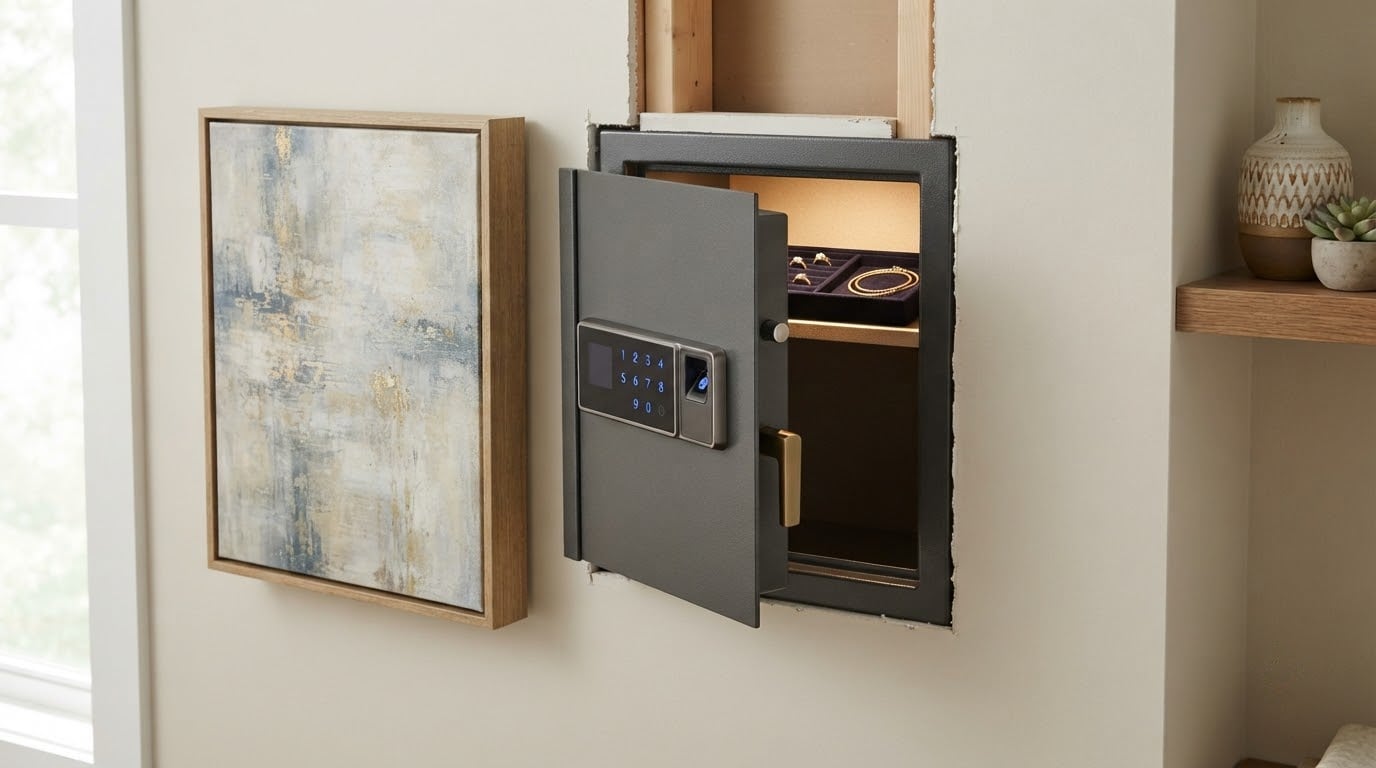
The best wall safes for jewelry are recessed steel boxes that drop between standard 16-inch wall studs and sit flush with the finished surface, so your pieces disappear into dead wall space instead of sitting in a drawer where anyone can pull them out. A good one for jewelry needs three things most people miss: a door that stays flush so art can hang over it, an interior that organizes rings and necklaces rather than one empty cavity, and enough steel weight that it stays put once bolted into the framing.
That last point is where budget models get exposed. Plenty of cheap in-wall safes advertise a keypad, but the bodies are thin and the included screws are drywall screws. The ten picks below range from a 4-pound concealment box to a 39-pound biometric safe with a motorized deadbolt, and I have flagged the honest limitation of each one rather than repeating the listing copy.
Weighing two options against each other, the general wall safe roundup covers fire ratings and burglary classes in more depth, and if you also restore pieces before storing them, our ultrasonic cleaners for jewelry guide covers the cleaning side. What follows is the jewelry-specific view: which interiors actually stop tangles, which fireproof claims are backed by a number, and which cabinets are worth cutting a hole in your wall for.
Table of Contents
Top 3 Wall Safes for Jewelry in October 2026
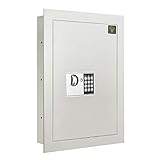
Paragon In-Wall Safe
- 0.83 cubic feet
- Flush mount between 16 inch studs
- Touchpad with two manual override keys
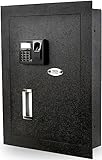
Viking VS-52BLX Biometric
- Fingerprint
- PIN and cross key entry
- 39 lb solid steel body
- LED light and three shelves
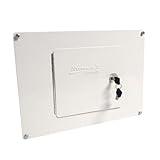
Homak First Watch Wall Safe
- 480 cubic inches
- Fits between 16 inch studs
- Four-point tubular lock with inner door
Our overall pick, the Paragon, has the largest owner base in this group by a wide margin and the interior volume that jewelry actually needs. The Viking takes the biometric crown with a 39-pound body and three independent ways in. The Homak is the simplest thing here that still works as a concealment box, and it carries the highest star rating of the lot.
Every Wall Safe We Compared in October 2026
| Product | Specs | Action |
|---|---|---|
| Paragon In-Wall Safe with Keypad |
|
Check Latest Price |
| Homak First Watch Steel Wall Safe |
|
Check Latest Price |
| Viking Security VS-52BLX Biometric Safe |
|
Check Latest Price |
 Elder Welder Outlet Hidden Wall Safe Elder Welder Outlet Hidden Wall Safe |
|
Check Latest Price |
 Protex PWS-1814E Electronic Wall Safe Protex PWS-1814E Electronic Wall Safe |
|
Check Latest Price |
 Nebakne 25.6 Inch Tall Wall Safe Nebakne 25.6 Inch Tall Wall Safe |
|
Check Latest Price |
 GUVELI 33.46 Inch Tall Wall Safe GUVELI 33.46 Inch Tall Wall Safe |
|
Check Latest Price |
 Giantex Electronic Wall Safe Giantex Electronic Wall Safe |
|
Check Latest Price |
 Grimtron Wall Safe with Spacer Kit Grimtron Wall Safe with Spacer Kit |
|
Check Latest Price |
 Tiskgg 29.53 Inch Tall Wall Safe Tiskgg 29.53 Inch Tall Wall Safe |
|
Check Latest Price |
Every one of these fits between studs, but they are not interchangeable. Four are short bodies in the 11-to-22-inch range, four are tall cabinets from 25 inches up, and two are small concealment boxes that hold almost nothing. Sort by interior height first, then by weight, then by lock.
1. Paragon In-Wall Safe with Keypad – Best Overall
Paragon Safes In Wall Safe with Keypad and 2 Manual Override Keys, White
0.83 cubic feet
Chamber depth 16.25 inches
39 lbs alloy steel
Touchpad plus two override keys
Pros
- Fits between 16 inch studs with about a quarter inch clearance
- Two separate 3-8 digit codes plus two manual override keys
- Alarm escalates from 20 seconds to 5 minutes
- Shelves remove for flat or long items
- Largest owner base in this group at 4723 reviews
Cons
- Center lock mechanism eats middle shelf space
- Keypad beeps on every press and cannot be muted
- Included anchors are weak so buy your own lag bolts
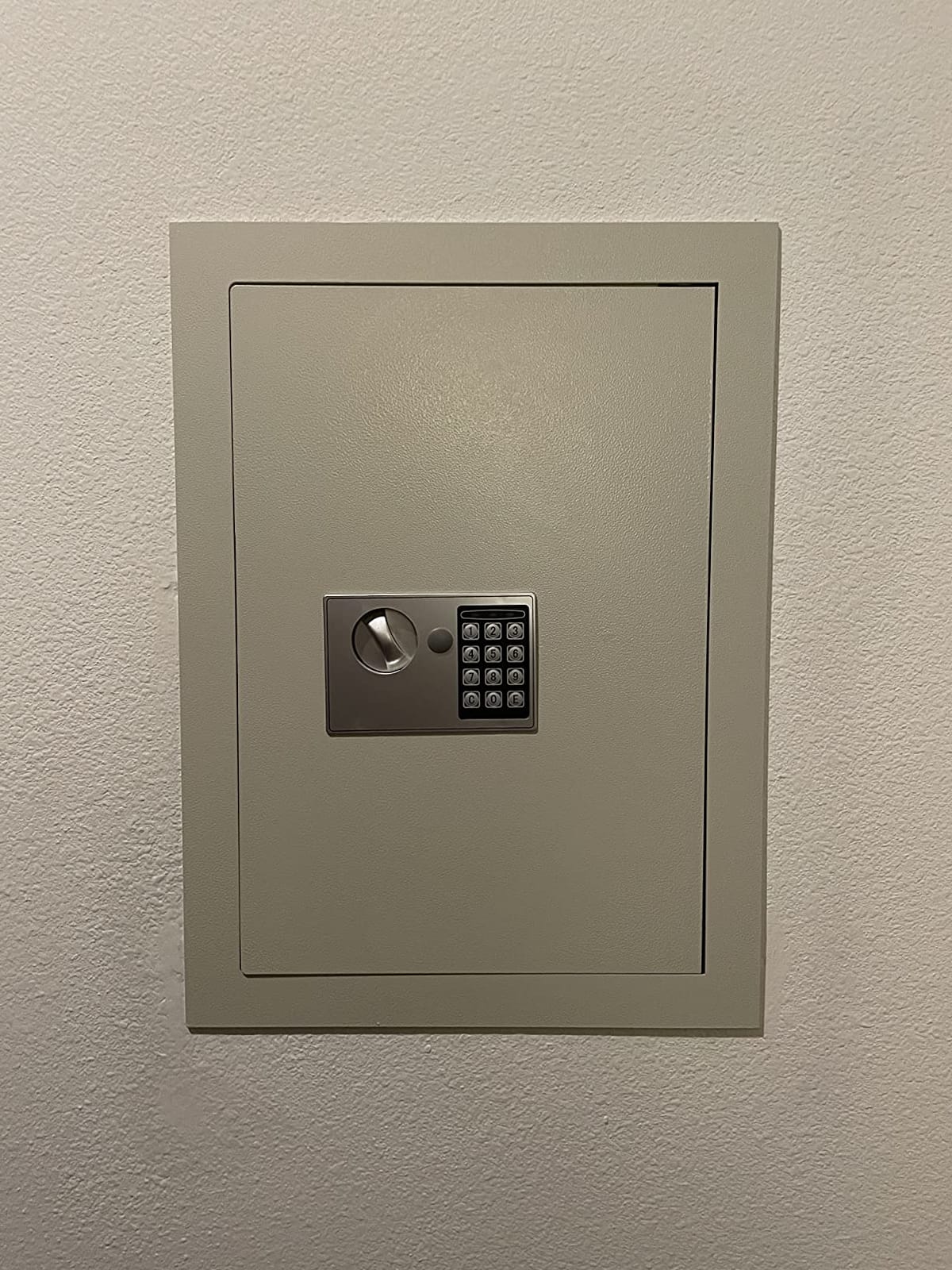
With 4723 reviews and a 4.4 star average, the Paragon is the one in this list where I could read years of long-term ownership reports, not just a launch-week spike. Owners consistently describe the same thing: a genuinely heavy body that feels closer to the safes costing several times more, and a flush face that lets a canvas go straight over it.
The fit is the reason it works in so many homes. At 16.25 inches wide it slides between standard 16-inch on-center studs with roughly a quarter inch of clearance on each side, and the included anchor bolts get it secured. Some buyers in non-standard walls had to trim a stud, which is worth knowing before you start cutting drywall.
The keypad takes two separate codes of 3 to 8 digits, so you can give a partner or adult child their own entry without handing over master access. Two manual override keys ship in the box, and roughly 4 to 5 months of battery life comes out of four AA cells at one opening per day.
Its anti-theft system is more considered than most at this level. Three wrong entries trigger a 20-second alarm, and three more after that stretch the alert to five full minutes. That is not burglary resistance, but it does shut down the casual keypad guessing that opportunistic thieves actually try.
What the Paragon does better for jewelry than the alternatives
At 0.83 cubic feet with a 16.25-inch chamber depth, this is one of only a few bodies here deep enough to take a necklace without forcing it to fold. That depth matters more than raw volume, because a shallow wide box holds rings and coins well and turns a pendant chain into a knot.
The removable shelves are the other quiet win. Owners pull them out to lay flat a bracelet or a strand of beads instead of draping it over a lip, and the wide flat middle shelf is where a ring roll or a padded earring tray actually fits.
Two independent codes also solve a problem most owners never think about. If both of you need access daily, one shared code means every keypad press announces your habits to anyone listening, and the beeping is the most common complaint across a thousand reviews.
Where the Paragon falls short
The central locking mechanism is the honest weak point, and it comes up repeatedly. It sits right where you would put a jewelry tray, which means the usable middle shelf is meaningfully smaller than the exterior dimensions suggest.
Keypad beeps cannot be disabled on this model, so each digit press is audible in a quiet room. Owners also routinely replace the included anchors, because the supplied hardware is closer to drywall fasteners than proper lag bolts, and a minority report a keypad that stopped responding after extended use.
2. Homak First Watch Steel Wall Safe – Top Rated
Homak First Watch Between The Studs High Security Steel Wall Safe, White
480 cubic inches
Chamber depth 3 inches
4 lbs steel
Four-point tubular lock
Pros
- Highest star rating in this group at 4.6
- Spot-welded secondary inner door behind the face door
- Black foam lining stops scratches
- Installs in about ten minutes
- Sits flush and hides behind art or a mirror
Cons
- No rim or lip around the opening so a pry bar can get leverage
- Door steel is thinner than buyers expect
- Tubular keys only with no electronic entry
- No shelf or hooks included
This is the highest-rated safe in the group at 4.6 stars across 657 reviews, and the reason is that owners have calibrated their expectations correctly. Buyers describe it as a concealment device that stops curious relatives and opportunistic thieves, not a bank vault, and the reviews reflect that clarity rather than disappointment.
At 480 cubic inches with a 3-inch chamber depth, it is a short box, which is perfect for a watch, a couple of rings, small earrings and a folded chain. It weighs 4 pounds, so one person can install it without an extra pair of hands, and it fits between 16-inch studs on a stud-width profile.
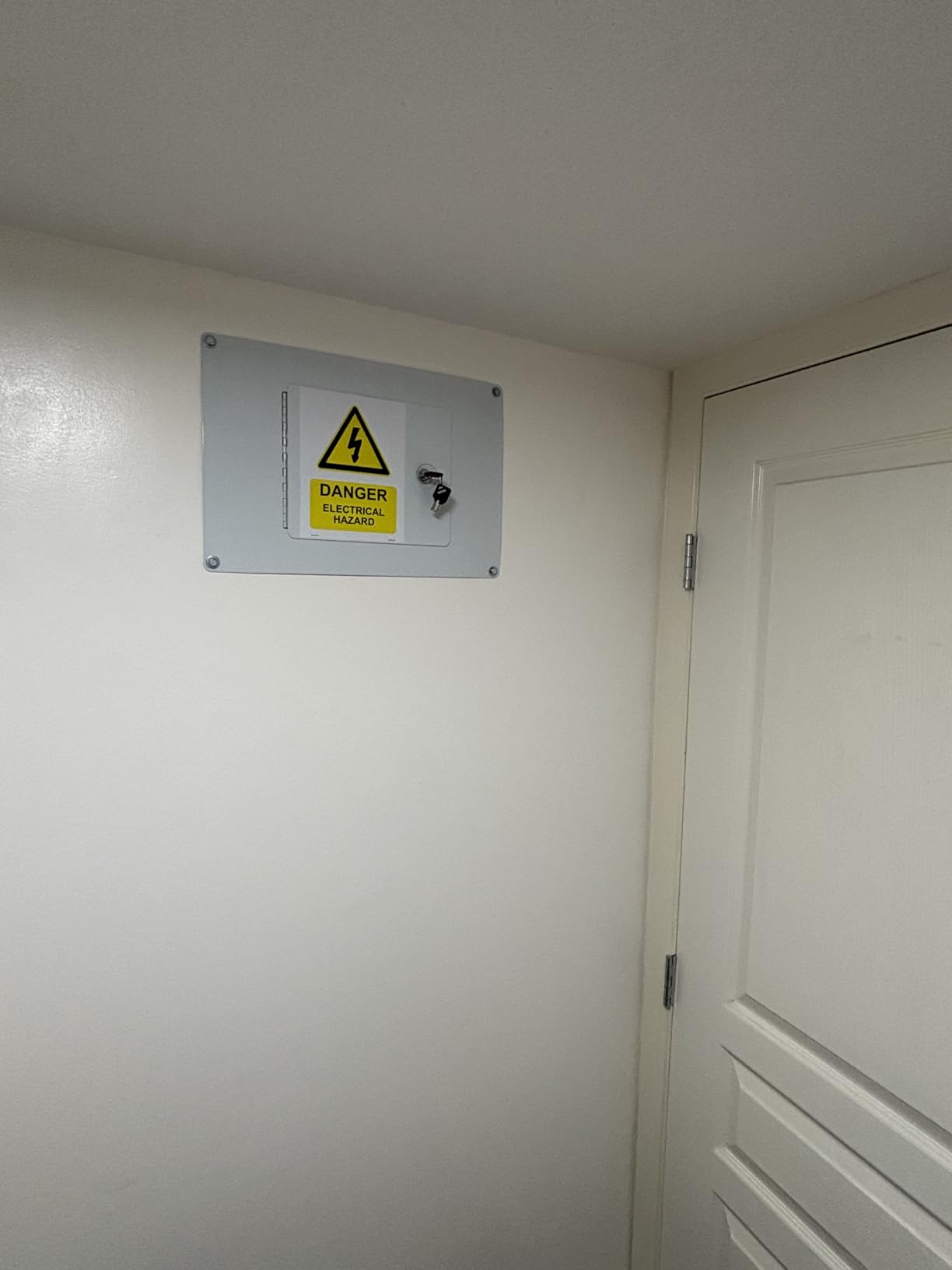
The security design is simple and effective for its purpose. A four-point tubular locking mechanism secures the face door, and behind that sits a spot-welded secondary inner door, so pulling the front panel off does not immediately expose contents. Two tubular keys are included.
A black foam lining runs across the interior, which matters for jewelry in a way most people underestimate. Bare steel on bare steel will scratch a polished band or leave marks on a gold chain, and this is one of the few budget options that addresses it at all.
When the Homak is the right choice
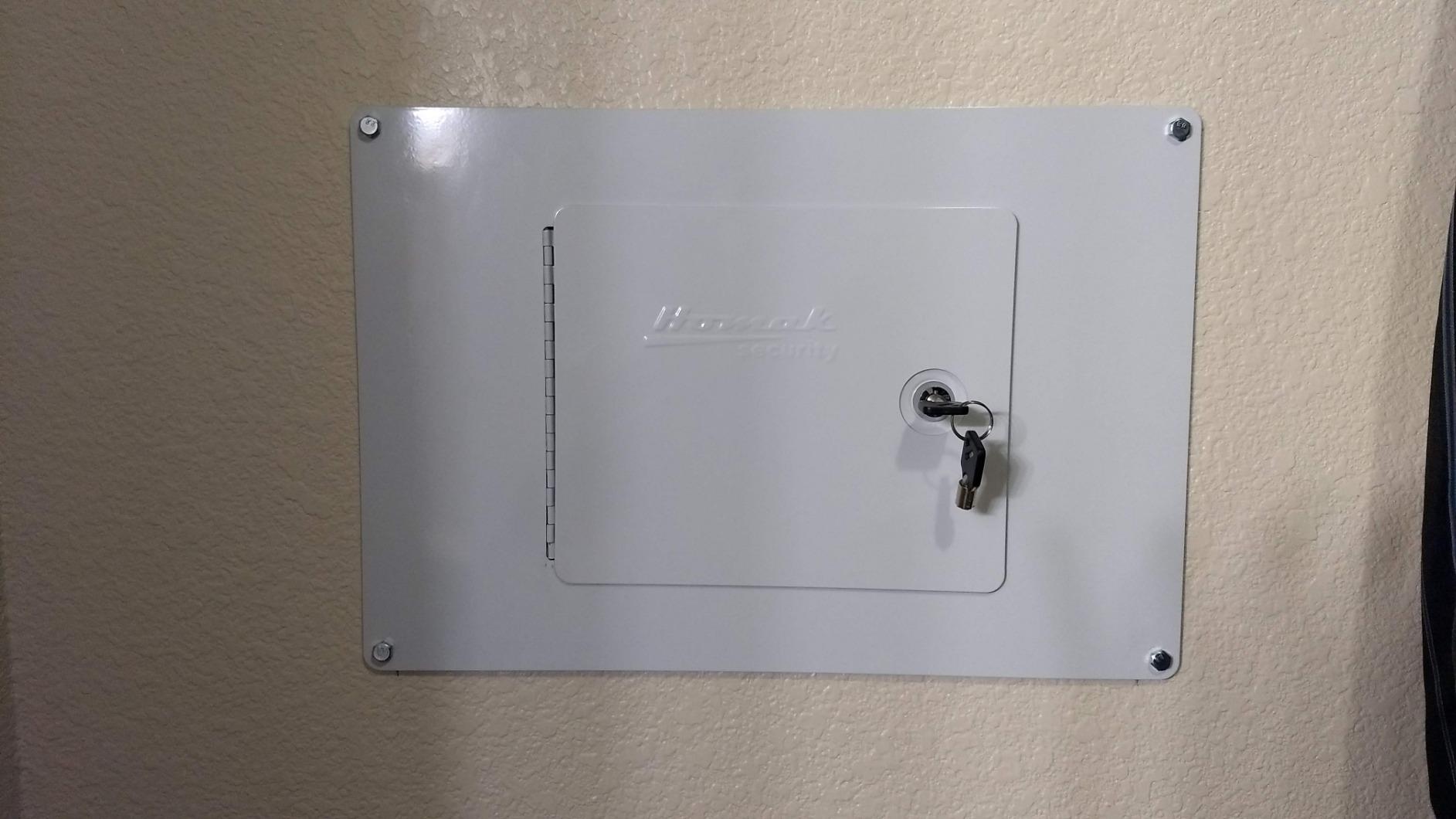
If your collection is a watch, a small stack of rings, and a couple of pieces you wear weekly, this box is sized correctly. It installs in about ten minutes and sits flush enough that a mirror or a framed canvas goes over it without a visible seam.
Watch owners get the most out of it, since the proportions suit a wristwatch laid flat and the foam keeps the case from contacting steel. It also works as a secondary box for pieces you wear daily, keeping them retrievable without cutting into the wall for something larger.
The lock is mechanical, so there are no batteries to die at the worst moment and no codes to forget. For a safe you open once a week, that reliability is worth more than a keypad.
Where the Homak falls short
The missing rim around the door opening is the flaw reviewers cite most. Without a lip, ridge or rebate for a pry bar to catch on, the door can be bent outward, and reviewers with hands-on experience are clear that a determined attack would succeed.
Door steel is thinner and softer than buyers expect at this price, and no shelf or hooks are included, so several owners added their own. The 3-inch depth also rules out anything bulky, so a jewelry case or a large handbag-shaped box will not go in.
3. Viking Security VS-52BLX Biometric Safe – Best Biometric
Viking Security Safe VS-52BLX Hidden Wall Biometric Safe
970 cubic inches
Fingerprint, PIN and key entry
39 lbs steel
Three shelves and LED
Pros
- Fingerprint reader stays fast on worn or older prints
- Three independent access methods including two cross keys
- 39 lb body feels far heavier than cheaper safes
- Carpeted interior with built-in LED light
- Fingerprint memory survives battery removal
Cons
- Large internal lock box reduces middle section space
- Shelf retaining tabs bend easily
- Default PIN must be changed on arrival
- Requires 16 inch on-center studs
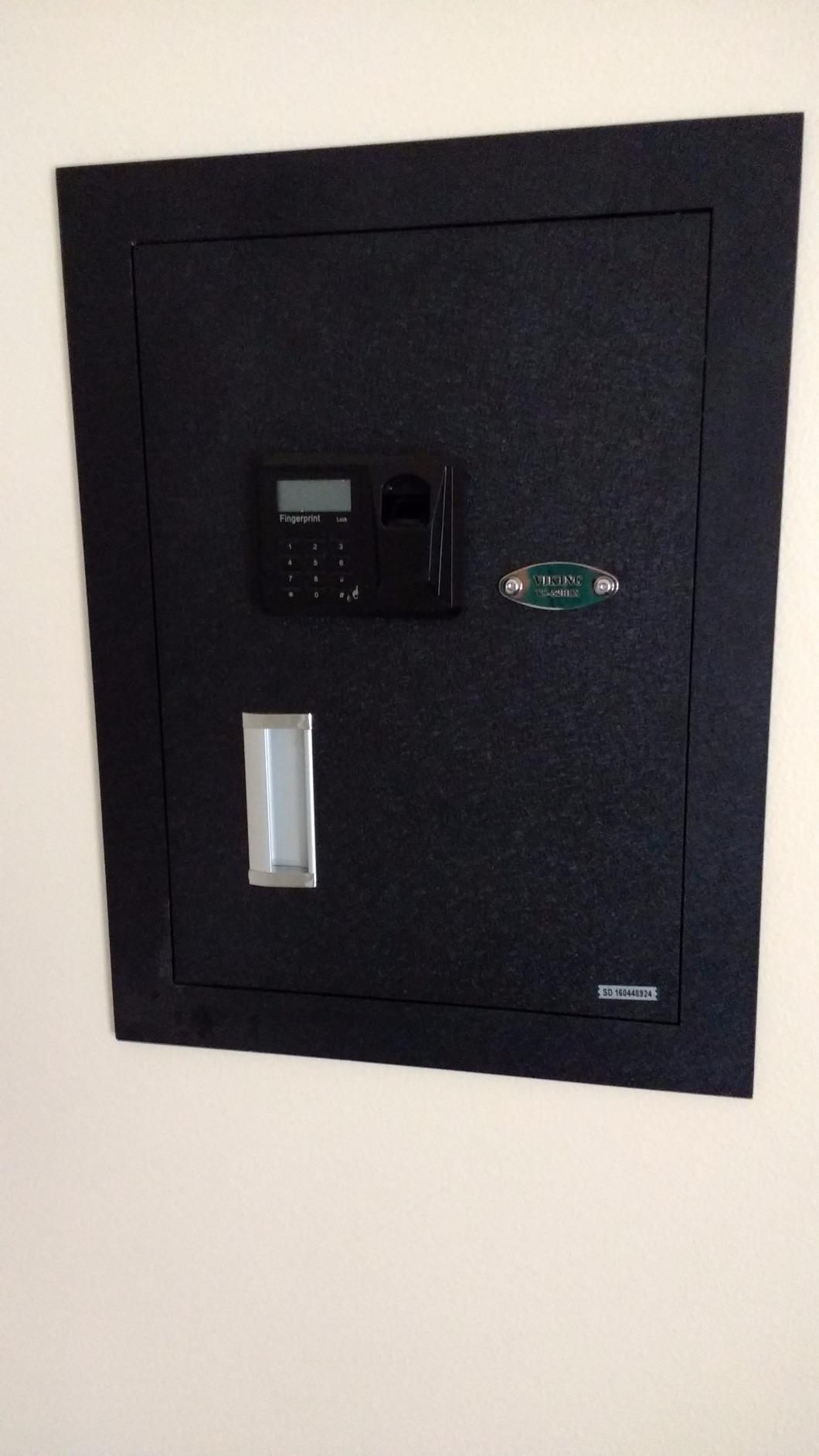
This is the biometric answer in the group, and the long-term reports are unusually reassuring for a fingerprint lock. Owners describe scanners that have run four to seven years without needing a battery change, which is the opposite of what most cheap fingerprint safes do.
Entry is genuinely three ways. You get a 500 DPI optical fingerprint sensor that stores up to 32 prints plus one PIN code, and two backup cross keys in the box. Critically, fingerprint memory is retained after the batteries come out, so a dead battery does not mean reprogramming everyone’s hand.
At 39 pounds, this body is the joint-heaviest in the group alongside the Paragon, and reviewers single it out for how it resists prying compared with lighter boxes. The lock is a motorized 20mm deadbolt working against a 5mm door, which is a meaningful step up from a latch.
The interior is the best in this roundup for organized jewelry. Three fully adjustable shelves, key hooks, a carpeted lining and a built-in LED light means you can actually see what is in the back rather than feeling around for it.
Why collectors pick this one
With 970 cubic inches and an 18.5-inch chamber height, this is the most volume you get from a standard between-studs footprint without going to a full-height cabinet. That makes it the pick for a collection of watches, chunky bangles and a few necklaces stored at once.
The LED matters more than the spec sheet suggests. Locating a single earring back at the bottom of a dark steel box is the reason many owners used to store their good pieces in a drawer instead, and a light removes that friction.
Fingerprint access changes the security calculus for daily pieces. With 32 print slots, several family members can each use their own finger, and you avoid announcing a code with beeps every time you open it.
Where the Viking falls short
The internal lock box is oversized and eats the middle section, the same complaint that shows up on nearly every between-studs model. Shelves are packed loosely in thin foam and the retaining tabs bend easily if you slide full trays in and out repeatedly.
Owners should change the factory PIN immediately, and one unit shipped unable to lock until repaired. You also need 16-inch on-center studs, a 24-inch wall needs added framing, and battery access for the LED panel means unscrewing a cover plate.
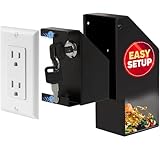
4. Elder Welder Outlet Hidden Wall Safe – Best for Stealth
Elder Welder® Electrical Outlet Hidden Wall Safe, 100% Real Plate Included
30 cubic inches
Welded all-metal box
Real 1-gang wall plate
1.4 lbs
Pros
- Reads as an ordinary electrical outlet once the plate is on
- Welded box keeps contents locked even if pulled from the wall
- Installs in about thirty minutes
- Key lock blocks faceplate removal
- Light enough for a solo install
Cons
- Only about 30 cubic inches of room
- Drywall-only screws give a weak mount
- Magnetic faceplate can be pulled by a curious hand
- Requires a permanent cut in the wall
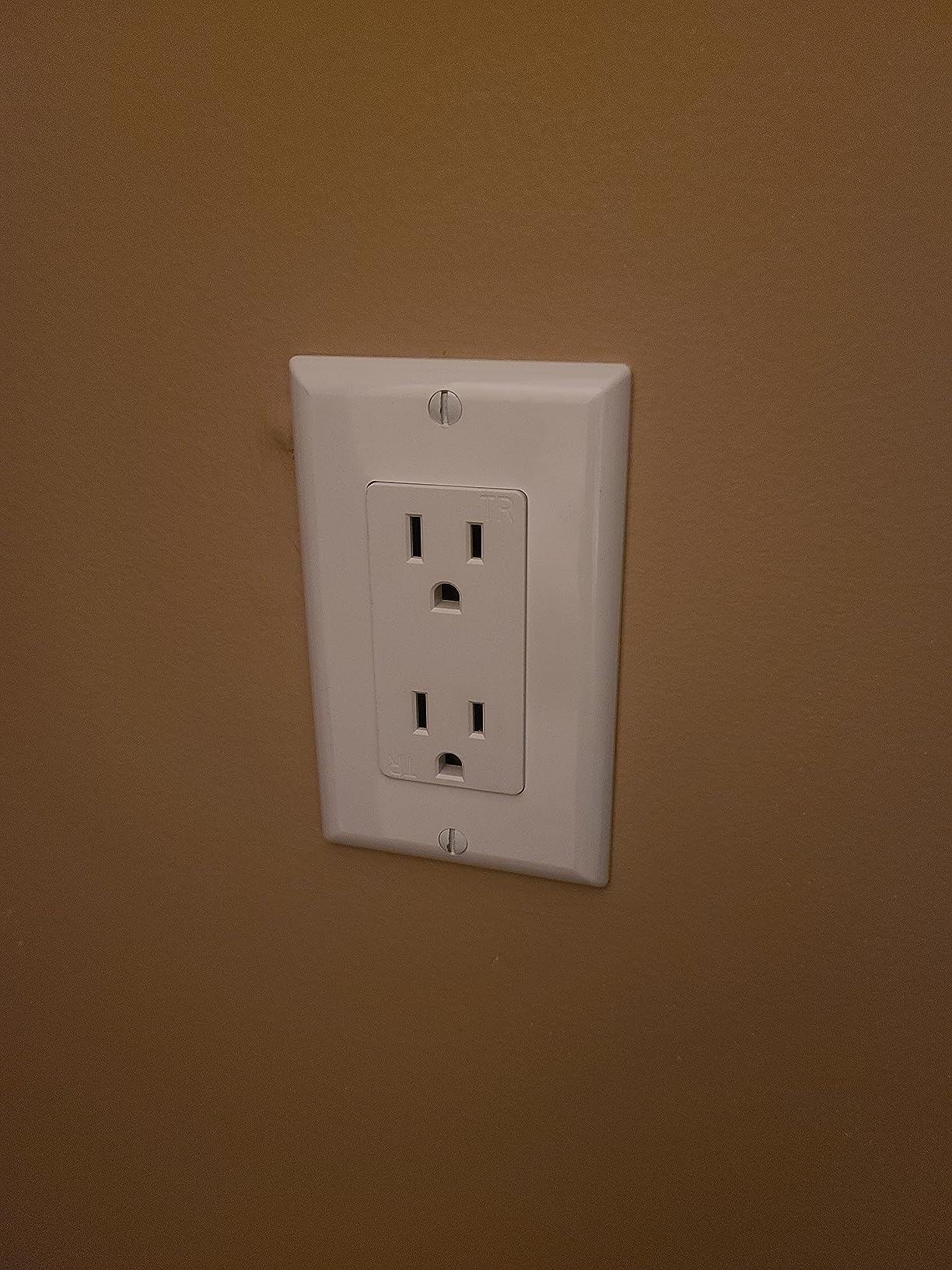
This is the most concealed option here, and the trick is not the safe. It is the 100% real wall plate: once the standard 1-gang faceplate goes on, the unit is indistinguishable from the outlets already in the room, which is a different kind of protection than a steel box hidden behind art.
At 1.4 pounds, it is the easiest in-wall safe in this roundup to install. A mounting template, drywall and stud screws, and both written and video guides come in the box, and owners report about thirty minutes from start to finished plate.
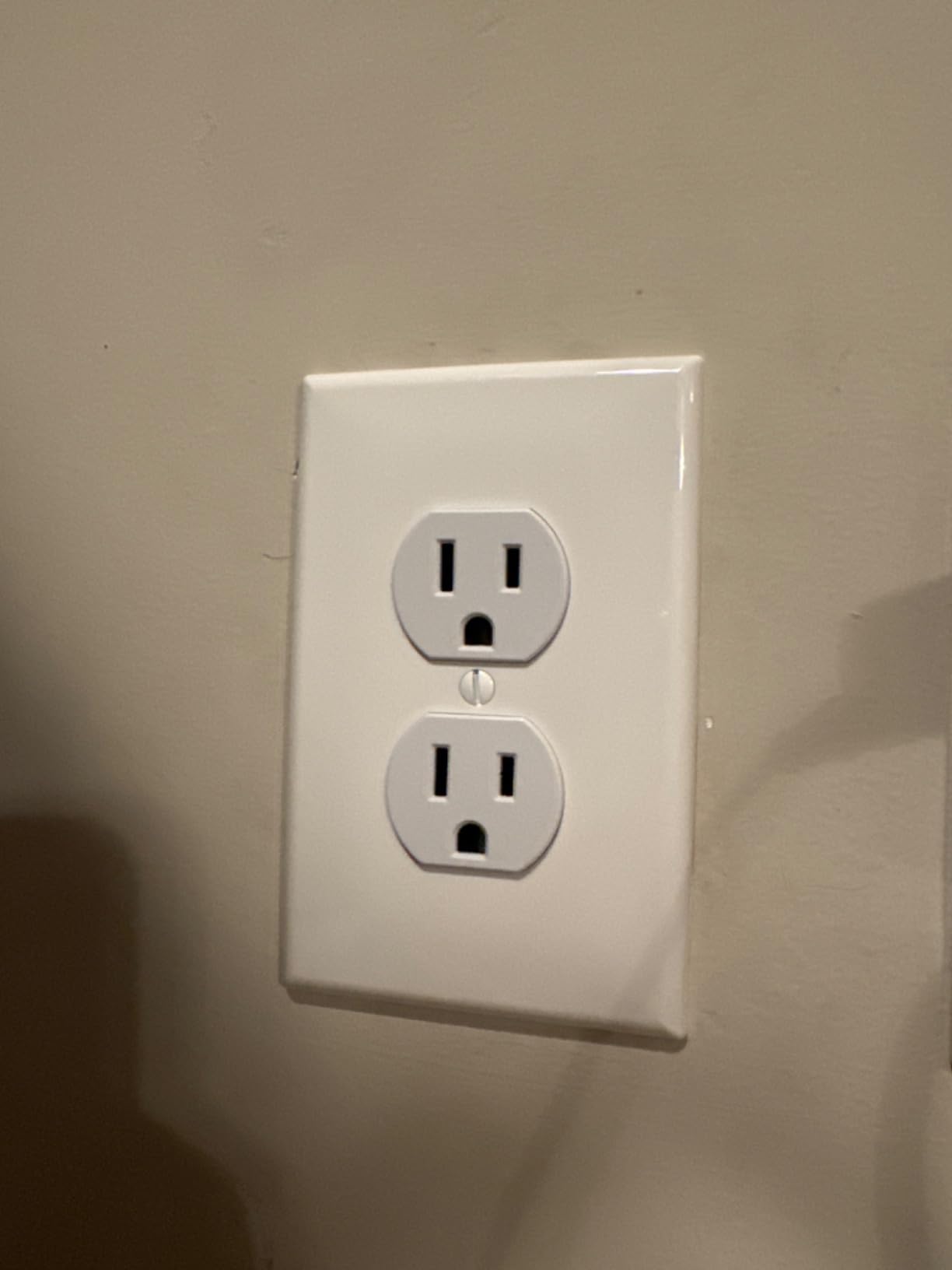
The build is better than the category average in one important way. It is a welded all-metal container rather than a folded sheet or a book-style hollow, and owners point out that even when someone pulls the box out of the wall, the contents stay locked inside.
Concealment works in layers here. The key lock keeps anyone without the key from removing the receptacle plate, owners pair it with a dead nightlight plugged in front, and the packaging is deliberately plain for anyone who handles the box before installing it.
Where this hidden safe genuinely earns its place
It is the right tool for the small valuables that people usually forget about. Spare keys, a second house key set, a small coin roll, a couple of rings in a roll, an SD card or a backup drive all fit in 30 cubic inches, and those are exactly the items people forget to secure anywhere else.
Because it does not read as a safe, it also works as a second layer under a larger wall safe. Keeping your everyday spare set in the outlet box and your heirlooms in a steel cabinet means an intruder who finds one still has not found the other.
Owners in apartments appreciate it too, since a single outlet-sized cut is far less disruptive than fitting a large cabinet into a finished wall.
Where the Elder Welder falls short
Capacity is the dominant complaint. At 30 cubic inches it holds a couple of rings or some coins at most, and reviewers repeatedly advise the 2-gang version for anything bigger. It is a drop box, not a collection safe.
The included drywall screws give a weak mount, and stud mounting is more secure but harder. The magnetic faceplate can also be pulled off by anyone curious enough to try, which is why owners hide the key separately. Some units arrived with damaged or missing keys.
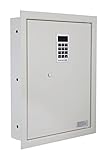
5. Protex PWS-1814E Electronic Wall Safe – Best Bolted Build
Protex Safe Electronic Keypad Wall Safe (PWS-1814E), Burglary Resistant wall safe, digital electronic locking system, velvet interior, automatic door opening, 2 Removable shelves
0.44 cubic feet
Dual 3/4 inch live bolts
Velvet interior
Requires 3.75 inch cavity
Pros
- Heaviest gauge steel in this group with dual live motorized bolts
- Door springs open after code entry with interior LED
- Four layers of fail-safe including external battery pack
- Virtually flush at a quarter to half inch proud
- Velvet lining protects jewelry and documents
Cons
- Keypad beeping is loud and only fixed by desoldering
- Only one user code plus the master code
- Shelves are flimsy
- Fixed door hinges on one side only
Where the budget models use a latch, the Protex runs two live motorized chrome bolts measuring 3/4 inch in diameter. Reviewers call it the most solidly built of the between-studs safes, and the bolt feel is the difference you notice the first time you close the door.
The convenience design is thoughtful. Enter the code and the bolts retract, then the motorized system springs the door open a couple of inches with an interior LED already lit, so you are not fumbling in the dark with one hand on a bracelet.
Fail-safe layering is where this model separates itself. You get a user code, a reprogrammable master code, a recessed cruciform key override, and a secondary exterior battery compartment for emergency power, which is four independent ways in or out of trouble.
At 28 pounds and 0.44 cubic feet it sits flush, protruding only a quarter to half inch from the wall surface, so it disappears behind art more completely than most keypad models.
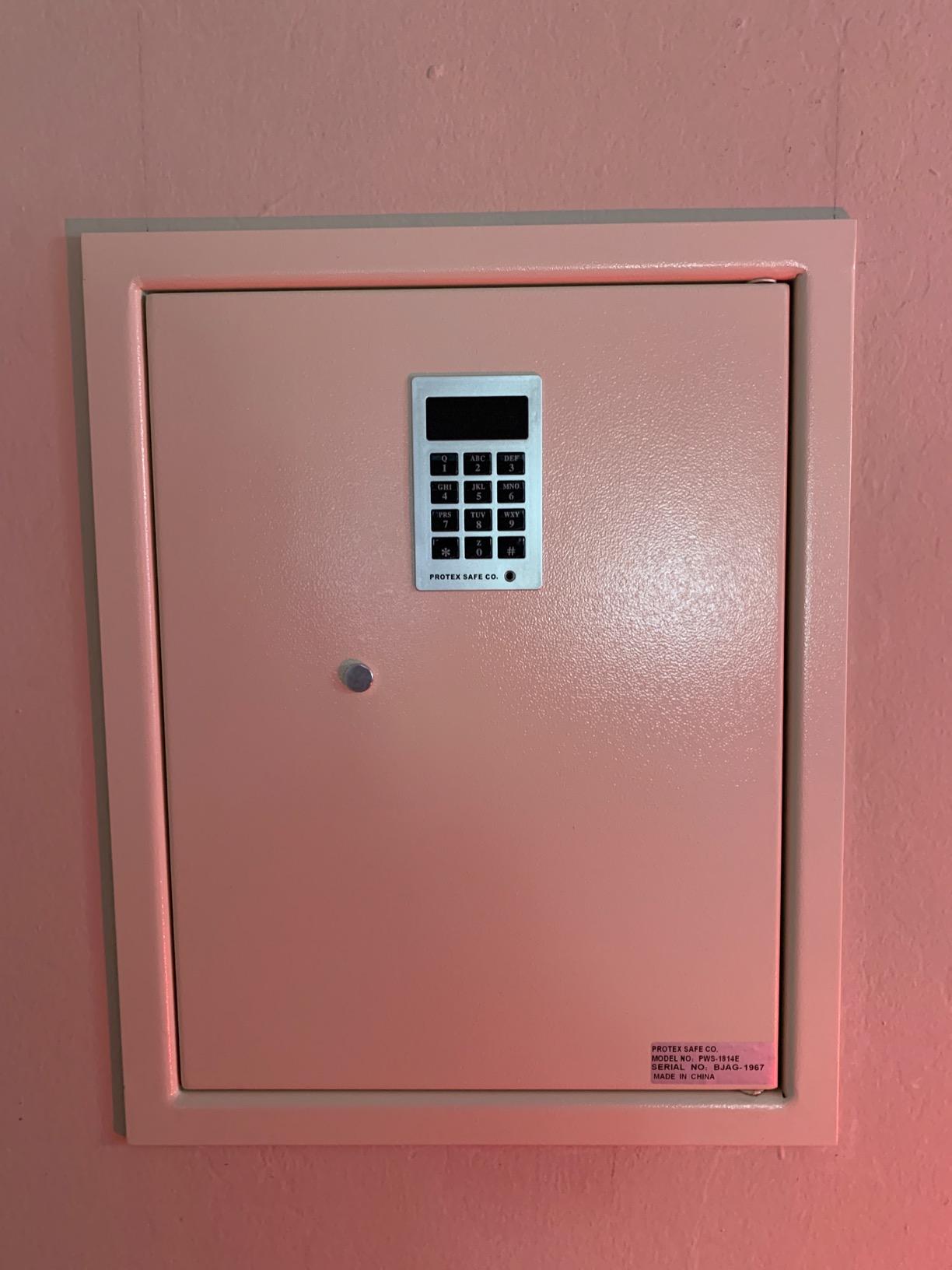
What jewelry owners like about the Protex
The velvet-lined interior is the detail collectors mention most. Velvet will not scratch a polished band or leave a mark on a chain the way bare galvanized steel can, and two removable shelves give you a place for a ring box and a flat tray.
The keypad uses individual buttons rather than a rubber membrane, and the display can be blanked. That matters in a bedroom safe where a glowing screen across the room is its own tell.
If you want documents and jewelry in the same box, the Protex handles both. Passports, deeds and a few valuable pieces fit in 0.44 cubic feet, and the external battery port means a house full of dead batteries is not a lockout event.
Where the Protex falls short
The keypad beep is loud and cannot be switched off in settings. Owners who solved it did so by desoldering the speaker, which is not a modification most people want to attempt on a safe they then rely on.
Only one user code plus the master code is supported, which limits shared access. The written instructions are poorly written, the shelves are flimsy, and the door hinges are fixed to one side and cannot be swapped, so a tight stud bay can make the install awkward.
6. Nebakne 25.6-Inch Tall Wall Safe – Best Hidden Compartment
25.6″ Tall Fireproof Wall Safe Between Studs 16″ Centers | Hidden Wall Safe
25.6 inch tall
4 cm thick steel door
Hidden lower compartment
Two 2.2 cm solid bolts
Pros
- Tall body gives far more vertical room than typical models
- Hidden lower secret compartment adds a second cache
- 4 cm thick steel door and all-metal panel
- Electronic code plus two emergency keys
- Removable shelf reconfigures for long items
Cons
- Only about 3.93 inches deep so bulky boxes will not fit
- Fireproof wording carries no stated rating or duration
- Default code must be changed so children cannot cycle it
- Instructions limited to a user manual
Height is the reason this one is on the list. At 25.6 inches tall it stands well above the 18-to-22-inch cabinets most people buy, and owners reviewing it against shorter between-studs models point to the vertical room as the deciding factor.
The concealed lower compartment is the second hook. It is a hidden cache behind the main cavity for cash and small pieces, so the obvious inventory of the safe does not tell anyone there is more inside.
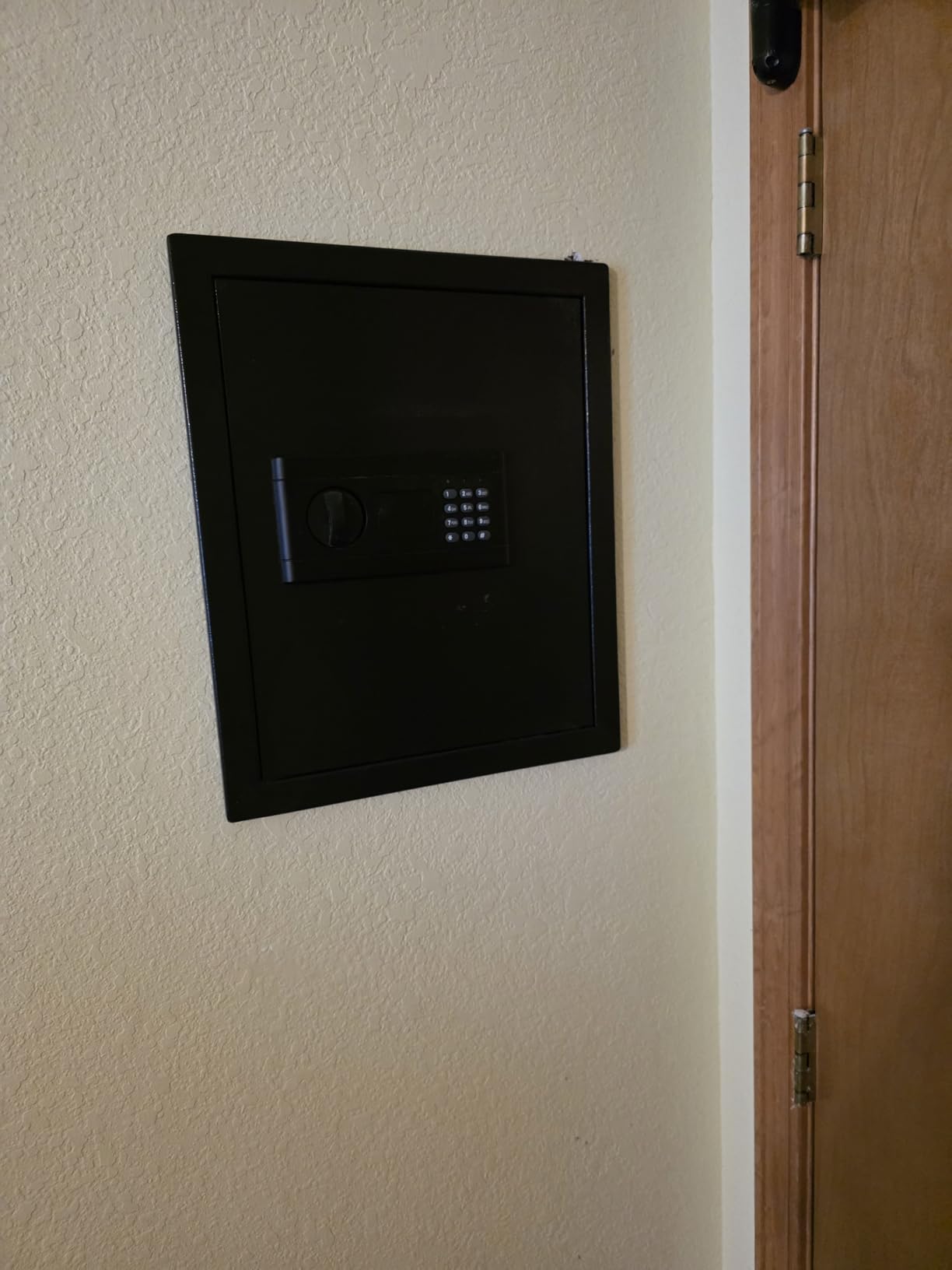
Construction is heavier than the price suggests. The door is listed at 4 cm thick with two 2.2 cm solid steel bolts, and reviewers prefer the all-metal integrated door panel over the semi-plastic door designs that dominate this price bracket.
Entry is electronic with 3-to-8 digit user and master codes, plus two emergency keys and a manual knob, so there are three routes in. At 28.7 pounds the body stays where you put it once the mounting screws are in.
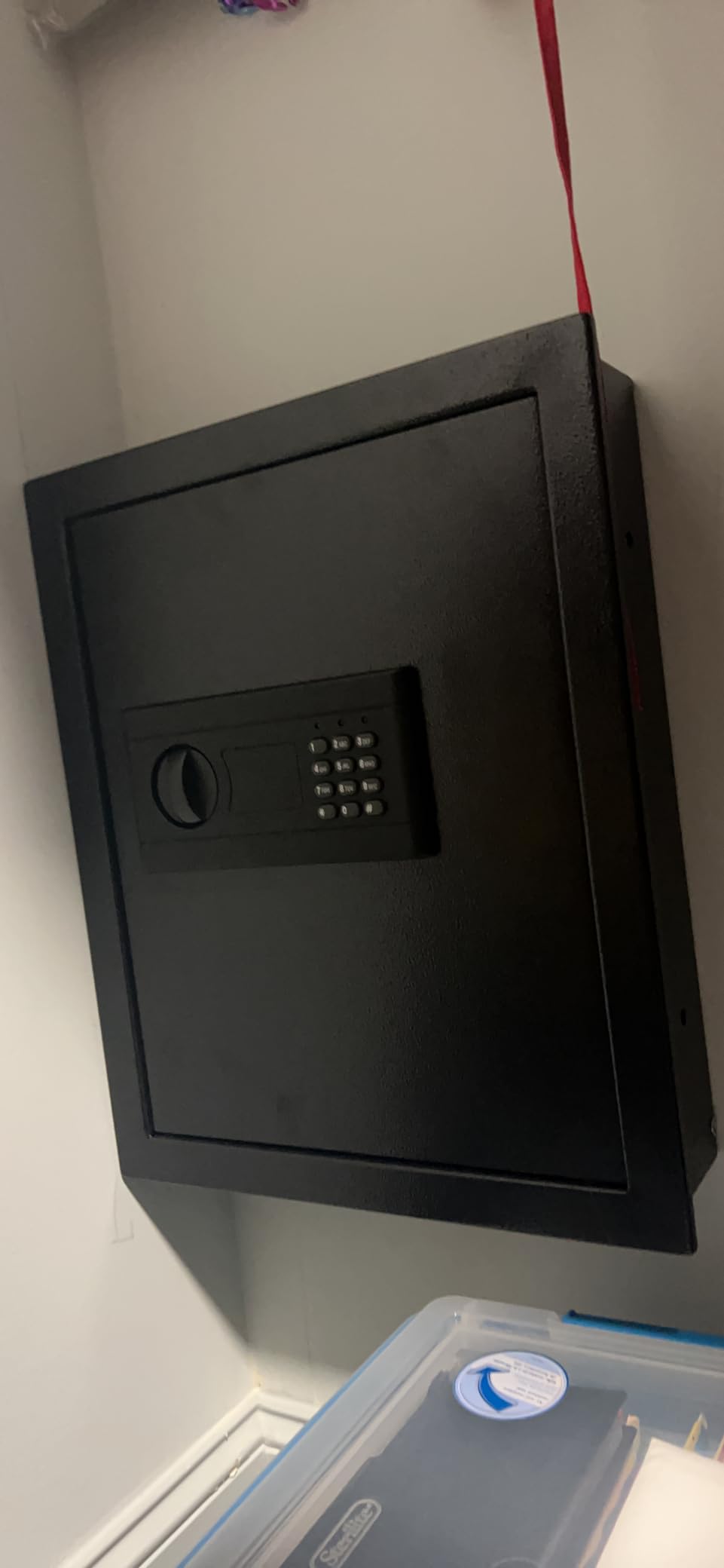
Who this tall cabinet suits
If your jewelry hangs rather than stacks, height is the dimension that matters. Longer pendants, chain sets and bead strands need vertical clearance more than they need width, and this is one of the few cabinets here that offers it in a standard stud bay.
The hidden compartment works well for pieces you do not want visible even when the safe is open. A small bag of coins or one specific ring can live back there, separate from everything else.
Flush mounting means a framed canvas or a mirror goes straight over it, and with six height and color variants offered you can match the wall rather than leaving a white rectangle in a painted room.
Where the Nebakne falls short
Depth is the limitation. At about 3.93 inches, a bulky jewelry case or a watch box will not go in, and owners who underestimated volume are the ones who end up disappointed.
The listing calls it fireproof without stating a rating duration or certification level, so treat that claim as marketing rather than a tested number. The default code should be reprogrammed immediately, since children can cycle through a default before you change it, and installation help is limited to the user manual.
7. GUVELI 33.46-Inch Wall Safe – Best Tall Cavity
White 33.46″ Tall Sturdy Wall Safes Between the Studs 16″ Centers
33.46 inch tall
36 lbs steel
Two motorized deadbolts
Three shelves and key hooks
Pros
- Tallest cabinet in this group with real vertical room
- 36 lb body with two motorized deadbolts
- Fleece lining prevents scratches
- Three removable shelves plus key hooks
- Emergency keys as battery fallback
Cons
- Lowest rating in the set at 4.2 stars
- Only about 3.93 inches deep
- Fireproof wording in the listing has no stated rating
- First opening requires the emergency key
- Marked not suitable for firearms
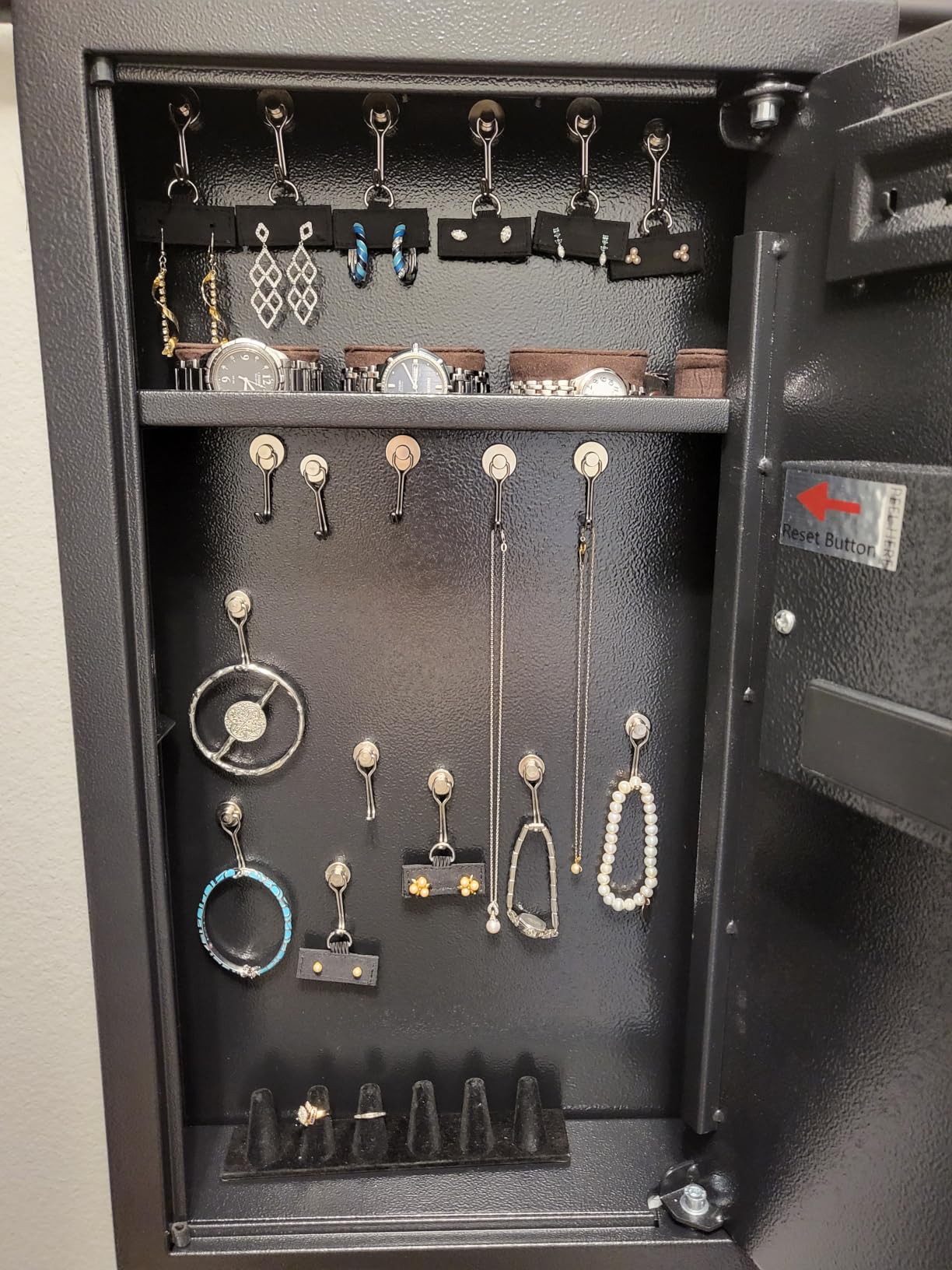
This is the tallest cabinet we compared at 33.46 inches, and if your wall has the vertical clearance it is simply the most usable volume you can get between 16-inch studs. Three removable shelves and key hooks mean it can be reconfigured for anything from a rolled bracelet to a folded wrap.
At 36 pounds with two motorized deadbolt locks, the security claim is more physical than most at this bracket. Powder-coated scratch-resistant finish helps the exterior stay presentable in a closet or garage wall.
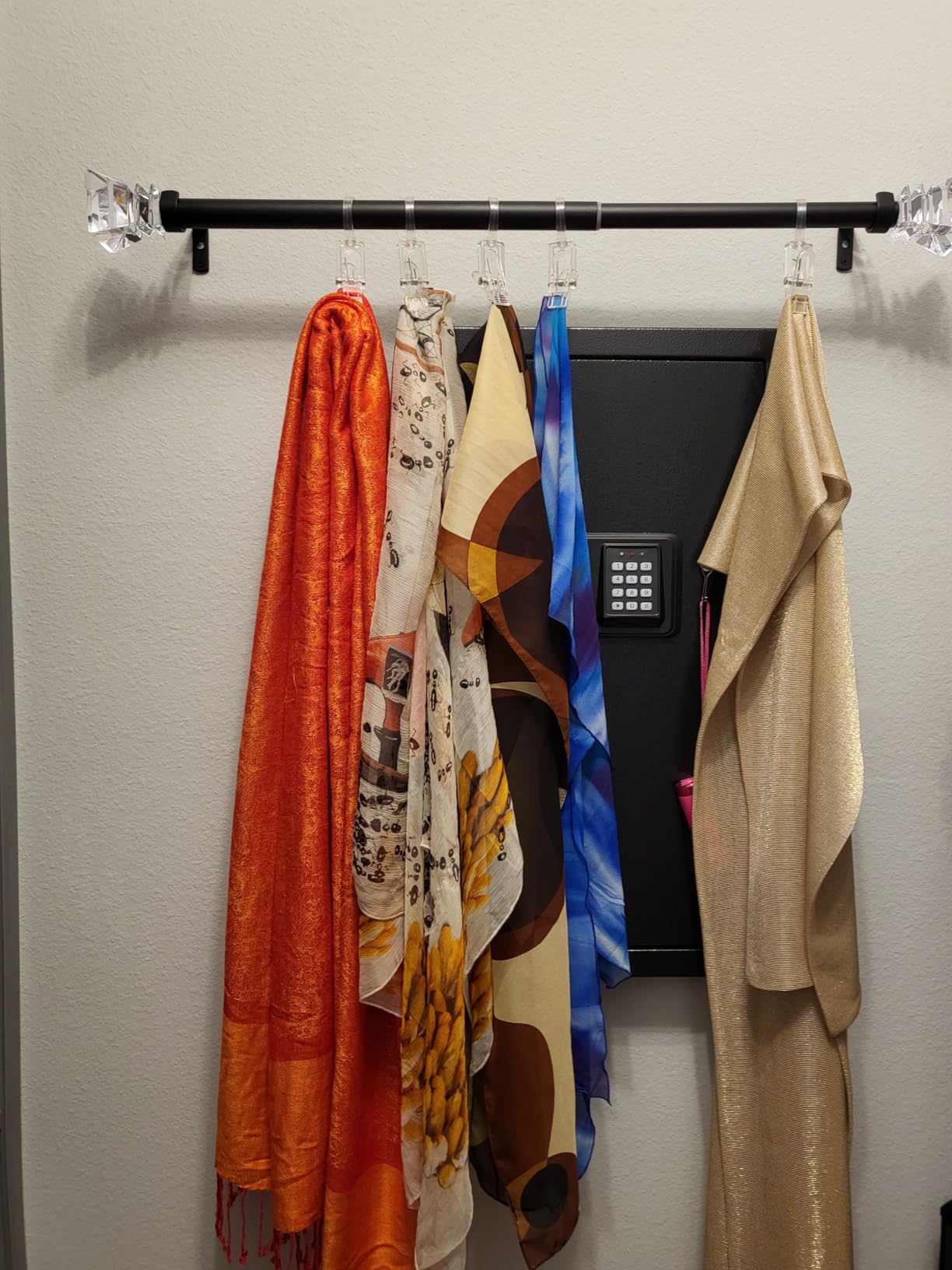
The fleece-lined interior is a genuinely thoughtful touch for jewelry. It is a softer liner than the bare carpet used elsewhere in this roundup, and it does the work of stopping pieces from contacting steel.
Access is an electronic combination lock with a turning knob and emergency keys as the fallback. Owners like having the physical keys in hand for the first open rather than relying on a code out of the box.
When the extra height pays off
A 33-inch cavity fits a full jewelry cabinet layout in miniature. Ring rolls stand upright on a shelf, a necklace hangs without folding, and there is enough clearance that you are not rearranging the contents every time you open it.
It suits walk-in closets and primary suites where vertical wall space is plentiful but floor space is not. Nothing you own is visible, nothing stands on a shelf, and the door still sits flush behind art.
Owners with mixed storage use it for documents alongside jewelry, which addresses the common request for a fireproof-style box that also holds papers.
Where the GUVELI falls short
It carries the lowest rating in this group at 4.2 stars, and the split explains why. One-star reviews make up 8% here against 3-to-6% for most of the others, with durability the recurring theme.
Depth is still about 3.93 inches, so bulky cases do not fit despite the height. The fireproof wording in the listing has no stated rating behind it, the first opening requires the emergency key beneath the badge, and the unit is explicitly marked not suitable for firearms storage.
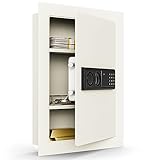
8. Giantex Electronic Wall Safe – Best Value
Giantex Electronic Wall Hidden Safe Security Box, Built-In Wall Electronic Flat Security Safety Cabinet (White)
0.83 cubic feet
Keypad plus override key
31.6 lbs steel
Lockout after 3 wrong codes
Pros
- Steel gauge and build match safes several times the price
- Keypad plus override key gives two ways in
- Lockout after three wrong codes adds real protection
- Fits 16 inch studs and hides behind art or a door
- Owners report long-term reliability over years
Cons
- Keypad membrane feels cheap and rubbery
- Door lock mechanism cuts into the middle of the interior
- Battery compartment is inside the safe
- Not fire rated
The Giantex is the value pick, and the argument for it is weight. At 31.6 pounds with 0.83 cubic feet of storage, reviewers repeatedly say the build matches safes in a higher price band, and several describe it as functionally identical to units costing two or three times more.
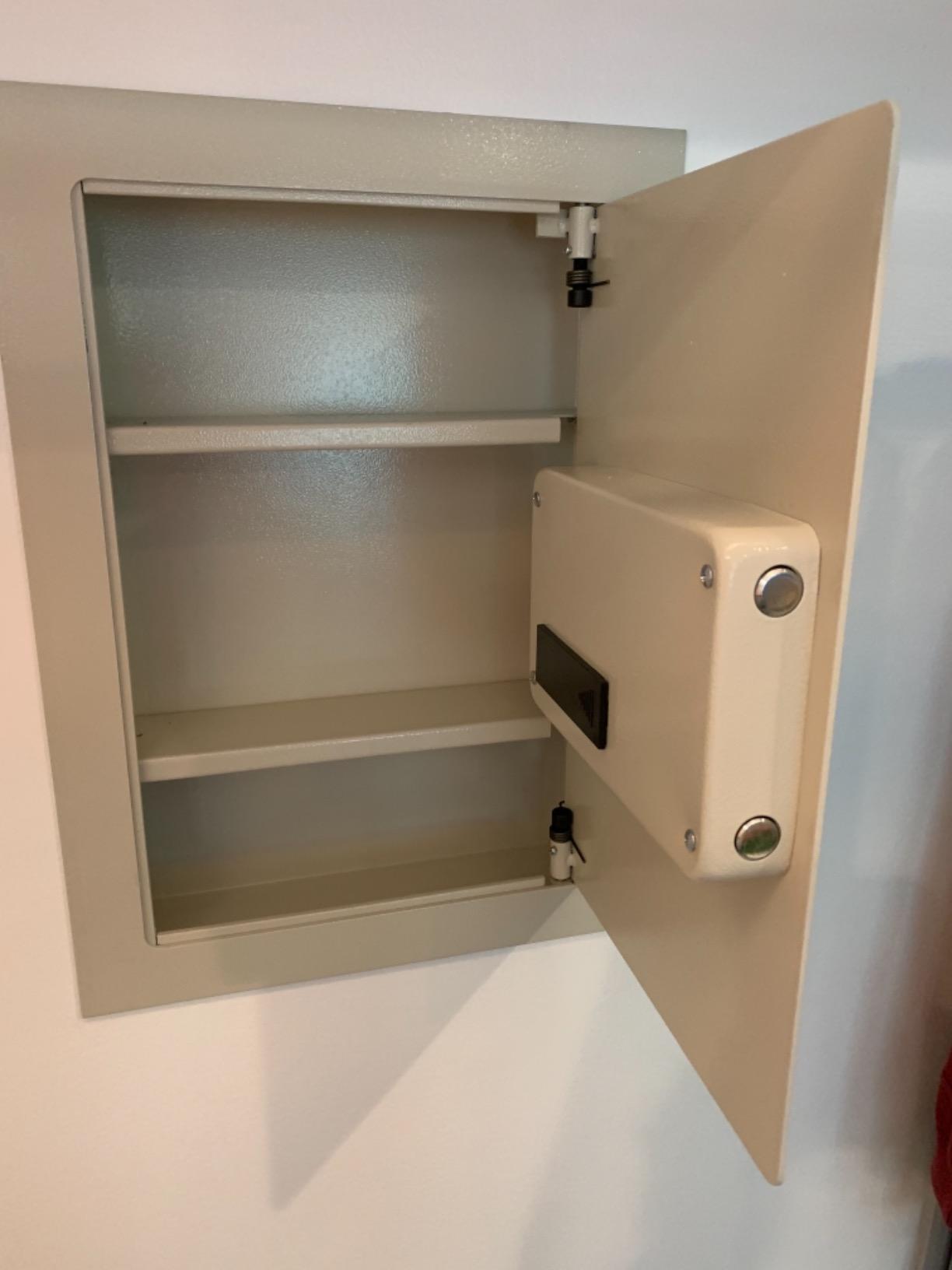
It shares the exact exterior footprint of our top pick at 16 inches wide by 22 inches tall and 4 inches deep, which means it drops into the same stud bay and hides behind the same piece of art. That makes it the easy swap if the keypad price is the deciding factor.
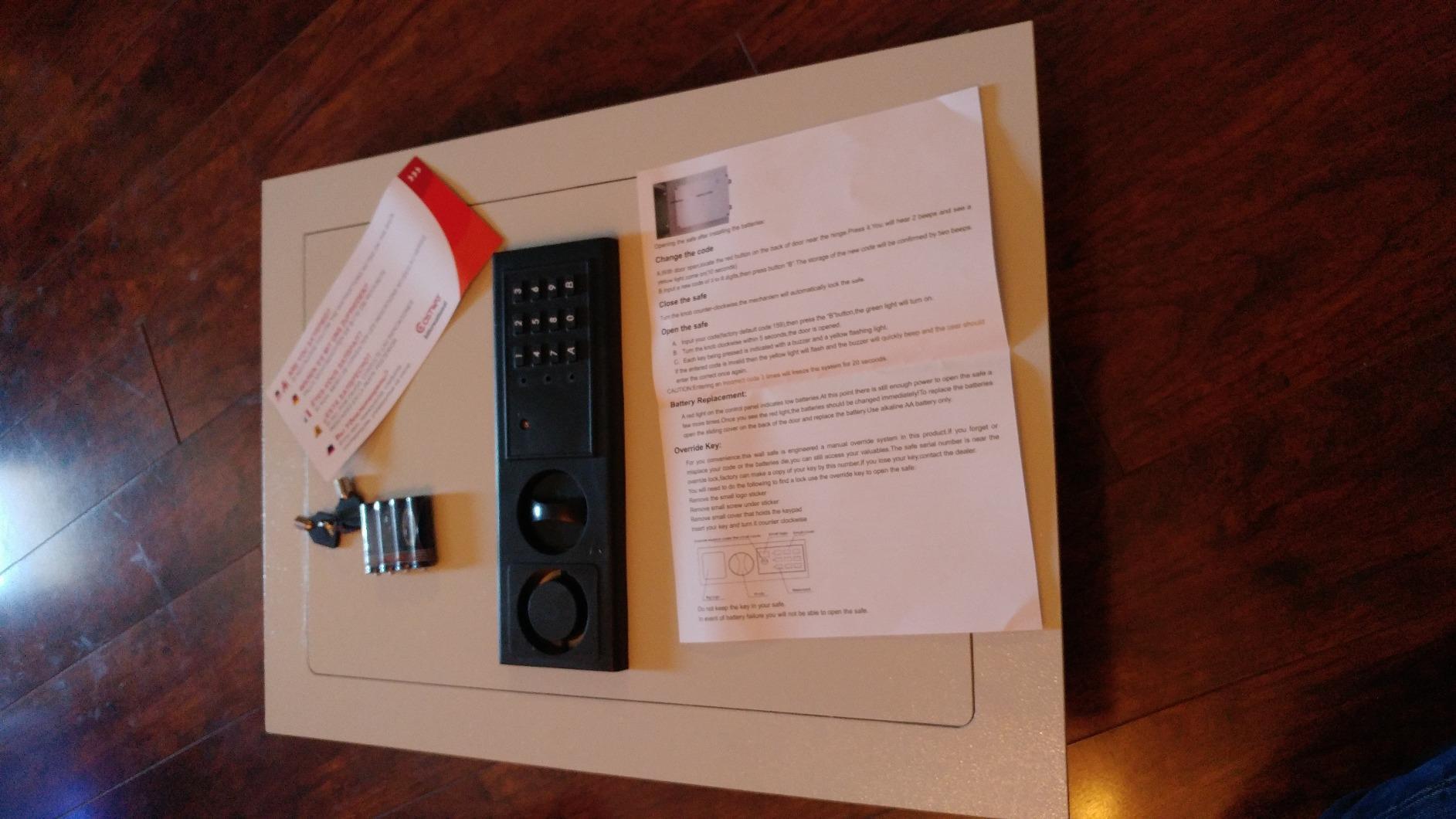
Access is electronic code or an override key, and there is a lockout after three incorrect combination attempts. That lockout is a small thing that separates it from the cheapest keypad safes, which let someone cycle through guesses indefinitely.
Long-term owners report the unit still working years after purchase, and a fair number bought a second unit, which is the strongest reliability signal a product in this roundup has.
Where the Giantex earns its spot
For a first in-wall safe in a rental or a first home, it covers the basics properly. Solid steel, two access methods, a lockout, and a bolt-down mount once you swap the included fasteners.
The interior is 19 inches tall by just under 14 inches wide and 3.75 inches deep, which fits a document folder flat plus a jewelry tray. Buyers wanting one box for papers and pieces get that combination here.
It is also the easiest of the full-size models to move between homes, since 31.6 pounds is manageable for two people without a dolly.
Where the Giantex falls short
The keypad membrane feels cheap and rubbery even though it works, and that is the first thing owners mention when comparing it to real buttons. The lock mechanism also cuts significantly into the middle of the interior, shrinking usable shelf space.
The battery compartment sits inside the safe, so dead batteries mean reaching for the backup key in the dark. It is not fire rated, and reviewers are explicit that it deters opportunistic thieves rather than determined ones.
9. Grimtron Wall Safe with Spacer Kit – Best for Odd Stud Spacing
Grimtron Electronic Wall Safe Between 16″ & 24″ Studs with Shelves & Hooks
0.76 cubic feet
Fits 16 and 24 inch stud centers
Emergency USB port
Silent Mode keypad
Pros
- Only option here that bridges 16 inch and 24 inch stud centers
- Lock box leaves more vertical shelf space than rivals
- Silent Mode mutes the keypad for discreet access
- Emergency USB port powers the keypad when batteries die
- Auto-opening door with interior LED
Cons
- Included screws are weak and strip easily
- Pegboard hooks are hard to reposition
- Plastic door handle adds nothing on a concealed install
- Body leaves a visible gap at each side of the cavity
- Thin U-shaped latch steel looks vulnerable to prying
Most safes in this roundup assume 16-inch on-center studs and nothing else. The Grimtron comes with a spacer kit that bridges both 16-inch and 24-inch stud centers, which solves a real problem in homes with a framed wall or an added partition.
The second thing owners notice is that the lock box does not consume the whole center shelf. On models where the mechanism eats the middle, the full-height usable space here is genuinely taller and it translates directly into more jewelry fitting per safe.
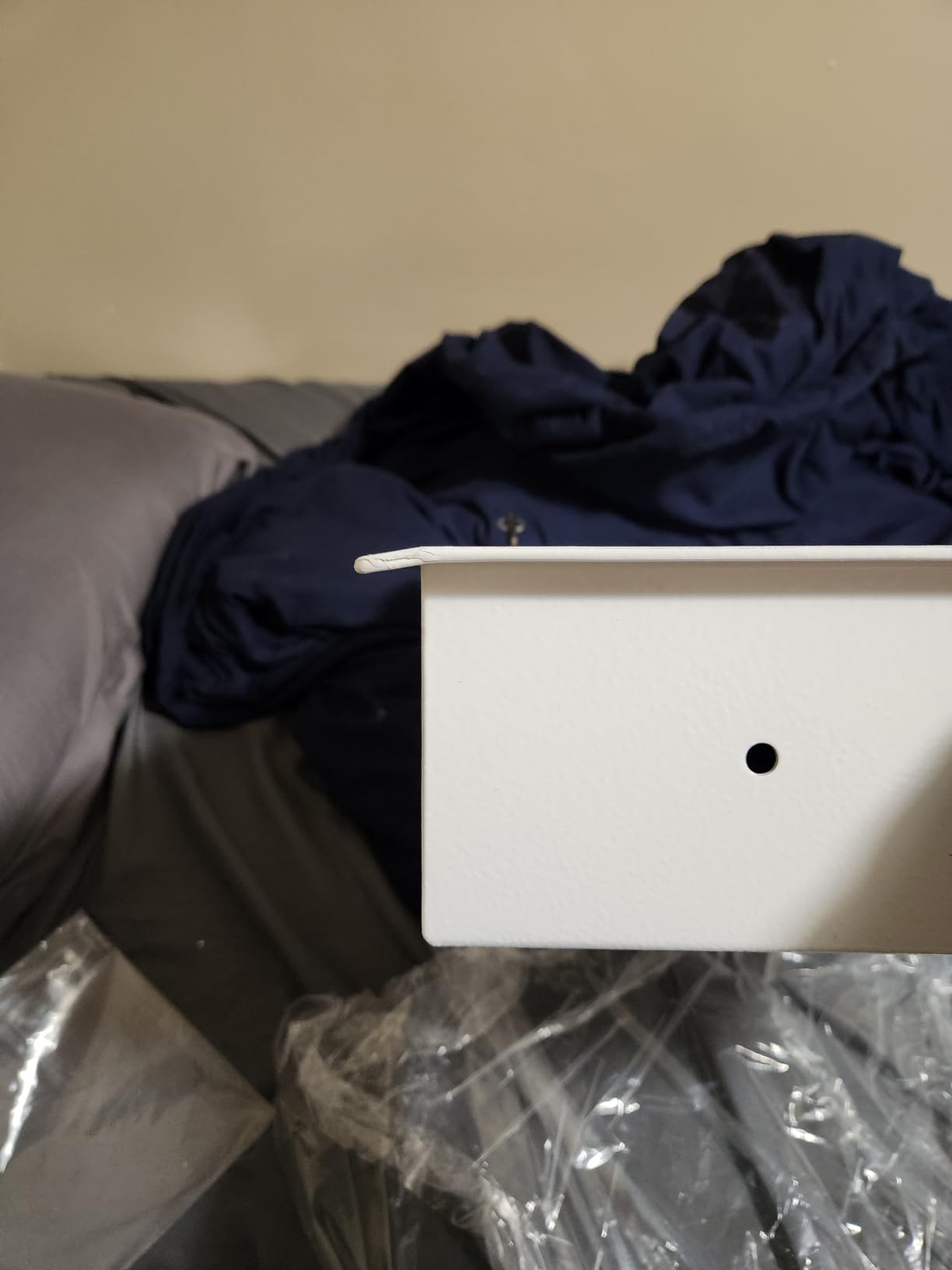
Silent Mode mutes the keypad tones, which solves the complaint we flagged on both of the higher-rated models. For a safe in a bedroom or closet, that is a meaningful difference rather than a gimmick.
There is also an emergency USB port for temporary power when the AA batteries are depleted, plus two emergency keys and an auto-opening door with an interior LED. That is more backup paths than most competing models offer.
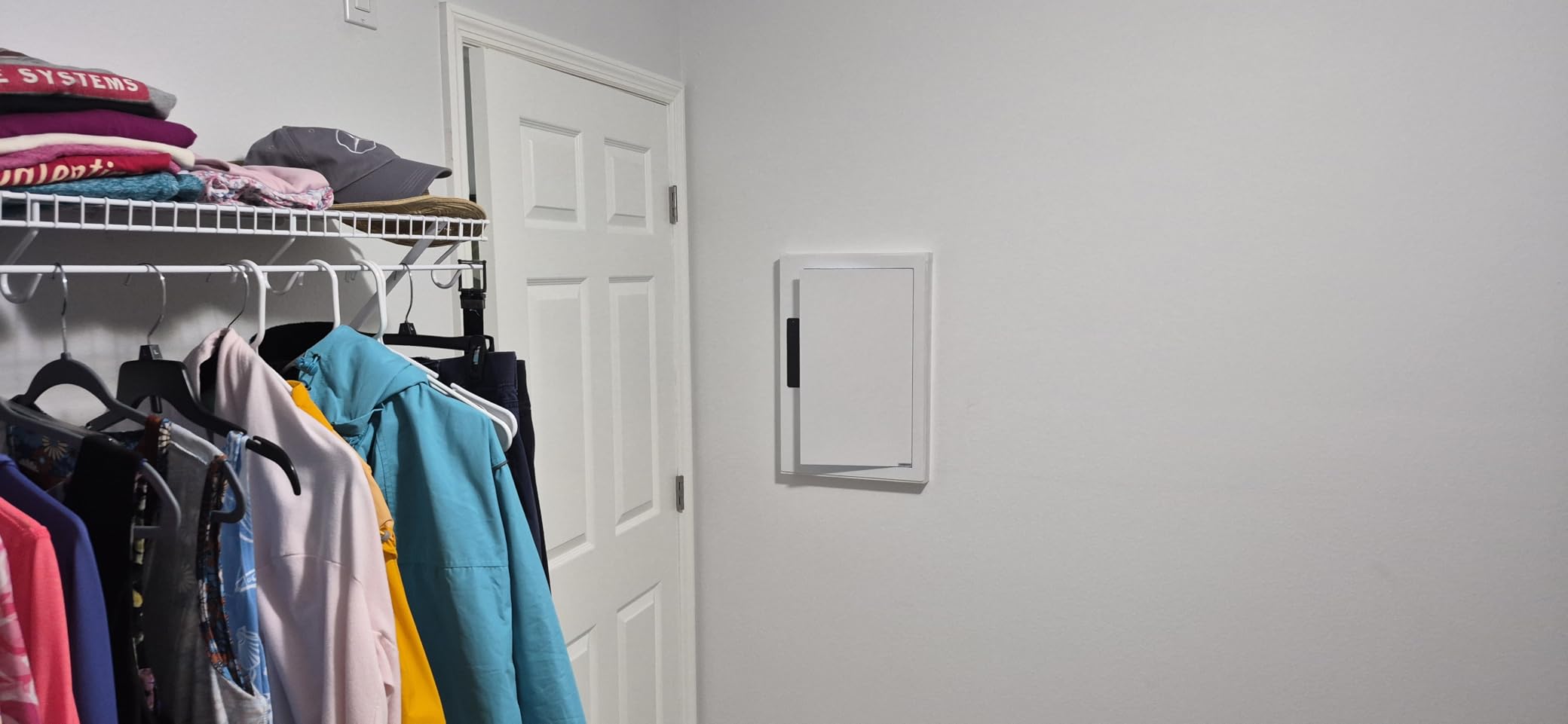
Why the spacer kit matters more than it sounds
If you have measured your studs and come up with something other than 16 inches, most of this list is a problem. The spacer kit means you can use a known-good safe without reframing the wall, which is the difference between a weekend project and a contractor visit.
Two removable shelves plus adjustable pegboard hooks give you ring storage and hanging space in one box, and the hooks suit necklaces and chains better than a flat shelf does.
Customer service is worth mentioning too. One owner had a missing key replaced within a week, which is unusual in this category and matters when the key is your only way in.
Where the Grimtron falls short
The included screws are weak and strip easily, so most owners substitute their own lag bolts. The pegboard hooks are screwed in and hard to reposition without pulling the whole panel, which limits reconfiguration.
The 14.57-inch body does not fill a wider cavity, leaving a visible gap on each side between studs. The latch is thin U-shaped welded steel and looks vulnerable to a pry bar, the included plastic handle adds nothing on a concealed install, and the unit is not fireproof.
10. Tiskgg 29.53-Inch Wall Safe – Best False-Bottom Storage
29.53″ Tall Fireproof Wall Safe 16″ Stud Centers with Combination Lock
29.53 inch tall
36.3 lbs steel
Two motorized deadbolts
Hidden false-bottom compartment
Pros
- Tall cavity suited to upright storage
- Hidden false-bottom compartment adds a second cache
- Three removable shelves plus key hooks
- 36.3 lb steel body with two motorized deadbolts
- Flush mount conceals behind framed artwork
Cons
- Only about 3.94 inches deep so long items will not fit
- Fireproof claim has no stated rating or burn time
- First opening requires the emergency key beneath the badge
- Costs more than shorter models for similar steel
This is the second-tallest cabinet here at 29.53 inches, and its distinguishing feature is the hidden false-bottom compartment. It is a second concealed layer inside the main cavity, so the visible inventory of the safe does not reveal everything you are storing.
At 36.3 pounds with two motorized deadbolt locks and a powder-coated scratch-resistant finish, it is built to the same standard as the taller GUVELI. The difference is the concealment feature rather than the raw height.
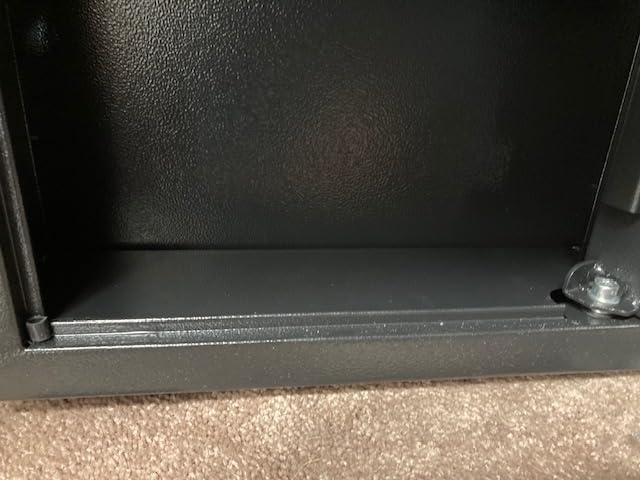
Three removable shelves plus key hooks make the interior configurable, and owners point out that pulling the shelves out is what makes it work for anything taller than the safe is deep. Jewelry cases and long boxes simply do not fit at 3.94 inches of depth.
Access is an electronic combination lock with a turning knob and emergency keys, giving two independent paths in. Flush mounting means framed artwork covers the face completely.
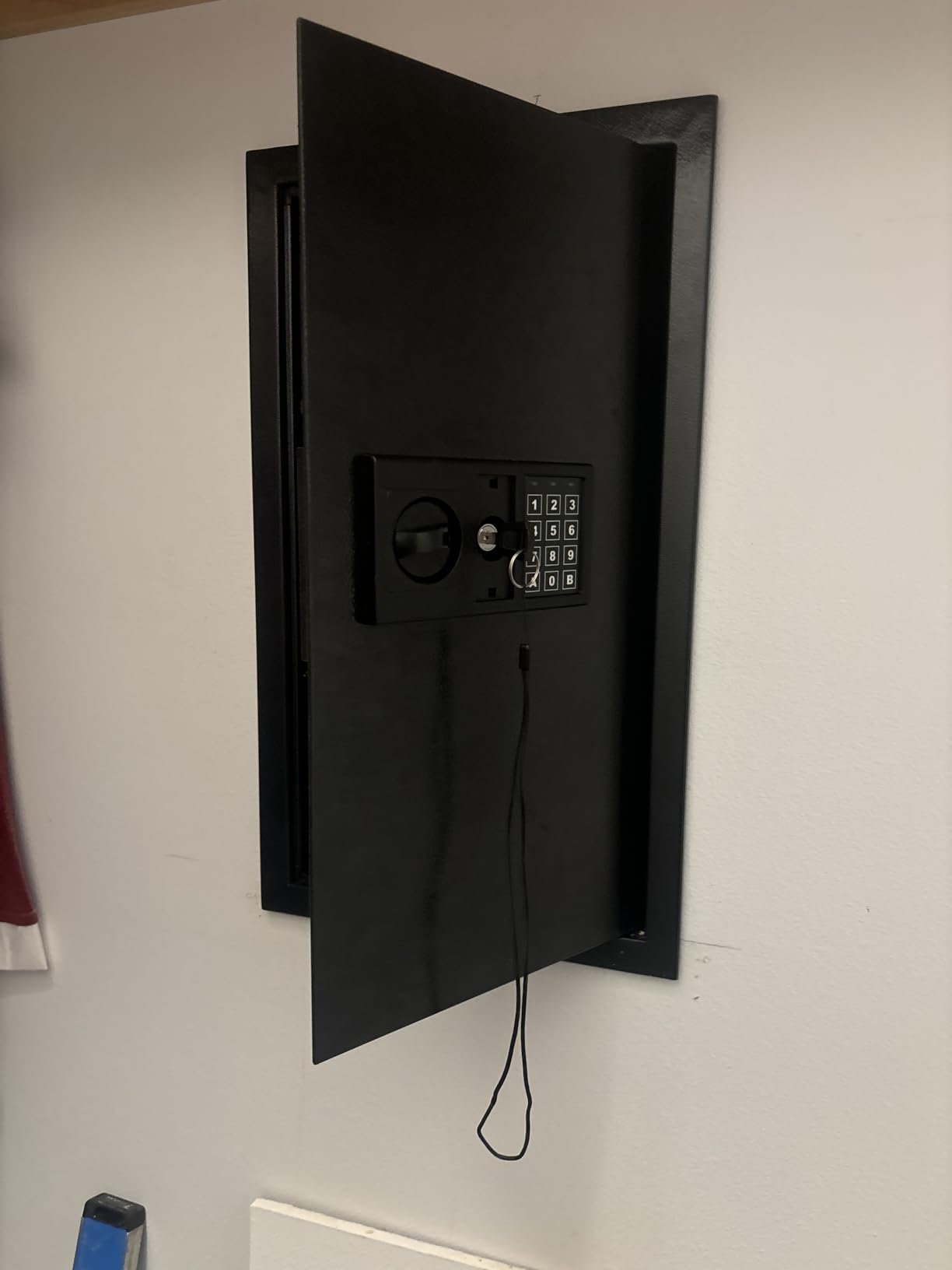
Who the false bottom is for
A false bottom solves a specific problem: a collection where not everything has equal value. You keep everyday pieces on the visible shelves and put the few genuinely irreplaceable items underneath, where a quick search of the safe turns up nothing.
The height suits a vertical layout. A wall safe that is tall and shallow works well for rings standing in rows, rolled chains and bracelet stacks stored on edge, which uses the space far better than a wide shallow box.
For anyone storing documents and jewelry together, the tall cavity holds a folder flat alongside a jewelry tray with room left over.
Where the Tiskgg falls short
Depth is the recurring caveat, at roughly 3.94 inches. Long items and bulky jewelry cases will not fit, and owners who underestimated volume are the ones who regret the size.
The fireproof claim has no stated rating or burn time behind it, so do not count on it for documents you cannot replace. The first opening requires lifting the badge to reach the emergency keyhole, and it costs more than shorter between-studs models for comparable steel.
How to Choose a Wall Safe for Jewelry
Measure your stud spacing before you buy anything
Standard framing is 16 inches on center, which means the clear cavity between studs is about 14.5 inches. Every full-size safe in this roundup is built to that dimension, and the ones that are not explicitly between-studs units say so in their specifications.
To check, tap along the wall with a stud finder or knock and listen for the hollow sound, then measure from the center of one stud to the center of the next. Then measure depth from the face of the drywall to the back of the cavity, because a 4-inch-deep safe needs at least that much plus a fraction for the flange.
If your studs measure 24 inches, the Grimtron with its spacer kit is the only pick here designed for it. If you have an old wall with irregular spacing, expect to trim a stud or reframing is a contractor job.
Pick your lock type by how often you will open it
Keypad entry is the sweet spot for most people. It needs no keys, supports two codes on some models, and takes about a second. Its weakness is battery life and the beep, which you cannot always mute.
Biometric entry suits a daily-access safe. The Viking stores 32 prints and one PIN, and keeps its print memory after battery removal, which is the feature that separates a good fingerprint safe from a frustrating one.
Mechanical combination or tubular key entry is the most reliable because nothing can die. For a safe you open weekly, that reliability is worth more than convenience.
Understand what a fire rating actually promises
A UL fire test heats the exterior of the safe to roughly 1550 degrees Fahrenheit for a set period and requires the interior to stay at or below 125. That is the standard the rating refers to, and the 125-degree interior limit is what protects paper.
Several listings in this roundup use the word fireproof without stating a rating duration or a certification level. That is marketing language, not a tested number, and it is the single most common fireproofing complaint in owner reviews. For documents that cannot be replaced, read our guide to fireproof safes for documents instead.
Judge security by weight, not by keypad
A 4-pound box and a 39-pound box look similar until someone puts a pry bar to them. Bodies in the 28-to-39-pound range, like the Paragon, Viking, Giantex and Tiskgg, resist casual attack far better than anything under 10 pounds.
Gauge numbers are more honest than the phrase solid steel, but weight is the fastest proxy. Also check that the safe has real mounting points, and buy your own lag bolts, since included drywall screws are a near-universal complaint.
Choose capacity by interior layout, not by cubic feet
Volume is misleading on its own. A wide, shallow box under 1 cubic foot may be useless for necklaces while a 30-inch tall cabinet holds the same collection better. Prioritize chamber height for chains, depth for cases, and shelves over volume for rings and earrings.
Watch for the lock mechanism taking center-stage space. On most between-studs models the mechanism eats a chunk of the middle shelf, and that is the gap between the advertised interior and what you can actually lay out.
Storing Jewelry in a Wall Safe Without Damage
A safe protects against theft, not against the slow damage a closed box causes. Sterling silver tarnishes from sulfur and humidity in the air, and a steel safe interior is not a humidity-controlled environment.
Store sterling and plated pieces in an anti-tarnish pouch or sealed bag before they go in, and drop a desiccant pack in the cavity if you live somewhere humid. That single step does more for a silver collection than any safe on this list.
Pearls and opals need the opposite treatment. Both are sensitive to dryness and to prolonged darkness, so keep them in the safe for security and take them out to wear rather than leaving them stored for months.
For necklaces, hang rather than pile. Most between-studs safes here have key hooks or pegboard hooks that suit a chain better than a shelf, and a soft roll keeps a pendant from swinging into a clasp.
Watch owners should check whether the safe stays cool and whether they will wind pieces. A watch left unwound for months stops, and a winding unit needs a power source, so many collectors keep the winding routine at a desk safe instead.
Layer the rest of the house too. Our floor safe roundup covers larger items you want out of sight entirely, and a layered setup beats relying on one box, especially for pieces small enough to pocket.
Are Wall Safes Actually Secure?
Here is the honest weakness. A wall safe is anchored to framing, not to the structure of the house, and a determined intruder with a reciprocating saw can cut a section of drywall around a recessed unit and take it out of the wall entirely. No safe at any price prevents that.
What a wall safe does well is defeat almost everything short of that. The location is hidden, the door is flush, and an intruder who does not already know where it is will almost never find it. Concealment is genuinely half the security here.
Two habits close the gap. Conceal the safe behind art or an outlet plate rather than an exposed keypad, and anchor it with real lag bolts into studs so it cannot simply be pulled away once the drywall is open.
Skip a wall safe entirely if you rent, if your walls are masonry or unusually thin, or if you are storing a single sentimental piece that fits in a small standalone box you can carry with you.
Frequently Asked Questions
What is the best safe for storing jewelry at home?
For most people the Paragon in-wall safe is the best home safe for jewelry because it offers 0.83 cubic feet of storage, fits between standard 16 inch studs, and takes two separate keypad codes plus two manual override keys. Its 39 pound alloy steel body also stays put once bolted into the framing.
Are wall safes any good?
Yes, as concealment rather than as fortresses. A wall safe stops casual thieves, curious family members and opportunistic entry, and it hides your pieces where nobody thinks to look. Its real weakness is that a determined intruder can cut a section of drywall and take the unit out of the wall, so location and anchoring matter as much as the lock.
How much wall depth does a wall safe need?
Most between-studs safes need about 4 inches of cavity depth, and the Protex requires 3.75 inches unobstructed. Measure from the face of the drywall to the back of the cavity before you buy, and remember that the flange still has to sit flat against a finished wall.
Can pearls and opals be stored in a wall safe long term?
Keep them in the safe for security, but take them out to wear rather than leaving them stored for months. Pearls and opals are sensitive to dryness and to prolonged darkness, and sterling silver will tarnish faster in a closed steel box unless you seal it in an anti-tarnish pouch or bag.
Do I need to bolt a wall safe into the wall?
Yes, and use your own lag bolts rather than the included fasteners. Nearly every model here ships with anchors that strip or pull out easily, and a safe anchored only to drywall can be removed by hand. Bolt through the frame into studs on both sides whenever the cavity allows.
The Verdict on the Best Wall Safes for Jewelry
The Paragon in-wall safe is our pick overall, with 0.83 cubic feet, a 16.25-inch chamber depth that suits necklaces, two keypad codes, two override keys and a 39-pound body that has held up across 4723 reviews. If you want fingerprint entry, the Viking VS-52BLX adds a 32-print scanner and an LED interior at 39 pounds.
Go tall if you store chains and documents, and pick the Tiskgg at 29.53 inches or the GUVELI at 33.46 inches when vertical space is what you are short of. Pick the Grimtron when your studs are not 16 inches, and the Elder Welder outlet safe when stealth matters more than capacity.
Whatever you choose, measure your cavity first, bolt it into studs with your own lag bolts, and seal sterling silver before it goes in. And if a collection eventually outgrows one wall, our guide to floor safes for homes covers the next tier up.