
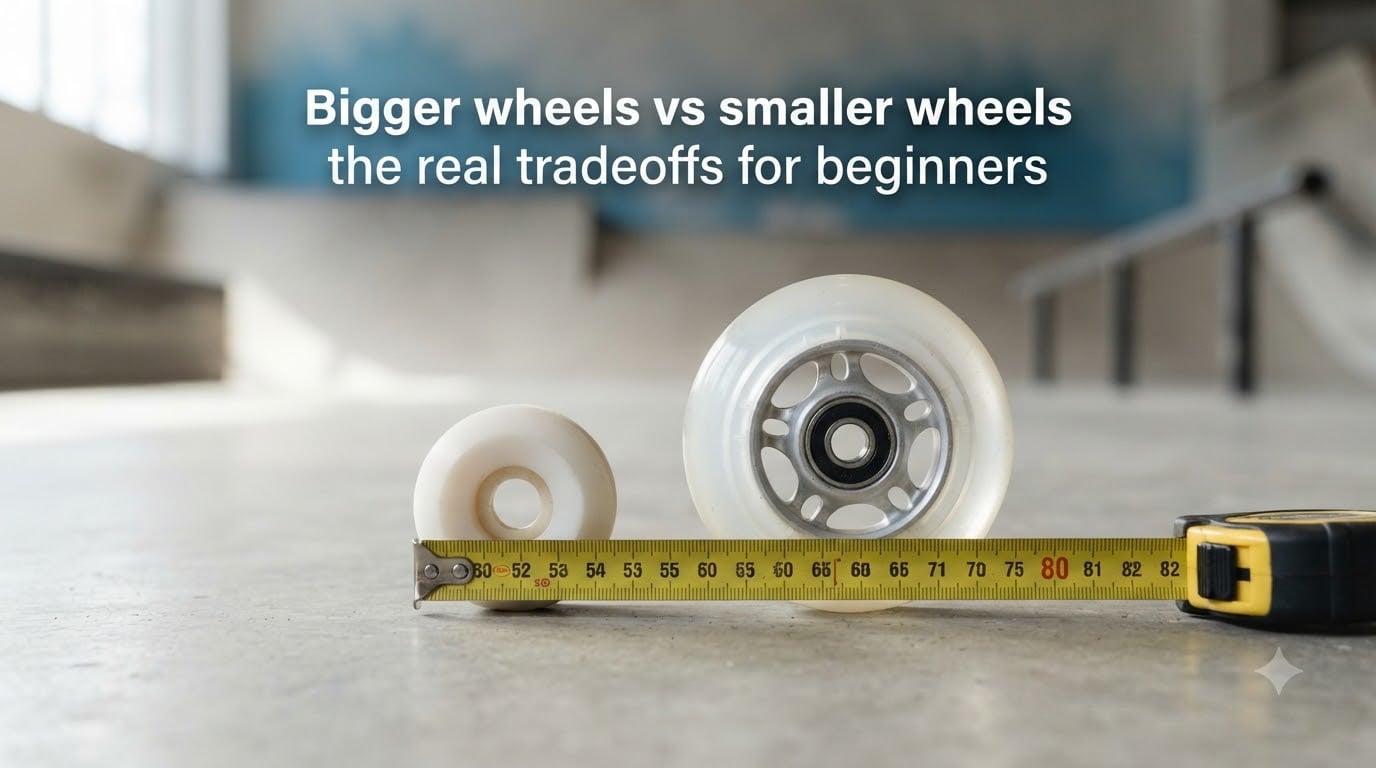
When you are just starting out in skating, one of the first decisions you face is wheel size. The debate around bigger wheels vs smaller wheels is everywhere in skating forums, shops, and conversations. Beginners often feel overwhelmed by the sheer number of millimeter options and conflicting advice.
Here is the short version: smaller wheels give you more control, quicker acceleration, and a lower center of gravity that helps you feel stable. Bigger wheels roll faster, hold momentum longer, and smooth out rough surfaces better. The right choice depends on your skill level, your terrain, and what type of skating you want to do.
In this guide, I will break down exactly how wheel diameter affects your skating. I will cover the physics in plain language, give you specific millimeter recommendations for every skill level, and share real experiences from skaters who learned this the hard way. By the end, you will know exactly which wheel size fits your situation.
Table of Contents
What Wheel Size Actually Means?
Wheel size refers to the diameter of the wheel, measured in millimeters. In skating, wheel diameters range from about 50mm on the small end up to 110mm or more on the large end. The number tells you how tall the wheel is from the ground to where it meets the truck or frame.
For skateboard wheels, you typically see sizes between 50mm and 75mm. Roller skate wheels usually fall between 57mm and 65mm. Inline skate wheels span the widest range, from around 72mm for recreational skates up to 125mm for speed and marathon skating.
Every 5mm change shifts how the wheel performs. A 52mm wheel feels noticeably different from a 58mm wheel, even though they look similar sitting next to each other. That is because even a small increase in diameter raises your center of gravity, changes how fast the wheel accelerates, and alters how it handles cracks and debris.
Size is only half the equation, though. Durometer, or wheel hardness, matters just as much. A soft 78a wheel at 60mm will feel completely different from a hard 99a wheel at the same 60mm. For this guide, I will focus on diameter, but keep in mind that hardness and size work together. Most beginners benefit from softer, smaller wheels because the combination maximizes grip and stability.
Bigger Wheels vs Smaller Wheels: Quick Comparison
Here is a side-by-side snapshot so you can see the core differences before diving into the details. Think of this as your cheat sheet for the bigger wheels vs smaller wheels skating debate.
Smaller Wheels (50-62mm for skateboards, 57-62mm for roller skates, 72-80mm for inline): Faster acceleration, tighter turning, lower ride height for stability, lighter weight, easier to control at low speeds. Best for beginners, street skating, park skating, and technical tricks.
Bigger Wheels (60-75mm for skateboards, 62-65mm for roller skates, 84-110mm+ for inline): Higher top speed, longer glide between pushes, better handling of rough terrain, smoother ride over cracks and debris. Best for cruising, commuting, downhill, fitness skating, and outdoor surfaces.
The tradeoff in one sentence: bigger wheels trade away quick acceleration and agility in exchange for speed and smoothness, while smaller wheels trade away top speed and terrain capability in exchange for control and responsiveness.
Why Smaller Wheels Help Beginners?
If there is one thing every experienced skater agrees on, it is that beginners should start with smaller wheels. The reasons come down to physics, biomechanics, and plain old confidence.
Smaller wheels keep you closer to the ground. That lower center of gravity means you feel more planted and stable on your skates or board. When you are learning to balance, every millimeter of height matters. I have talked to dozens of beginner skaters who switched to smaller wheels and immediately felt less wobbly.
Smaller wheels also accelerate faster. Each push gets you moving more quickly from a standstill, which is exactly what you need when you are still building leg strength and coordination. With larger wheels, it takes more effort to get going, and that lag can make beginners feel like they are fighting their equipment.
Control is where smaller wheels really shine. A smaller wheel has less rotational mass, so it responds instantly when you shift your weight or adjust your edges. This translates to tighter turns, quicker stops, and a more connected feeling between your body and the ground. When you are still learning how your weight distribution affects movement, that responsiveness builds confidence.
Reddit users in the r/NewSkaters community consistently recommend starting small. One skater who began with 90mm inline wheels said they felt completely out of control and nearly quit. After dropping to 80mm wheels, the experience transformed. The skater described feeling grounded for the first time.
For skateboarding specifically, wheels in the 52-54mm range are the sweet spot for beginners. They are light enough to learn tricks with, low enough to feel stable, and small enough that you will not accidentally wheel-bite when you are still figuring out how to distribute your weight.
Why Bigger Wheels Excel?
Smaller wheels are the beginner default, but bigger wheels are not inherently worse. They simply serve a different purpose. Once you understand what large wheels do well, you will appreciate why experienced skaters gravitate toward them.
Bigger wheels hold momentum better. Once you get a large wheel up to speed, it keeps rolling with less effort. This is why distance skaters, commuters, and fitness skaters all prefer larger wheels. You spend less energy maintaining speed and more time enjoying the ride.
Top speed is where bigger wheels pull ahead. A larger wheel covers more ground per rotation, so your maximum speed increases. For inline speed skaters rolling on 110mm or 125mm wheels, this is the entire point. The tradeoff is that it takes longer to reach that top speed from a dead stop.
Rough terrain is the other area where bigger wheels dominate. Cracks, pebbles, tree roots, and uneven pavement that would stop a small wheel dead in its tracks barely register on a large wheel. The larger diameter simply rolls over obstacles instead of catching on them. If you skate outdoors on anything other than pristine smooth surfaces, bigger wheels make a noticeable difference in comfort and safety.
Outdoor roller skaters frequently switch to 65mm soft wheels for exactly this reason. Forum posts from r/Rollerskating are full of skaters who started on small, hard indoor wheels outdoors and felt every single crack. Moving up to a larger, softer wheel transformed rough sidewalks from terrifying to enjoyable.
Vibration reduction is an underrated benefit. Bigger wheels absorb more road chatter because there is more urethane between the ground and your bearings. Your feet and ankles feel less fatigue on long sessions. For older skaters or anyone with joint concerns, this comfort factor matters more than you might expect.
The Speed vs Acceleration Tradeoff
This is the heart of the bigger wheels vs smaller wheels skating conversation. Understanding why small wheels accelerate faster but big wheels reach higher top speeds will make everything else click into place.
Think about a bicycle gear. A small gear is easy to pedal from a stop but tops out quickly. A large gear is hard to get moving but flies once you are up to speed. Skate wheels work on the same principle. Smaller wheels have less mass to spin up, so each push translates into rotation more quickly. You feel that instant response when you push off.
Larger wheels have more rotational mass and cover more distance per revolution. They take more energy to get spinning, but once they are moving, that extra mass helps maintain rotation. The wheel essentially stores momentum, carrying you forward between pushes.
For beginners, acceleration matters more than top speed. You are not sprinting or racing. You are learning to push, balance, turn, and stop. Quick, predictable acceleration from smaller wheels gives you more control during the learning process. You can start and stop without building up more speed than you can handle.
As you progress and start skating longer distances or bombing hills, top speed and momentum become more valuable. That is when upgrading to bigger wheels starts to make sense. The transition is natural. You will feel ready for more speed and glide before you consciously decide to change wheels.
Wheel Size Recommendations by Skill Level
Here are specific millimeter ranges organized by skill level and skating type. Use these as starting points, not absolute rules. Your terrain and personal preference will fine-tune the final number.
1. Beginner Skateboarders: Start with 52-54mm wheels. These are low enough for stability, light enough for learning basic tricks, and standard enough that you will not outgrow them immediately. Pair with a durometer around 92a-99a for a balance of grip and slide.
2. Beginner Roller Skaters: Aim for 57-62mm wheels. For outdoor skating, go with 60-62mm at 78a hardness for maximum smoothness. For indoor or rink skating, 57-59mm at 95a-101a gives you the grip and agility you need on smooth floors.
3. Beginner Inline Skaters: Start with 72-80mm wheels. These provide enough stability for learning while keeping you close to the ground. Avoid 84mm or larger until you have solid balance and braking technique. One Reddit user described jumping straight to 90mm wheels and feeling like the skates had a mind of their own.
4. Intermediate Skateboarders: Move to 54-56mm for street and park skating. If you start cruising or skating rougher surfaces, consider 56-60mm. By this stage, you have the control to handle the extra height and speed.
5. Intermediate to Advanced Inline Skaters: Progress to 84-90mm for fitness and recreational skating. Speed skaters and marathon participants typically use 100-110mm or even 125mm wheels. Only move to these sizes when your technique is dialed in.
6. Advanced Roller Skaters: Derby and jam skaters often stick with 57-62mm because agility is king in those disciplines. Outdoor trail skaters may go up to 65mm for the terrain advantage.
How Terrain Changes Everything
You could pick the perfect wheel size for your skill level and still have a miserable experience if you ignore terrain. The surface you skate on is just as important as the wheel you choose.
Smooth indoor surfaces like rink floors and skate park concrete work well with smaller, harder wheels. The smooth surface does not punish the lack of vibration absorption, and the hard durometer maximizes grip on polished floors. This is why rink roller skaters typically use 57mm wheels at 95a or harder.
Rough outdoor pavement demands bigger, softer wheels. Asphalt, sidewalk concrete, and chip-seal roads transmit every imperfection straight through hard small wheels. A 65mm wheel at 78a absorbs that chatter and keeps you rolling instead of stuttering over every crack.
Street skating falls somewhere in between. For flip tricks and ledges, you want 52-54mm wheels because the low profile keeps the board close to the ground for technical control. For cruising through city streets, 60mm or larger makes the ride bearable over all the road imperfections you encounter.
If you skate multiple terrains regularly, consider having two sets of wheels. Swapping wheels takes five minutes and completely changes how your setup performs. Many experienced skaters keep a small, hard set for the park and a large, soft set for outdoor adventures.
When Should a Beginner Upgrade Wheel Size?
This is the question no competitor answers clearly, and it is one of the most common things beginners ask in skating forums. There is no fixed timeline, but there are clear signs that tell you it is time to move up.
You are ready for bigger wheels when you feel confident at your current speed and find yourself wanting more glide between pushes. If you are pushing constantly on flat ground and still not building the momentum you want, a larger wheel will help. Your balance and edge control should be solid enough that the extra height does not make you feel unstable.
For inline skaters, the typical progression looks like this: start at 80mm, move to 84mm after a few months of regular skating, then consider 90mm when you are comfortable at speed and want longer distance capability. Some skaters stay at 84mm forever because it strikes the perfect balance for their needs.
For skateboarders, the upgrade path is less dramatic. Many skaters never go above 54-55mm because their skating style does not demand it. If you transition from park and street to more cruising, that is when you bump up to 58-60mm.
Older beginners, especially skaters over 30, should be extra cautious about jumping to large wheels too quickly. Balance reactions slow slightly with age, and the extra height of large wheels amplifies any wobble. Take your time. There is no rush. The wheels will be there when you are ready.
One final sign you are ready: you stop thinking about your wheels entirely. When your current setup feels like an extension of your body and you are no longer focused on balance or control, that is when upgrading will enhance your skating rather than overwhelm it.
Common Beginner Mistakes With Wheel Size
These are the pitfalls I see beginners fall into over and over. Avoid these and you will save yourself weeks of frustration.
1. Starting too big. Beginners see pro skaters on large wheels and assume bigger is better. It is not, at least not yet. Start small and earn your way up.
2. Ignoring durometer. Wheel size gets all the attention, but hardness matters just as much. A small hard wheel on rough pavement is a recipe for a terrible time.
3. Copying someone else’s setup. Your friend’s wheel choice works for their weight, terrain, and style. It may not work for yours. Experiment within recommended ranges.
4. Changing wheels before mastering basics. If you cannot confidently stop, turn, and balance on your current wheels, a wheel change will not fix it. Focus on fundamentals first.
5. Buying wheels for a skating style you have not tried yet. Get wheels for what you are doing now, not what you imagine doing in six months. You can always upgrade later.
Frequently Asked Questions
Are wider wheels better for skating?
Wider wheels provide more grip and stability because they have a larger contact patch with the ground. They are better for cruising, downhill, and rough terrain where traction matters. For technical street skating and flip tricks, narrower wheels are preferred because they are lighter and more responsive. Width matters, but it works alongside diameter and hardness to determine overall performance.
What size wheels should a beginner skateboarder have?
Beginner skateboarders should start with 52-54mm wheels at 92a-99a hardness. This size keeps the board low for stability, accelerates quickly for easy pushing, and is light enough for learning basic tricks. Avoid anything over 56mm until you have solid balance and control. Stick with standard widths (around 30-32mm) for the best all-around beginner experience.
Are smaller or larger wheels more efficient?
Larger wheels are more efficient at maintaining speed because they cover more ground per rotation and hold momentum longer between pushes. However, smaller wheels are more efficient at accelerating from a stop because they have less rotational mass to spin up. For distance and commuting, larger wheels win. For stop-and-go skating like street tricks, smaller wheels are more efficient.
Are smaller wheels better for roller skating?
For beginner roller skaters and those doing rink skating, jam skating, or roller derby, smaller wheels (57-62mm) are better because they offer quick acceleration, tight turning, and a lower center of gravity. For outdoor roller skating on rough surfaces, larger wheels (62-65mm) at 78a hardness are better because they roll over debris and absorb vibration more effectively.
Final Thoughts
The bigger wheels vs smaller wheels skating debate comes down to one principle: match your wheels to your current skill level and terrain, not to where you hope to be someday. Start small, build your fundamentals, and let your comfort guide your upgrades. Your wheels are the only thing between you and the ground, so choose wisely and enjoy the ride.