
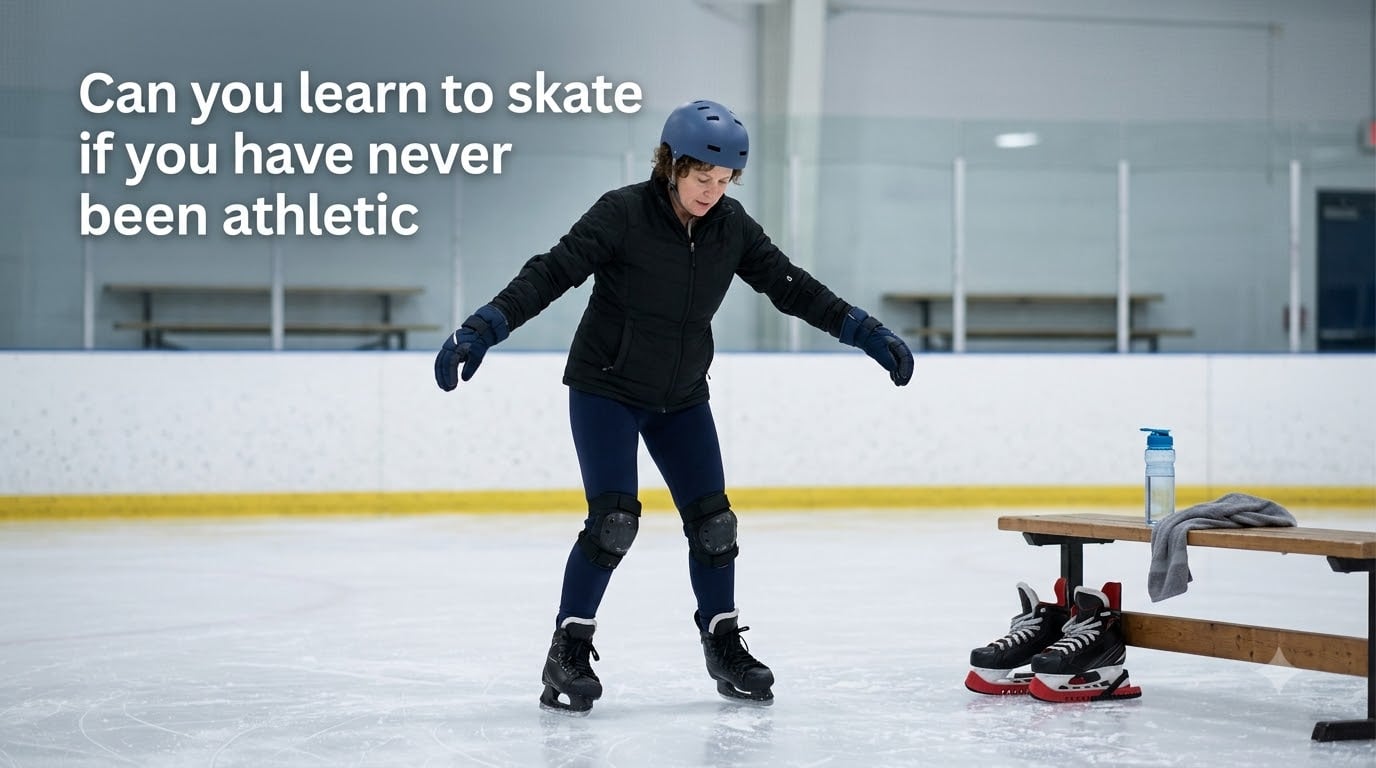
Yes, you can absolutely learn to skate if you have never been athletic. Skating is not a sport reserved for naturally coordinated people or former athletes; it is a skill anyone can build with practice, patience, and the right approach.
I have spent years talking to adult beginners who walked into their first session convinced they would be the worst one on the ice or the rink. The truth is, the “unathletic” adult label does not predict how quickly you will learn. What predicts success is showing up consistently, accepting a few bruises, and being willing to look a little awkward for a couple of weeks.
This guide covers exactly what to expect when learning to skate as someone who has never been athletic. We will address the mental barriers that hold most adult beginners back, walk through your first five sessions, talk about falling without panic, and answer the questions adult learners ask most often. By the end, you will have a clear picture of what is realistic, what is overrated, and how to start.
Table of Contents
What It Really Means to Learn to Skate as a Non-Athletic Adult?
“Learning to skate” sounds like one big thing, but it is really a stack of smaller skills. Basic gliding, balancing on one foot, stopping, turning, and eventually skating backward are all separate motor patterns your nervous system has to figure out.
Here is the part most beginners miss: being athletic is not a prerequisite for motor learning. Muscle memory does not care whether you played soccer in high school or spent your teens reading books. It responds to repetition. People who pick up new physical skills easily usually have one thing in common: they are used to being beginners. That is a learned skill too, not a talent.
The phrase “I have never been athletic” usually means one of three things. It means you did not play organized sports growing up. It means you think of yourself as clumsy or uncoordinated. Or it means you are out of shape and worried about that. None of these stop you from learning to skate.
What does help is reframing what “athletic” means in this context. Skating is more about quiet body awareness than about explosive power. You will be working on ankle stability, weight distribution, and small balance corrections. These are teachable skills, not gifts.
The Mental Barrier: Why Not Being Athletic Feels Like a Dealbreaker
Most adult beginners do not fail because of physical limits. They quit because of how it feels to be a beginner at an age when they thought they would be past that stage. This is the part almost no skating article talks about, and it is the biggest content gap I see in this niche.
When I asked a friend who started skating at 32 after 24 years off the ice about her first month, she said the hardest part was not the falling. It was the falling in front of teenagers who picked it up in two sessions. That comparison trap is where adult beginners lose motivation.
Here are the three mental traps that catch non-athletic adults, and how to get out of each one.
Trap 1: Comparing yourself to others on the rink. Kids and young adults often learn faster, partly because their nervous systems are still adapting to new movement patterns. Your timeline will be different. That does not make it worse, just different.
Trap 2: Treating falls as evidence of failure. Every single person who skates well now fell hundreds of times when they started. Falling is information. It tells your body what not to do next time, and that is how the skill gets built.
Trap 3: Believing “athletic” is a fixed identity. It is not. People build coordination in their 30s, 40s, 50s, and beyond. The label “non-athletic” describes a past, not a future. Plenty of adults who describe themselves that way have gone on to compete in adult figure skating, play recreational hockey, or skate marathons.
One Reddit user who started figure skating at 25 after a lifetime of being told she was “not sporty” now teaches beginner classes. Stories like hers are not rare. They are normal outcomes when someone sticks with it for a few months.
Age Is Just a Number: Starting in Your 20s, 30s, 40s, and Beyond
One of the most common questions I see from adult beginners is some version of “Is [my age] too late?” The short answer is no, but it helps to understand what actually changes with age and what does not.
What changes as you get older: your recovery time, your tolerance for impact, and the speed at which your brain forms new neural pathways. All of these matter, but none of them put skating out of reach.
What does not change: the underlying process of motor learning. Adults in their 40s and 50s regularly pick up skating. There are adult learn-to-skate programs designed specifically for people who never skated as kids, and they are full of beginners who started in their 30s and 40s.
If you are 26 or 27 and wondering whether you missed your window, you did not. The 24-year-old who posted on r/hockeyplayers about learning to skate for the first time got hundreds of responses from people who started in their late 20s and 30s. The consensus was clear: it is harder than starting at 7, but absolutely doable.
If you are 40 or older, the same applies. You may progress a little slower and you will want to invest in good protective gear, but the ceiling on what you can learn is not meaningfully different from a 25-year-old’s.
Self-Learning vs Taking Lessons: Which Path Is Right for You?
Can skating be self-taught? Yes, it can. Plenty of adults have learned to skate without ever taking a formal lesson, especially for casual recreational skating. But the path you choose changes how fast you progress and how much you struggle.
Here is a fair comparison of the two options.
Self-teaching works best if: you have some natural body awareness, you are willing to watch a lot of tutorial videos, you are skating purely for fun and not aiming for any specific skill milestone, and you are okay with a longer learning curve. The upside is flexibility. You can practice whenever the rink is open.
Taking lessons works best if: you want to build correct habits from day one, you learn faster with feedback, you have a specific goal (basic figure skating moves, hockey, etc.), or you find self-directed practice frustrating.
Group lessons are cheaper and you get to meet other beginners. They run on fixed schedules, which can be a hassle for working adults. Private lessons cost more but you get personalized correction, which matters a lot in the first few weeks when bad habits are easy to form.
My honest recommendation for non-athletic adults: take at least a handful of lessons in the beginning. Even four or five sessions with a coach can shortcut weeks of frustration. After that, you can mix in self-practice if cost or schedule is a constraint.
If you cannot find a local coach, online tutorials can fill part of the gap, but treat them as supplements, not substitutes. Without someone watching you, it is hard to know what you are doing wrong.
What to Expect in Your First Five Sessions?
Telling non-athletic adults what the first month actually looks like is one of the most useful things I can do here, because almost nobody does it. Let me walk you through a realistic progression.
Session 1. You will spend most of it holding the wall or rail. You will learn how to fall without hurting yourself (yes, this is taught explicitly). You will take a few shaky steps on the skating surface. You will feel exhausted after 30 minutes because balancing uses more muscles than you expect. This is normal.
Session 2. You will start to glide short distances while holding on with one hand. You will likely fall at least once. The fear will still be there, but slightly less sharp.
Session 3. Short unaided glides become possible. You will probably still grab the wall at the end of each glide. Stopping is still mostly the wall. You will feel your ankles and inner thighs the next day.
Session 4. You start linking glides together. You might attempt a basic snowplow stop (for ice) or a t-stop (for roller). You may catch yourself thinking “I am actually skating” for the first time.
Session 5. You can move around the rink at a slow pace without holding on. You can stop without slamming into the boards. You still fall occasionally, but less often. You start recognizing other beginners and feeling part of a community.
That progression assumes about 2 to 3 sessions per week. If you go less often, stretch the timeline. If you go more often, compress it. Either way, by week 5 or 6, you should feel a meaningful shift from “I cannot do this” to “I cannot do this yet.”
Falling Is Part of Skating (Not a Sign of Failure)
No matter what kind of skating you choose, you will fall. Ice, roller, inline, the physics do not care about your athletic history. The difference between people who learn and people who quit is not falling less. It is falling better.
Here is the mindset shift that helps: every fall teaches your body what the limit of your balance is. That information is the actual mechanism of learning. So when you fall, you are not failing. You are collecting data.
Practically speaking, you will fall less painfully if you learn to fall correctly early. Bend your knees, try to land on a padded area, and avoid catching yourself with straight arms. Most rinks and skating programs teach a basic falling technique in the first 10 minutes. Pay attention to it. It will save you bruises and sprained wrists.
Protective gear helps here, too. Wrist guards, knee pads, and a helmet are not optional for adult beginners in my opinion. They are not because you are bad at skating. They are because you are new, and new skaters fall in unpredictable ways.
If you are skating at a public rink and feel embarrassed about falling, remember that everyone else there either remembers falling or is currently hiding their own. Skating culture is unusually forgiving. People are rooting for you.
Tips to Manage Frustration and Stay Motivated
Frustration is the silent killer of adult skating journeys. The body learns, but the mind gets tired of being bad at something. Here are the strategies that actually work for non-athletic adults.
Track tiny wins. Your first unaided glide counts. Your first successful stop counts. Your first lap without touching the wall counts. If your only measure of progress is “I want to skate like I have been doing it for years,” you will be discouraged for months. Switch the metric to “what can I do today that I could not do last week?” and the wins show up.
Skate with someone worse than you. Teaching a friend the basics a few weeks into your own journey reinforces your learning and gives you a front-row seat to your own progress. It also makes the rink feel less intimidating because you are the experienced one for a change.
Set a session-based goal, not a calendar-based one. “I will be comfortable skating by August” is a recipe for frustration because progress is not linear. “I will attend eight sessions this month” is a goal you can actually control. The skill follows the practice.
Take rest days seriously. Adult bodies need recovery. Skating uses stabilizer muscles and ankles you have probably never trained. A day off between sessions is not laziness. It is how your nervous system consolidates what it learned.
Build a skating identity. This sounds corny, but it works. Buy yourself a small piece of gear you like. Pick a skating style you find cool. Follow a couple of adult skaters on social media. The identity of “I am a skater” matters more than people expect. It changes how you show up.
What Gear Do You Need to Start Skating?
You do not need much to start, but a few basics will make your first month far more pleasant.
For ice skating: Rental skates work fine for the first few sessions. When you know you are sticking with it, get fitted for a proper pair. Thin socks (not thick cotton athletic socks) prevent blisters. A helmet is required at many rinks and strongly recommended everywhere else. Layered, warm clothing that lets you move.
For roller or inline skating: Outdoor wheels are softer than indoor wheels and handle rough pavement better. Wrist guards are non-negotiable for beginners. Knee pads and a helmet complete the setup. Avoid the temptation to buy cheap skates with hard plastic boots. They will hurt your feet and discourage you.
For both: Water, a small towel, and snacks. Skating burns more calories than people expect, especially when you are working on balance.
You do not need to spend a lot in 2026. Most beginners do well with mid-range starter gear. The point is to have what keeps you safe and comfortable, not what looks impressive.
Frequently Asked Questions
Can skating be self-taught?
Yes, skating can be self-taught, especially for casual recreational skating. Many adults have learned to glide, stop, and turn without ever taking a formal lesson, using online tutorials and self-practice. That said, even a few lessons with a coach early on can correct bad habits and shorten your learning curve significantly.
Is 26 too late to learn how to skate?
Not at all. Many adults start skating in their mid-to-late 20s and go on to enjoy it for decades. You may progress a little slower than a child learning the same skills, but there is no age window that has closed by 26. Most rinks run adult learn-to-skate programs specifically for people in their 20s, 30s, and 40s who started late.
Is skating harder than running?
In some ways yes, in some ways no. Skating requires balance and body awareness that running does not, which is why many beginners find it intimidating at first. However, skating is low-impact once you find your balance, and many adults who hate running find skating far more enjoyable because it feels like gliding rather than pounding the pavement.
Can a 40 year old learn to skate?
Yes, a 40 year old can absolutely learn to skate. Adult skating programs regularly have students in their 40s, 50s, and beyond. Recovery time may be slightly longer than for younger adults, and good protective gear is especially important, but the underlying motor learning process works the same at any age.
Is it hard to learn how to skate as an adult?
It is challenging but not unusually hard. Most adults can reach comfortable recreational skating within 4 to 8 weeks of consistent practice (2 to 3 sessions per week). The main hurdles are mental, including fear of falling, frustration with slow progress, and embarrassment, rather than physical limits.
The Bottom Line on Learning to Skate as a Non-Athletic Adult
You can learn to skate if you have never been athletic. The athletic identity you have carried around is a story about your past, not a forecast of what your body can do.
Pick your skating style, find a rink or smooth path near you, and commit to 4 to 6 sessions over the next month. Wear protective gear. Expect to fall. Track your tiny wins. By the time you hit your fifth session, you will not feel like a non-athlete trying to skate. You will feel like a skater who is still learning. That shift is what the journey is really about.