
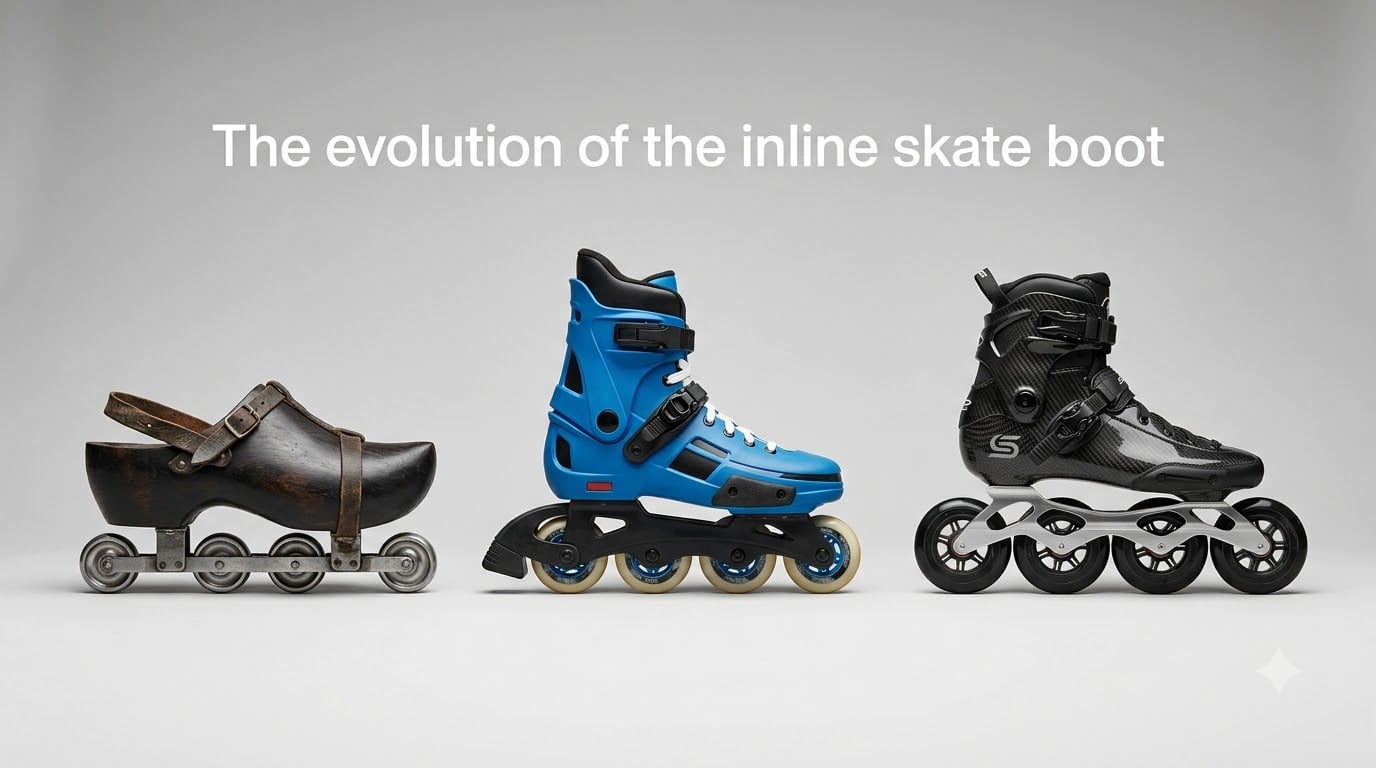
If you have ever laced up a pair of inline skates and wondered why the boot looks more like a ski boot than a hockey skate, you are not alone. The story behind that design choice spans more than 260 years of experimentation, failure, and reinvention. The evolution of the inline skate boot is really a story about how the human foot keeps asking the same question: how do I balance support, comfort, and control on a single line of wheels?
I have spent years digging through patents, museum archives, and old forum threads to put this timeline together. What surprised me most was how much the boot’s shape was shaped by materials available in a given decade, not just by rider demand. Leather gave way to plastics. Plastics gave way to composites. And the ski boot connection? It was not a stylistic choice. It was an engineering inheritance that stuck.
This guide walks through every major phase of inline skate boot development, from a wooden prototype in 1760 to the heat-molded, carbon-blank skate of 2026. You will see why the hard boot dominated for a decade, why soft boots took over, and what the next decade of inline boot design might look like.
Table of Contents
The Evolution of the Inline Skate Boot: A Timeline Overview
Before diving into the details, here is a quick chronological snapshot of the key milestones that shaped inline skate boot evolution:
- 1760: John Joseph Merlin demonstrates the first recorded inline wheeled shoe in London.
- 1760s: Dutch inventor Jan van der Waals sketches a refined wooden single-line skate.
- 1863: James Plimpton’s quad skate patent introduces pivoting action, indirectly inspiring later inline pivoting cuff designs.
- 1980: Scott and Brennan Olson build the first modern inline skates from hockey skate boots and roller ski wheels.
- 1983: Rollerblade Inc. is founded in Minneapolis, Minnesota.
- Late 1980s: Ski-boot-inspired hard shell construction becomes the industry standard for inline boots.
- 1990: K2 introduces the first true soft boot inline skate, reshaping comfort expectations.
- Mid-1990s: Aggressive inline skating emerges; soul plates and grind plates become standard boot features.
- 2000s: Heat-moldable liners and memory foam enter mainstream boot design.
- 2010s: Carbon composites and BOA closure systems appear in premium skate boots.
- 2026: Sustainability, 3D-printed lasts, and bio-based liners drive current boot innovation.
This is the skeleton. Now let me fill in the bones.
Early Origins: 18th and 19th Century Inline Skate Boot Prototypes
The earliest chapter of inline skate boot history begins with a Belgian-born inventor named John Joseph Merlin. In 1760, Merlin arrived at a masquerade in London wearing metal-wheeled shoes. According to legend, he rolled straight into a mirror and shattered it, along with several valuable violins. Whether the story is true or not, the demonstration counts as the first recorded appearance of an inline wheeled boot in public.
Merlin’s design was simple. He strapped small wooden or metal spools in a single line to the bottom of a regular leather shoe. There was no ankle support, no cuff, no closure system beyond a strap. The “boot” was essentially a dress shoe with wheels bolted on. The leather upper offered no lateral stability. Wearers had to balance purely on ankle strength.
Around the same time, Dutch inventor Jan van der Waals sketched a more refined inline concept that featured a slightly raised heel and a wooden frame holding a row of small wheels. His drawings, preserved in Dutch technical archives, show a boot with a rigid wooden sole and a single line of wheels mounted beneath it. It was crude, but it introduced the idea that an inline skate needed a rigid platform under the foot, not just wheels strapped to soft leather.
Throughout the 19th century, inventors filed dozens of inline skate patents. None of them caught on commercially because the quad skate dominated. James Plimpton’s 1863 quad skate patent introduced a pivoting truck under each foot, which gave unprecedented control. That pivoting principle would later return in the inline boot cuff, but only after another century of waiting.
By the late 1800s, inline skate boot construction had stabilized around a few ideas. The boot itself was a leather work boot or dress shoe. Wheels were metal, prone to slipping on wet floors. There was no ankle articulation. The user simply tightened leather laces around their foot. Looking back, the foundation was being laid, even if the sport had not yet found its moment.
The Rollerblade Revolution: Scott Olson and the Birth of Modern Inline Skate Boots
Nothing moved the inline skate boot forward more than a hockey player from Minneapolis named Scott Olson. In the winter of 1980, Olson wanted to keep training for hockey during the off-season. Ice was hard to find in Minnesota that year, so he went looking for inline training wheels.
He found a pair of off-road roller skis with small wheels mounted in a single line. He bolted them to a pair of old hockey skate boots. Hockey boots were the obvious choice. They already had ankle support, a stiff outsole, and a leather upper that wrapped the foot securely. Olson was not designing a new product. He was solving a personal training problem.
Olson’s brother Brennan immediately saw commercial potential. Together they founded Ole’s Innovative Sports, which became Rollerblade Inc. in 1983. Early Rollerblade models looked almost identical to hockey skate boots, with a leather upper, a pivoting cuff, and laces. The only visible difference was the frame underneath holding a line of polyurethane wheels instead of a blade.
That first design choice, to base the inline boot on a hockey skate, matters enormously. Hockey boots are anatomically narrow, low-cut around the ankle to allow forward flexion, and built for forward motion. They fit poorly on many recreational skaters. Within a few years, Rollerblade and competitors began experimenting with higher cuffs and wider lasts to suit a broader audience.
By the mid-1980s, the basic anatomy of the modern inline skate boot had emerged. A rigid shell held the foot in place. A pivoting cuff wrapped the ankle and allowed forward lean while preventing backward wobble. Laces or ratcheting buckles closed the boot. A frame bolted to the bottom held the wheels. That architecture is still the foundation of nearly every inline skate boot you can buy in 2026.
The Hard Boot Era: Why Inline Skates Look Like Ski Boots
Walk into any inline skate shop and the boots look unmistakably like ski boots. The hard outer shell, the pivoting cuff, the ratcheting buckle across the instep, the power strap on top. None of that came from ice hockey. It all came from skiing. Here is the story.
Through the late 1980s and early 1990s, Rollerblade hired engineers with backgrounds in ski boot design. The logic was simple. Ski boots had decades of refinement in lateral support, impact absorption, and quick closure. Inline skates needed all three. The engineers adapted ski boot shells, buckles, and cuff pivot designs directly into inline hardware.
The result was the hard shell boot that defined the 1990s. A hard plastic or composite shell wrapped the foot from toe to mid-calf. A separate cuff pivoted at the ankle and was held in place by a ratchet buckle. A power strap across the top of the cuff provided extra leverage and forward support. Laces or a buckle closed the foot section. The design was rigid, supportive, and unforgiving.
This is exactly the question I see all over Reddit: why are inline skate boots closer to ski boots than hockey boots? The answer is engineering inheritance. Ski boot manufacturers like Salomon, Nordica, and Tecnica had already solved the problem of transmitting power from the leg to a sliding surface. Inline skates needed the same kind of lateral stiffness and forward flex. The hard shell was the obvious answer.
The hard boot era also gave us the modern closure system. Ratcheting buckles with ladders of notches let skaters dial in precise tension with one hand. Power straps added micro-adjustability on top. For aggressive skaters in the mid-1990s, this support was essential. They were landing 720-degree rotations onto rails, and a soft boot would have folded under the impact.
Hard boots had downsides. They were heavy. They required a break-in period. They could not match the natural shape of every foot, and a poorly fitting hard boot would create pressure points that no amount of padding could fix. By the late 1990s, comfort complaints were piling up, and a challenger was waiting in the wings.
The Soft Boot Innovation: Comfort Changes Everything
In 1990, K2 Skates introduced something radical. The K2 Kinetic was a recreational inline skate with a soft shell upper instead of hard plastic. It looked more like a sneaker than a ski boot. Skaters who tried it noticed something immediately. The boot moved with their foot. It did not fight them.
The soft boot design borrowed heavily from running shoes and snowboard boots. A flexible textile upper wrapped the foot. Internal structures provided support where needed. Padding did most of the comfort work. A cuff strap secured the ankle. The result was a lighter, more forgiving boot that required almost no break-in.
For recreational and fitness skaters, the soft boot was a revelation. Long-distance skaters especially loved it. Anyone who had finished a 10-mile cruise with hot spots and bruised ankle bones understood the appeal of a boot that breathed and flexed. Within five years, every major manufacturer had a soft boot in their lineup.
Material science drove the soft boot revolution. Breathable mesh uppers replaced solid plastic shells. High-density foams replaced rigid padding. Moisture-wicking liners kept feet drier. Memory foam, which had been developed for medical and aerospace applications in the 1980s, found a perfect home inside skate boots. It conformed to each individual foot’s shape over time.
The trade-off was support. Soft boots could not handle the abuse of aggressive skating. A hard plastic shell spreads impact across a wider area. A soft boot concentrates it. By the mid-1990s, the sport had split into two clear categories. Hard boot aggressive skates dominated skate parks. Soft boot recreational skates dominated bike paths and city streets. You can see the same split today in our guide to the 5 best comfortable inline skates for all-day cruising.
If you want to feel the difference for yourself, the K2 Kinetic’s legacy lives on in modern soft boot designs. Today’s modern recreational inline skates combine the soft boot comfort philosophy with materials the 1990s pioneers could only dream of.
The Aggressive Era: Soul Plates, Grind Plates, and Boot Reinforcement
While soft boots conquered the recreational market, hard boots evolved in a different direction. By the mid-1990s, aggressive inline skating had exploded from a hobby into a competitive sport. Skaters were grinding rails, jumping stairs, and landing tricks that required the boot to act as armor.
Two components defined the aggressive boot: the soul plate and the grind plate. The soul plate is a flat, replaceable piece of hard plastic or metal mounted to the outside of the boot at the level of the wheel frame. It provides a surface for grinds. Before soul plates existed, skaters ground directly on the boot itself. The plastic shell would wear down within weeks. Soul plates changed that.
The grind plate sits under the boot between the soul plates. It is the main contact surface for top-side grinds. Together, soul plates and grind plates turned the inline skate boot into a modular system. When a plate wore out, you replaced it. The boot itself could last for seasons.
Brands like Razors, USD, and Salomon drove aggressive boot innovation. Razors introduced the Cult boot in 2001 with a streamlined shell and replaceable soul plates that slid in and out without tools. USD pioneered the one-piece soul frame design. Salomon brought ski boot construction into aggressive skating, with carbon-reinforced shells and micro-adjustable buckles.
Closure systems evolved alongside the shells. Standard ratchet buckles were joined by lacing systems, Velcro power straps, and eventually BOA dial closures. Each offered different trade-offs. Ratchet buckles gave fast, repeatable tightening. Laces allowed fine-tuned pressure distribution. BOA dials offered one-handed micro-adjustment on the fly.
By the early 2000s, the aggressive boot was a high-performance piece of equipment. Carbon shells, replaceable plates, multi-zone closure systems, and heat-moldable liners were all standard. The aggressive boot remains the most technically advanced inline skate boot ever built, and its DNA shows up in modern urban and freestyle skates today. If you are curious about what current aggressive skates look like, our beginner-friendly aggressive skate guide shows how the technology has trickled down to entry-level gear.
Modern Boot Technology: Heat Molding, Composites, and Smart Closures
The 2000s and 2010s brought three revolutions to inline skate boot design: heat-moldable shells, composite materials, and precision closure systems. Each solved a problem the previous era could not.
Heat-moldable shells changed fitting forever. Skates like the Salomon X-Lab and certain Rollerblade models use thermoplastics that soften when warmed. A skater puts on the boot, the shop heats it with a specialized oven, and the shell conforms to the exact shape of the foot as it cools. The result is a custom fit without a custom price tag.
Composite materials reshaped the upper end of the market. Carbon fiber-reinforced shells offered the stiffness of plastic at a fraction of the weight. They also transmitted energy more efficiently. When you pushed off, more of your effort went into the wheel and less into flexing the boot. Speed skaters and aggressive skaters both benefited.
Closure systems evolved into a small arms race. Traditional ratchet buckles remained the workhorse for aggressive and recreational skates. BOA dial systems, originally developed for snowboarding, appeared in high-end inline skates. A BOA dial tightens a steel lace in small, even increments with a simple twist. Micro-adjustments became effortless.
Hybrid closure systems combine the best of each technology. A ratchet buckle across the instep provides primary closure. A Velcro power strap adds forward support. A BOA dial fine-tunes the fit across the forefoot. Three zones of adjustment give a level of customization that 1990s hard boots could never match.
Ventilation is another area where modern boots quietly improved. Mesh panels, moisture-wicking liners, and air channels in the shell allow airflow that older hard boots could not. On a long summer ride, the difference is dramatic. If you have ever wondered whether your feet should feel hot inside skates, the answer is no. Modern boots are designed to keep them cool.
Anatomical lasts also got serious attention. A “last” is the foot-shaped form around which a boot is built. In the 1990s, most inline skate boots used a generic last that fit maybe half the population well. Today’s manufacturers offer multiple width profiles and foot-volume options. Brands like Rollerblade and Powerslide now build boots around gender-specific lasts that account for differences in arch height, foot width, and ankle shape. If you are between sizes or have a hard-to-fit foot, our guide on how to measure your foot correctly for inline skates walks through the process.
For skaters with wider feet, the anatomical last revolution matters even more. The modern market finally has real options, as our wide-fit inline skate guide details. None of this would have been possible without 3D foot scanning technology that became affordable in the 2010s.
Future Trends: Where Inline Skate Boot Design Is Heading Next
Boot evolution has not stopped. Several trends are reshaping the next decade of inline skate boot design. None of them are speculative. All of them are already in production boots you can buy.
Sustainability is the most visible trend. Traditional skate boots use petroleum-based plastics and foams. Newer manufacturers are experimenting with bio-based liners, recycled shells, and water-based adhesives. Powerslide’s recyclable shell program is one example. Rollerblade’s eco-line uses partially bio-based uppers. These are small steps, but they point toward a future where boot construction has a smaller environmental footprint.
Custom fit is becoming accessible. 3D scanning kiosks in specialty shops capture foot shape in seconds. The data feeds directly into custom insoles and, in some cases, custom lasts. Within a few years, expect to see fully 3D-printed custom boot uppers in mid-range skate models. The technology exists. The price is the only barrier.
Smart materials are entering the boot. Phase-change liners respond to temperature, absorbing heat when your foot is warm and releasing it when cool. Self-healing polymers can repair minor scuffs automatically. Smart fabrics with embedded sensors can track foot pressure and temperature in real time. Most of these are still in labs, but a few are already in production skates.
Modular construction is the third wave. Aggressive skates already use replaceable soul plates and grind plates. Recreational skates are beginning to adopt similar systems. Swappable cuffs, interchangeable frames, and modular liners let one boot serve multiple skating styles. You buy one boot and configure it for fitness, urban, or aggressive use. This is the future the industry is building toward in 2026.
Frequently Asked Questions
When did inline skate boots become soft?
Soft boot inline skates arrived in 1990 when K2 Skates released the K2 Kinetic. The design replaced the rigid plastic shell with a flexible textile upper, internal padding, and a supportive cuff. Within five years, every major manufacturer had a soft boot option, and the soft boot became standard for recreational and fitness skating. Aggressive skates kept hard shells because the impact and grinding forces demanded rigid construction.
Why are inline skate boots hard like ski boots?
Inline skate boots borrowed their hard shell design directly from ski boot engineering in the late 1980s. Rollerblade and competitors hired ski boot engineers to solve three problems: lateral support for the ankle, impact absorption for landings, and quick, repeatable closure. The result was a hard plastic or composite shell with a pivoting cuff and ratchet buckles, an architecture that works on wheels just as well as it does on snow.
Who invented the modern inline skate boot?
Scott Olson is widely credited with inventing the modern inline skate in 1980 by bolting roller ski wheels to old hockey skate boots. He and his brother Brennan founded Ole’s Innovative Sports, which became Rollerblade Inc. in 1983. Olson’s specific innovation was the boot-frame-wheel combination, not the components themselves. The boot was a hockey skate. The wheels were off-road roller ski wheels. The combination was new.
What are soul plates on inline skates?
Soul plates are flat, replaceable pieces of hard plastic or metal mounted to the outside of an aggressive inline skate boot at the level of the wheel frame. They provide a durable surface for grinds on rails, ledges, and coping. Before soul plates existed in the mid-1990s, skaters ground directly on the boot shell, which wore out within weeks. Soul plates made aggressive skating economically sustainable. Today, most aggressive boots ship with replaceable soul plates that slide in and out without tools.
How are inline skate boots made today?
Modern inline skate boots combine injection-molded plastic or composite shells with sewn textile uppers, padded tongues, and heat-moldable liners. Production starts with the shell, formed under heat and pressure in precision molds. The cuff and buckle base are attached separately so they can pivot. The liner is sewn separately and inserted. The upper is stitched or bonded to the shell. Quality control includes weight checks, flex tests, and fit scans before shipping.
Conclusion
The inline skate boot has come a long way from Merlin’s mirror-shattering debut in 1760. Wooden prototypes gave way to hockey skate derivatives. Hockey skate derivatives gave way to ski-boot-inspired hard shells. Hard shells eventually shared the market with soft boot comfort designs. Aggressive skating pushed shell reinforcement to new extremes. And in the past two decades, heat molding, composite materials, and precision closure systems have made modern boots lighter, more comfortable, and more responsive than anything the original pioneers could have imagined.
If you want to experience the current state of inline skate boot technology firsthand, our guides to the best fitness inline skates for adults and the best skates for skating with a stroller showcase the soft boot comfort revolution in action. For aggressive skaters, the beginner aggressive skate guide shows how today’s modular soul plate designs evolved from the 1990s originals. And if you are unsure how to size any of them, our guide on fitting adjustable skates safely walks through the process step by step.
The story of inline skate boot evolution is not finished. Sustainability, smart materials, and custom 3D-printed fits are all pushing the next decade of design forward. Whatever comes next, it will be built on the foundation those early innovators laid, one wheel, one buckle, and one boot at a time.