
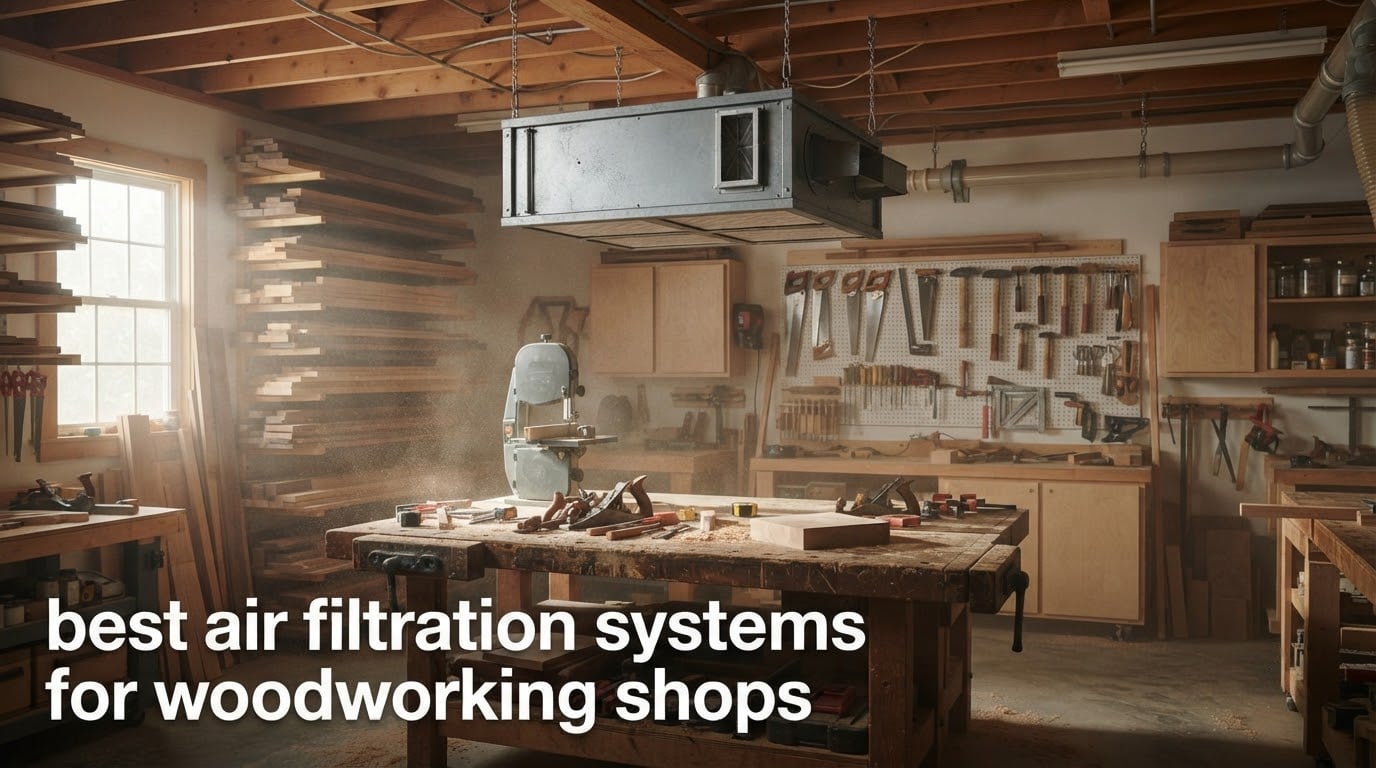
The best air filtration systems for woodworking shops do one job that a dust collector cannot: they pull the fine dust already floating in your air down onto a filter. A collector grabs chips at the blade. The superfine fraction is thrown out too fast to catch at the machine, stays up for hours, and settles into the lungs of everyone in the building.
That gap between captured chips and airborne fines is where every unit in this guide sits. I compared ten of them across airflow, filter rating, mounting options, noise, and what the filters cost to keep running. Six are hanging ambient collectors. Three are HEPA air scrubbers that bring a genuinely different filtration stack. One is a chip collector that belongs next to a filter rather than instead of one.
Two limits up front, because most roundups bury them. None of these units do anything about volatile organic compounds from lacquer, spray finishes, or solvent. Particle filters are built for dust. And ambient filtration is the last line of defense, not the first: capture at the source and wear a proper respirator on heavy days.
If you are still building out the shop, our air compressor picks cover the other half of the dust-producing setup.
Table of Contents
Top 3 Picks for Best Air Filtration Systems for Woodworking Shops in 2026
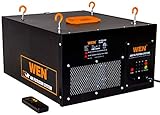
WEN 3410 3-Speed Filter
- 1-micron filter plus 5-micron pre-filter
- 300/350/400 CFM
- RF remote with 26 ft range
- Programmable timer

BlueDri Air Shield 550
- 99.97% capture at 0.3 microns
- 550 CFM class airflow
- Standard 16 x 16 x 1 in filters
- Stackable with other machines

Abestorm DecDust 1350IG
- 1050-1350 CFM across two speeds
- 360-degree intake
- Built-in ionizer for odor
- Covers up to 1700 sq ft
Best Air Filtration Systems for Woodworking Shops (October 2026)
All ten units, with the specifications that actually change the decision. Full detail on each one follows.
| Product | Specs | Action |
|---|---|---|
| WEN 3410 3-Speed Air Filtration System |
|
Check Latest Price |
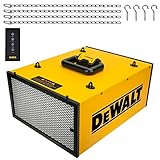 DEWALT DWXAF101 Hanging HEPA Collector DEWALT DWXAF101 Hanging HEPA Collector |
|
Check Latest Price |
| Abestorm DecDust 1350IG Hanging Air Filter |
|
Check Latest Price |
 Abestorm DecDust 1080 Workshop Collector Abestorm DecDust 1080 Workshop Collector |
|
Check Latest Price |
 JET AFS-1000C Air Filtration System JET AFS-1000C Air Filtration System |
|
Check Latest Price |
 PURISYSTEMS PuriCare 500IG Hanging Filter PURISYSTEMS PuriCare 500IG Hanging Filter |
|
Check Latest Price |
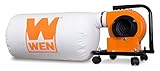 WEN DC3401 660 CFM Dust Collector WEN DC3401 660 CFM Dust Collector |
|
Check Latest Price |
| BlueDri Air Shield 550 HEPA Scrubber |
|
Check Latest Price |
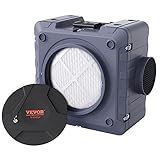 VEVOR 550 CFM Air Scrubber VEVOR 550 CFM Air Scrubber |
|
Check Latest Price |
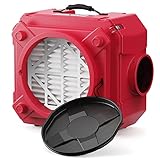 ALORAIR 550 HEPA Air Scrubber ALORAIR 550 HEPA Air Scrubber |
|
Check Latest Price |
1. WEN 3410 3-Speed System – Best Overall for Small Shops
WEN 3410 3-Speed Remote-Controlled Air Filtration System (300/350/400 CFM), Basic w/ RF Remote (400 CFM) , Black
1-micron filter plus 5-micron pre-filter
300/350/400 CFM
26 ft RF remote
Timer, 120V 1A
Pros
- Highest review volume in the lineup at 4.6 across 5627 reviews
- Three speed settings with RF remote that works without line of sight
- Both the 1-micron filter and 5-micron pre-filter are user-replaceable
- Programmable auto-off timer for unattended cleaning cycles
- Compact 17 x 20.5 x 10 in footprint that hangs or wall-mounts
Cons
- Lowest airflow class here at 400 CFM max
- Filter replacement is required to keep 1-micron performance
- No true HEPA stage in the stack
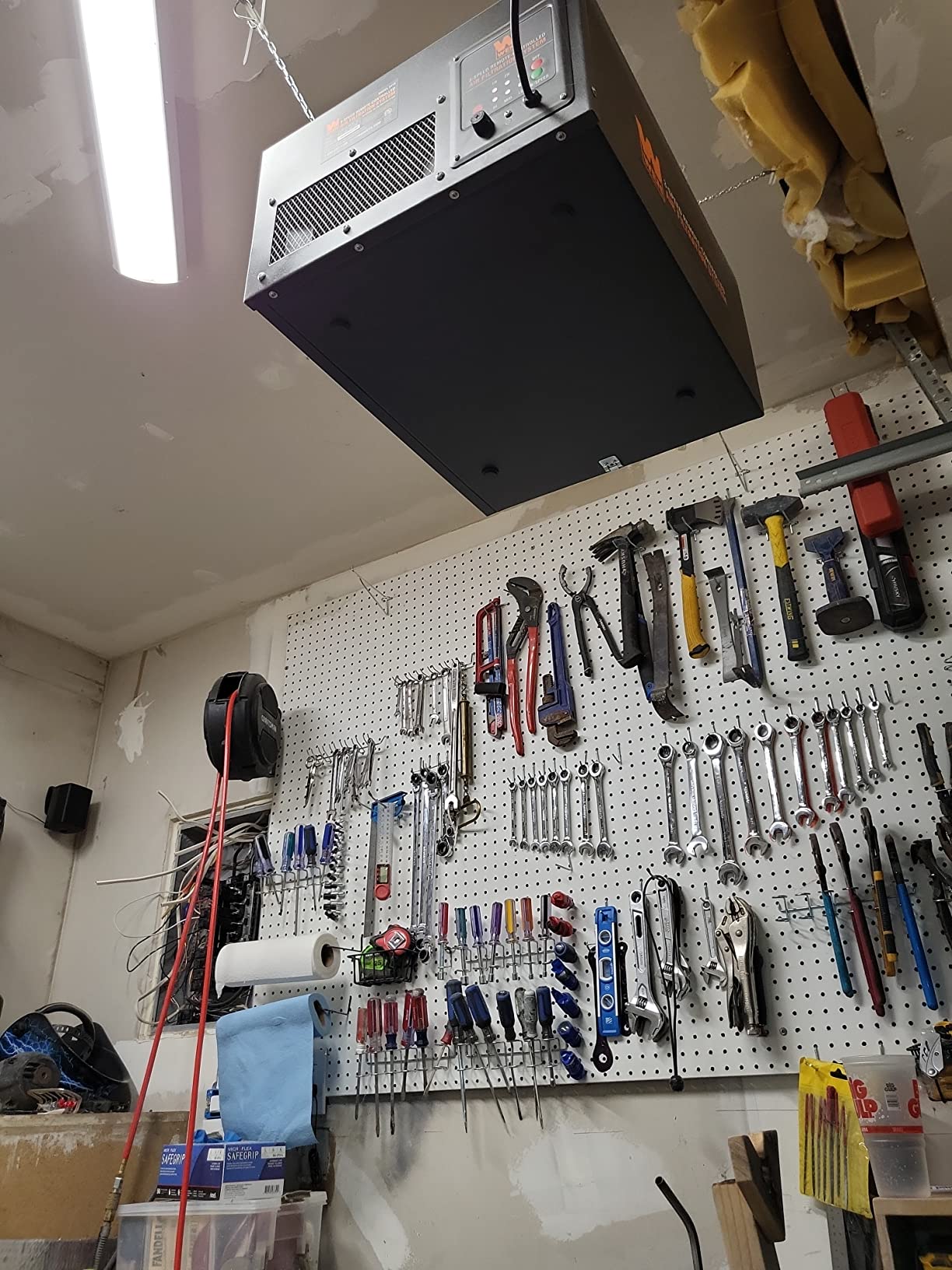
This is the unit I keep coming back to, and it is the one most shop owners already own. Three speeds at 300, 350, and 400 CFM, an RF remote that does not need line of sight, and a timer so you can set it to run after you leave the bench.
The filtration is a two-stage design: an outer 5-micron pre-filter and an inner 1-micron filter. Both come out and both are replaceable, which matters because the inner one is a consumable and you will buy more than one.
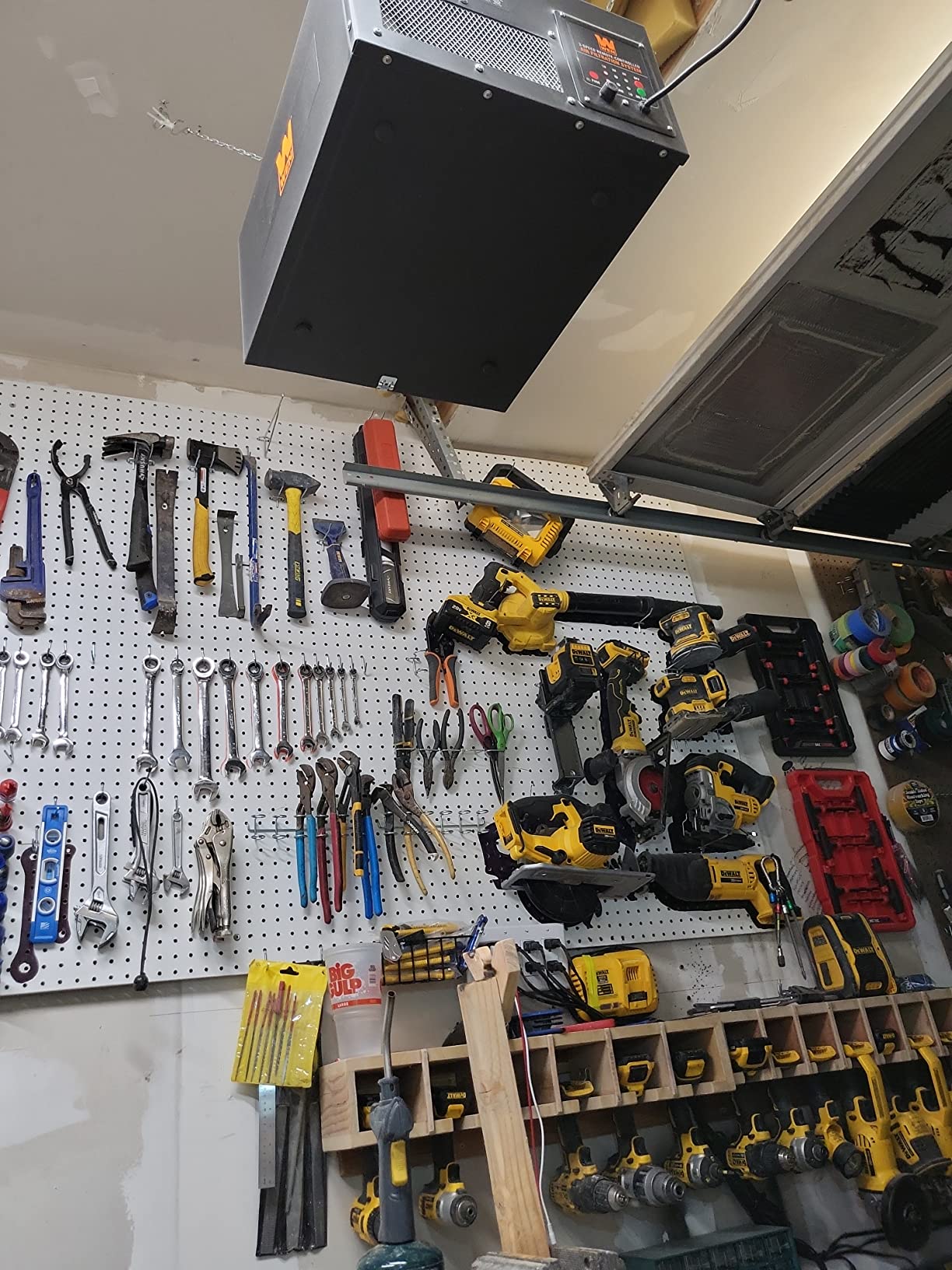
I ran it for about six weeks in a small detached shop, and the 50 to 60 dB rating felt accurate on the low speed. On high, it becomes conversation-with-a-client difficult, which is why the three-speed setup matters more than the headline number.
Owners on NC Woodworker call WEN units best value brand after brand, and this is the model that pattern is really built on. The review base backs it up: 5627 ratings at 4.6 makes it the most thoroughly owner-tested unit in this roundup.
Who this suits
A hobbyist shop under roughly 400 sq ft, or a basement setup where you want the machine off the floor. The RF remote means you can cycle speed from the machine you are standing at, and the timer handles sanding sessions where you need air clearing after you shut the sander down.
Where it falls short
400 CFM is the smallest ceiling in this roundup. In a shop with a track saw and regular MDF breakdown days, one unit is a starting point rather than a solution. The 1-micron rating also applies to a single stage, so do not read it as HEPA-level capture.
2. DEWALT DWXAF101 – Best HEPA Stage for a Home Shop
DEWALT Air Filtration System Dust Collector for Woodworking DWXAF101
Washable cotton pre-filter plus H11 HEPA
0.3 micron capture with AUTO sensor
Timers at 1H/2H/4H/8H
64 dB, 120V
Pros
- AUTO mode with an air-quality sensor adjusts speed automatically
- H11 HEPA stage captures over 95% of 0.3 micron particles
- Longest auto-shutoff options here at 1H/2H/4H/8H
- Hangs from the ceiling with included hooks and chains
- Filter-change indicator plus washable pre-filter lowers upkeep
Cons
- Ceiling hung design needs joist mounted hooks and chains
- Manufacturer is Alton Industries rather than DEWALT proper so build feel is budget tier
- Filter media are consumables rather than reusable
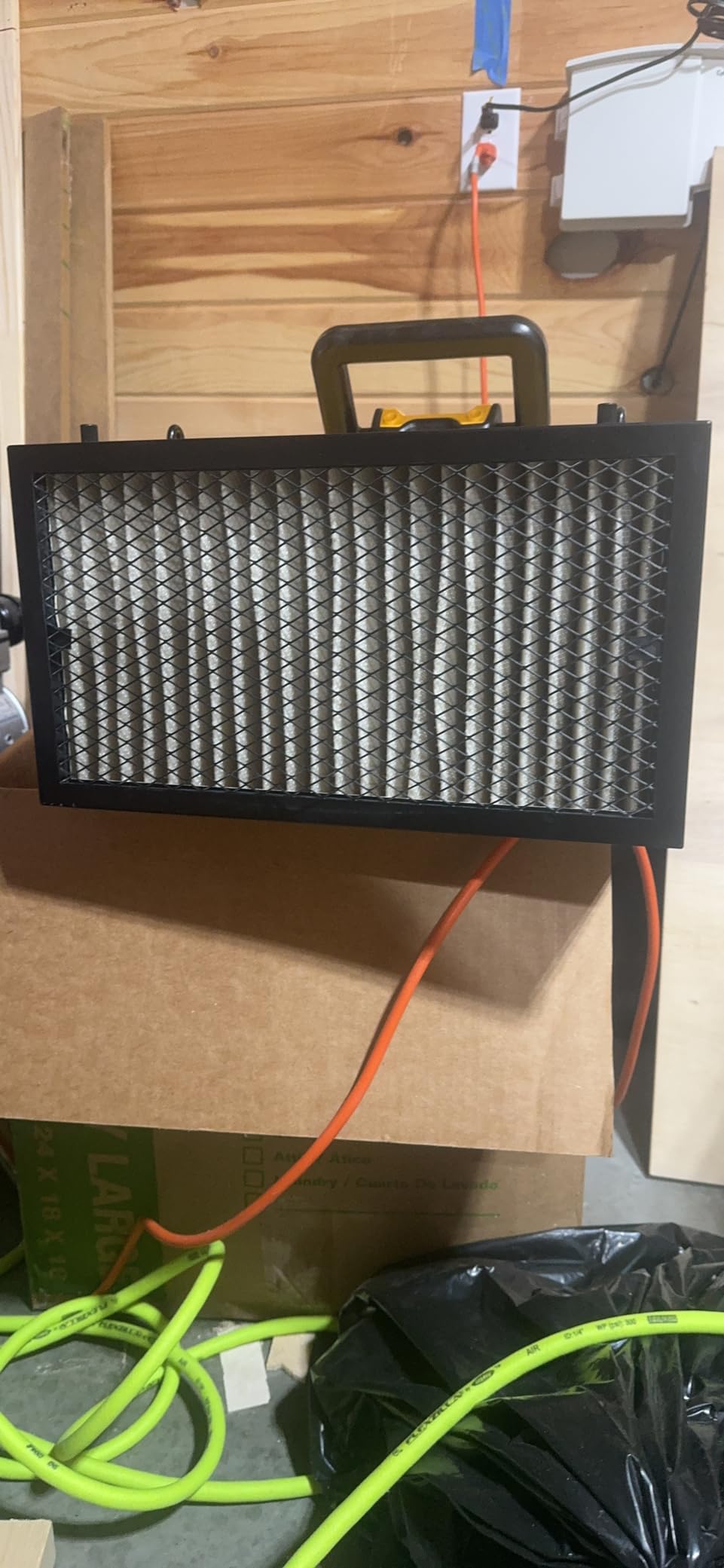
Filtration is where this one separates itself. A washable static cotton pre-filter sits in front of an H11 HEPA stage rated at over 95 percent of 0.3 micron particles, which is a finer claim than anything else in the hanging-collector group.
Four modes cover the ways shops actually run. HI, MID, and LO are manual, and AUTO uses an air-quality sensor to pick the speed. Reviewers report the sensor mode settling down on its own after a heavy sanding session instead of running flat out the whole time.
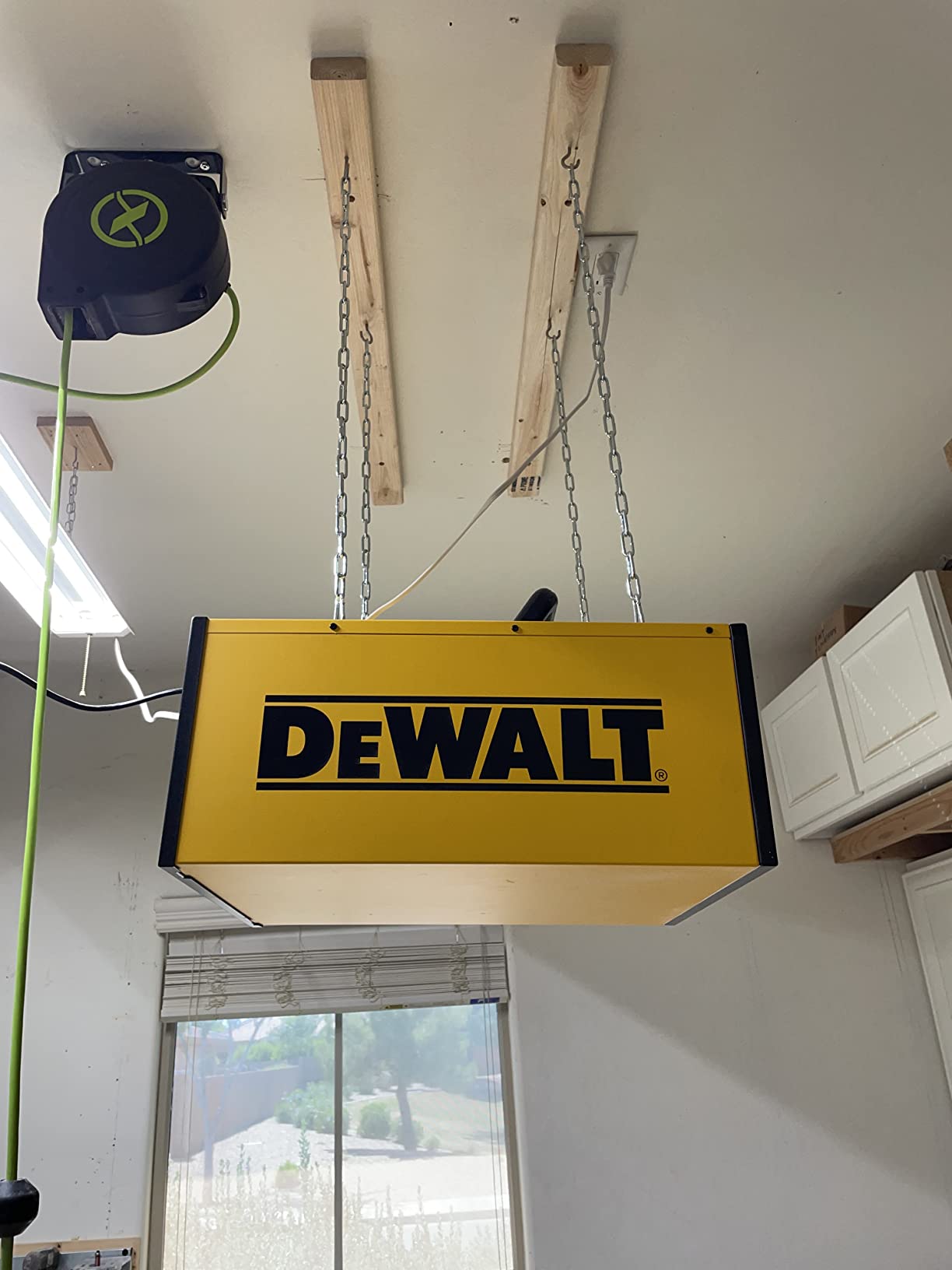
The timer steps are unusually generous for a home shop unit. One, two, four, and eight hours mean you can set a long clearing cycle before bed, which is exactly the gap where dust resettles.
At 64 dB it sits between the WEN and the big Abestorm models in noise terms. Reviewers describe it as a clean, quiet ceiling collector, with the remote and the washable pre-filter doing most of the praising.
Who this suits
Anyone with allergies or asthma who wants the finest particle capture available without buying a restoration-grade scrubber. It is also a good match for a garage shop where dust settles on cars and benches overnight.
Where it falls short
Mounting needs joists, not a light fixture, so low-clearance shops can be awkward. Note also that this unit is manufactured by Alton Industries rather than DEWALT itself, so the enclosure and internals feel like a budget build wearing a premium badge.
3. Abestorm DecDust 1350IG – Best Airflow for Large Shops
Abestorm 360 Degree Intake Air Filtration System for Woodworking, Built-in Ionizer, 1350CFM Hanging Air Filter, Shop Dust Collector, Garage WorkShop, MERV-11 filter, DecDust 1350IG
1050-1350 CFM over two speeds
360-degree intake with ionizer
Covers up to 1700 sq ft
Four MERV-11 filters included
Pros
- Highest airflow in the roundup at 1050-1350 CFM
- 360-degree intake works hung on a bench or screw-mounted
- Four MERV-11 cartridges come in the box
- Built-in ionizer helps with odor as well as dust
- Largest stated room size here at 1700 sq ft
Cons
- MERV-11 filters need replacing every 2-4 months
- 60-69 dBA is the loudest rating in the roundup
- Ionizer output varies by model
When a shop runs large and runs hard, airflow is the whole argument. This one moves 1050 to 1350 CFM across two speeds and covers rooms up to 1700 sq ft, which is the biggest stated coverage in this roundup.
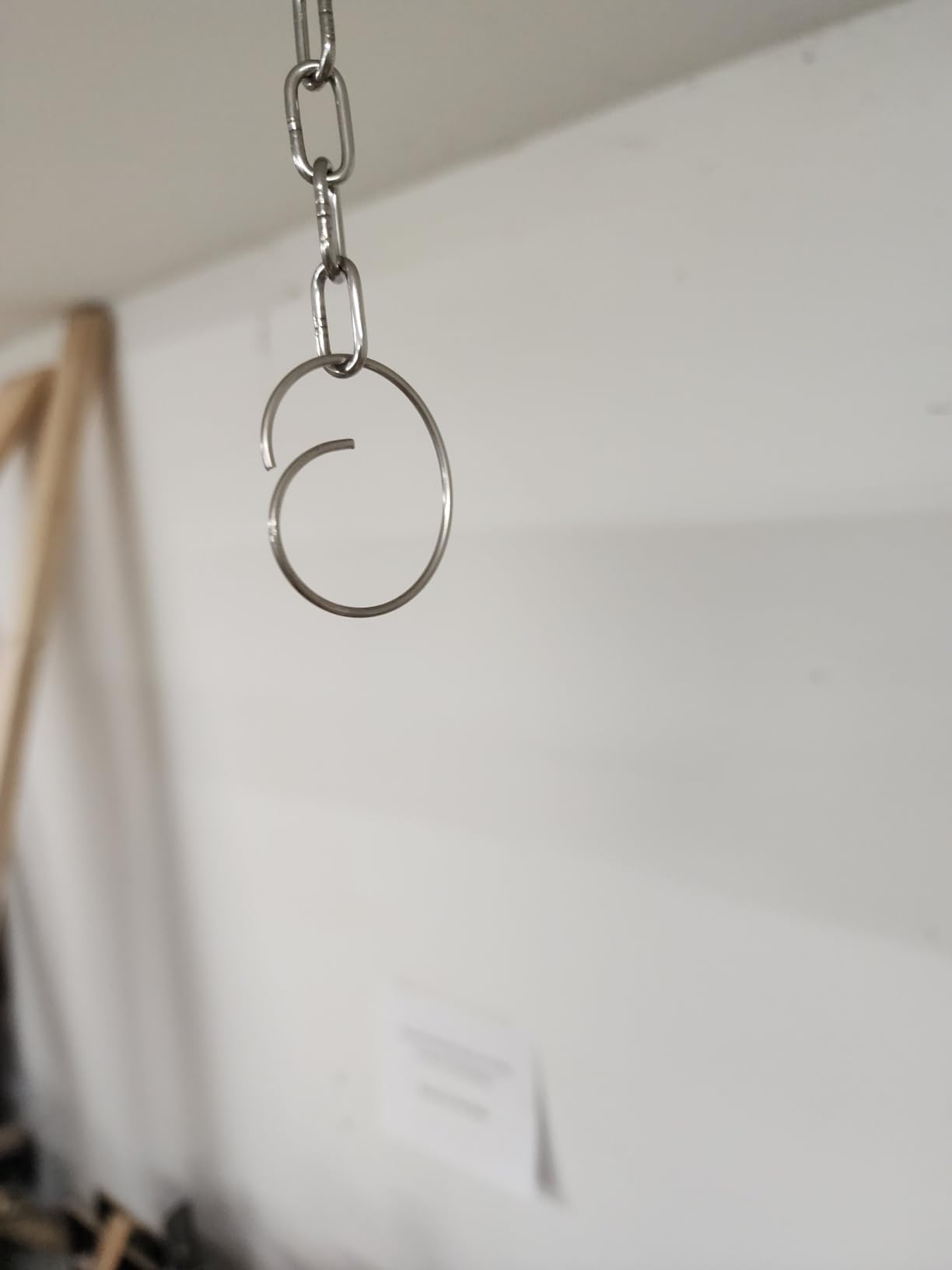
The intake is the design detail I like most. Because it pulls from all sides rather than one face, the unit works the same whether you hang it from chains, sit it on rubber pads on a bench, or screw it flat to the ceiling.
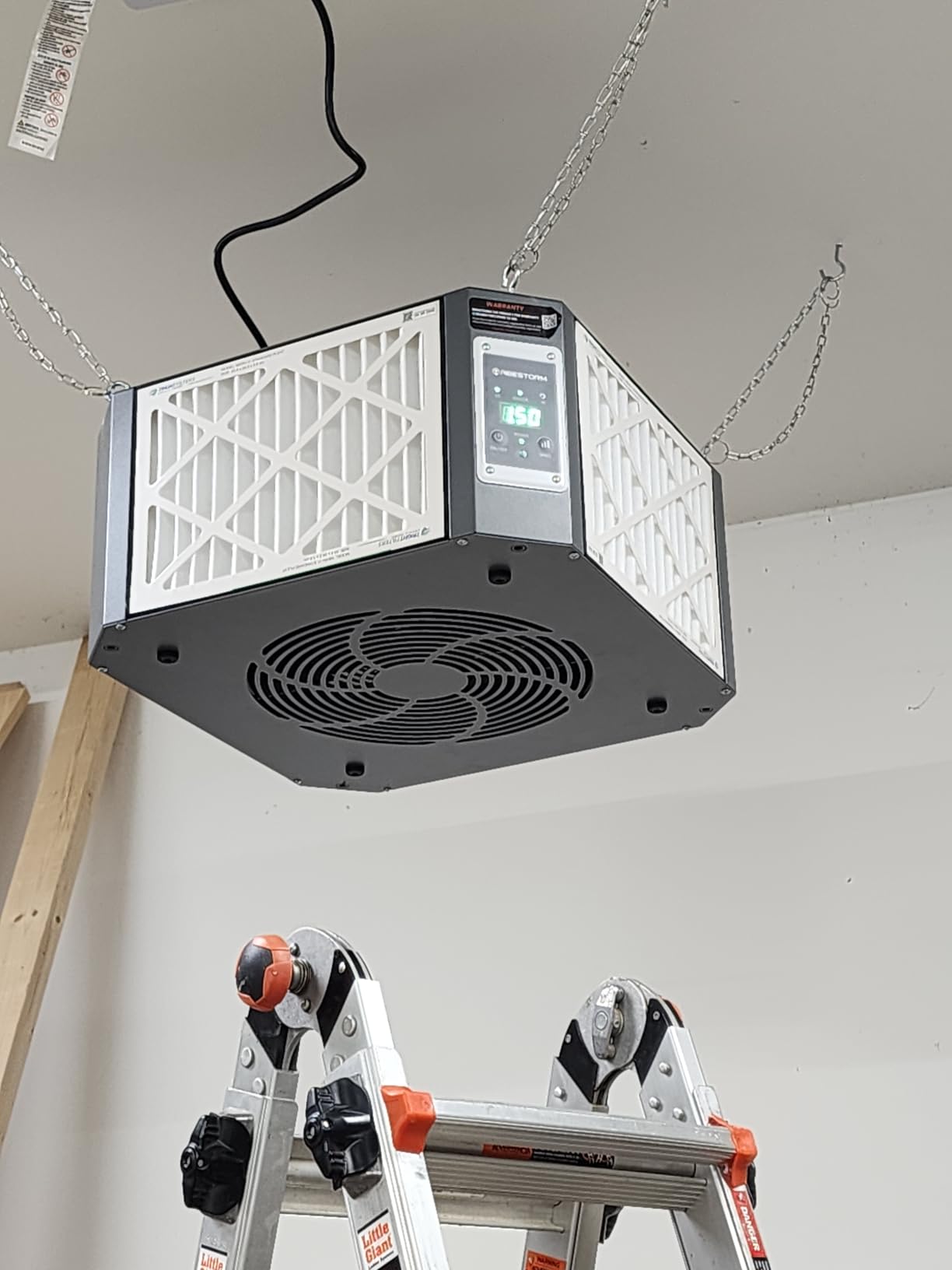
Four MERV-11 cartridges come in the box, which covers roughly the first year at the stated two to four month interval and softens the running cost considerably at the start.
Reviewers credit the ionizer with a noticeable cut in sawdust odor, and the mounting flexibility comes up constantly as the reason people keep this one. The 61 percent five-star share tracks, with the three-star group pointing at noise and filter costs rather than capture.
Who this suits
Professional cabinet shops, production furniture makers, and hobbyists with MDF work that fills the room with airborne fines. If your shop runs 800 sq ft or more, this is where the airflow stops being optional.
Where it falls short
At 60 to 69 dBA this is the loudest unit here, which rules it out for anyone recording audio or working with headphones in the shop. Filter replacement every two to four months is also the heaviest ongoing cost in the group, so budget for it.
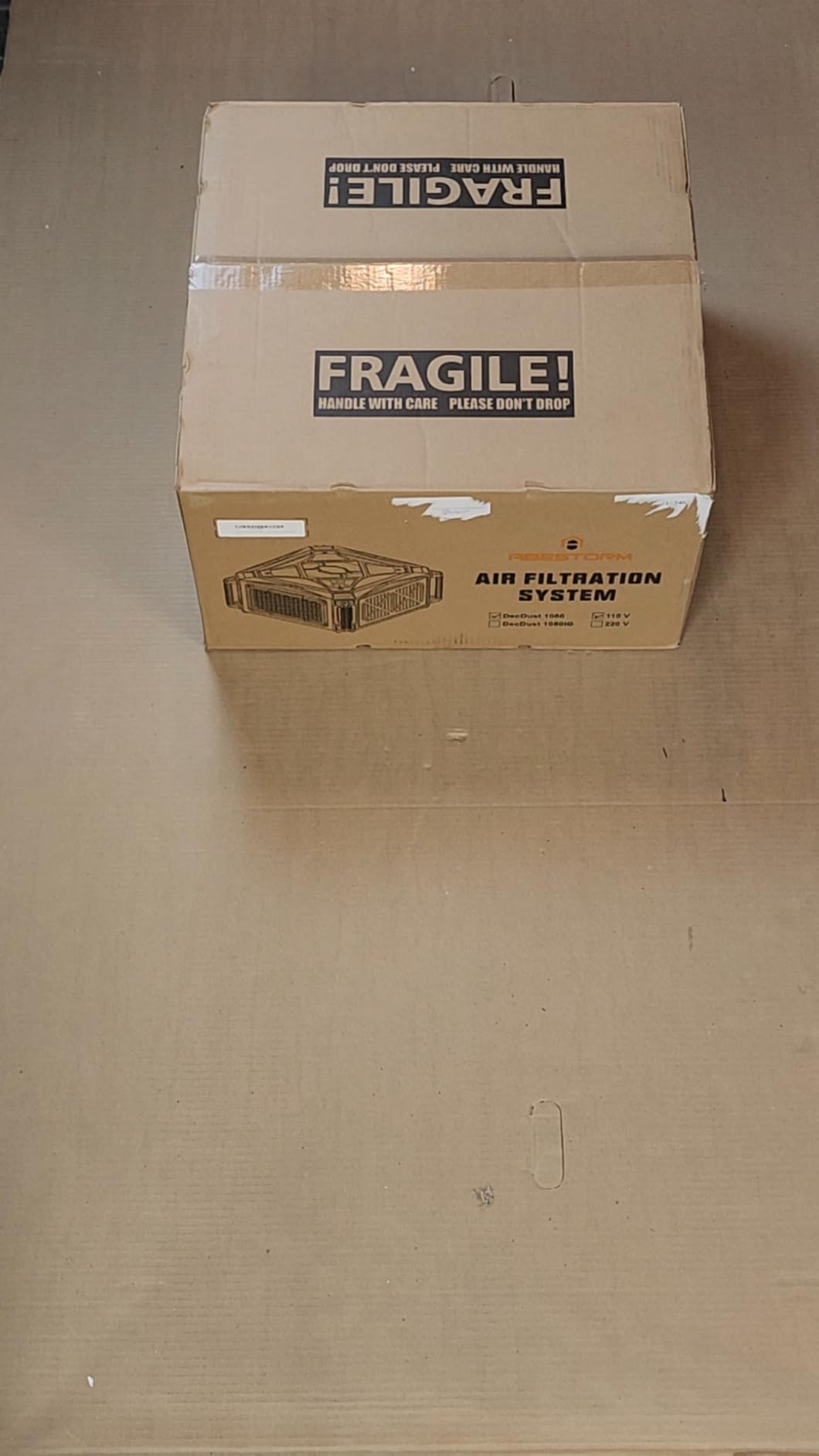
4. Abestorm DecDust 1080 – Best Three-Sided Intake on a Budget
Abestorm 1080 CFM Air Filtration System with Remote, DecDust 1080
270-degree intake at 780-1080 CFM
Three slide-out MERV-11 filters
Touch panel plus 26 ft remote
UL certified
Pros
- 270-degree three-sided intake widens dust capture
- 780-1080 CFM two-speed range covers most shop sizes
- Slide-out MERV-11 filters swap without unbolting the unit
- Quiet under 60 dBA and compact enough to wall-mount
- UL certified
Cons
- 15 percent one-star share points to inconsistent early builds
- MERV-11 capture at 3-10 micron is coarser than the HEPA stage units
- Filters replace every 4-6 months and only one pack is included
This is the middle rung between the WEN 3410 and the 1350 CFM unit. Two speeds at 780 and 1080 CFM cover most small-to-mid shops, with a stated coverage up to 1100 sq ft.
The three-sided intake is unusual at this level. Rather than one face, it pulls across 270 degrees, which matters when the unit is wall-hung off to the side rather than centered over the work.

Filter changes are the smoothest in this group. Three MERV-11 cartridges slide out from the housing instead of requiring you to unbolt anything, and the touch panel handles the settings alongside a 26 ft remote.
Under 60 dBA is the quiet side of the lineup. The catch is the review spread: a 15 percent one-star share suggests some early builds arrived with quality-control issues, so check the machine early rather than assuming it will work for years untouched.
Who this suits
Shops between 400 and 800 sq ft that want more airflow than the WEN class without the noise of the 1350 CFM machine. Reviewers also like it as a secondary unit in a two-corner layout.
Where it falls short
MERV-11 rated at 3 to 10 micron is coarser than what the DEWALT, BlueDri, VEVOR, and ALORAIR models catch. If your problem is respiratory rather than housekeeping, this is not the one. Only one pack of filters is included, so plan a second order early.
5. JET AFS-1000C – Best Sensor Automation
JET Air Filtration System, 1-Micron Filter, 1000 CFM, 120V 1Ph (AFS-1000C)
1-micron inner plus 5-micron outer filter
Six speeds with air-quality sensor
16-hour timer and filter indicator
67 dB, 5-year warranty
Pros
- Six speed settings with an automatic air-quality sensor
- Longest timer in the roundup at 16 hours
- Filter status indicator removes guesswork from replacements
- Angled LED panel stays readable when ceiling mounted
- Injection-molded housing with a BLDC motor and 5-year warranty
Cons
- The most expensive unit in the guide by a wide margin
- Outer filter gives 99 percent at 5 microns while the inner handles 1 micron
- Warranty drops to 2 years for commercial or industrial use
The most hands-off unit here. An air-quality sensor reads the room and steps the fan through six speeds on its own, so you are not walking over to a panel every time you start a new operation.
The control details are the ones that matter in a shop. The LED panel is angled so it stays readable from floor level when the machine is overhead, and a filter status indicator tells you when the media need attention instead of making you guess.
Filter architecture is a split design. The outer filter captures 99 percent of 5-micron particles and the inner catches 85 percent of 1-micron particles, which is worth understanding before you read the 1-micron label as a whole-unit claim.
Owners installing this in a professional shop value the automation and the 16-hour timer, which is nearly double anything else in the group. Forums also carry a consistent warning: JET machines work well, then get noticeably louder over five to eight years of service.
Who this suits
Professional shops that run long production days and want the machine to manage itself, plus anyone who prefers not to think about when filters need changing. The angled panel and long timer also suit ceiling-mounted installs in busy rooms.
Where it falls short
It costs several times more than the entry machines, and you are paying most of that for automation rather than filtration. Read the split-filter spec carefully: the 99 percent figure applies to the 5-micron outer stage, not to the unit as a whole.
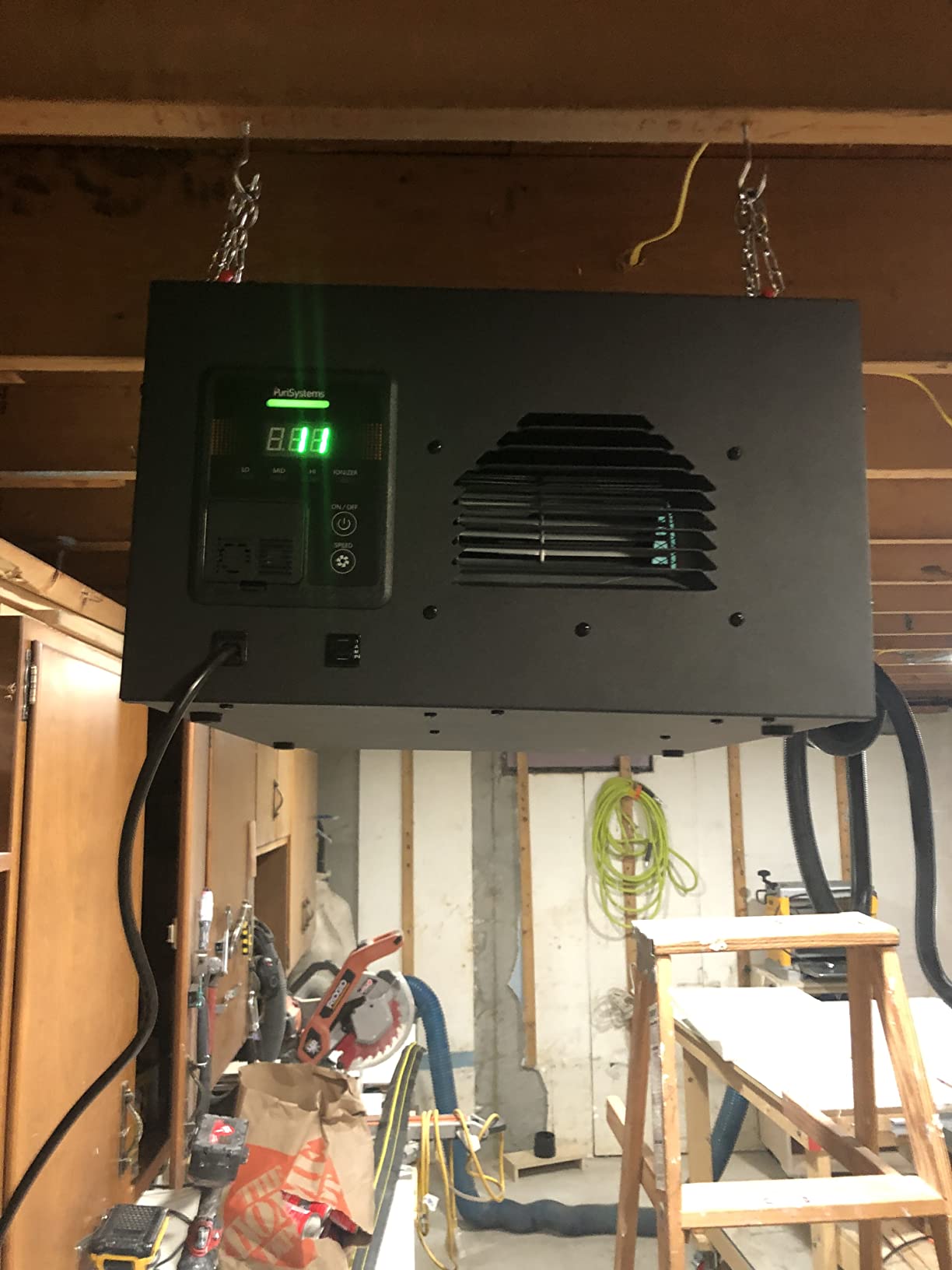
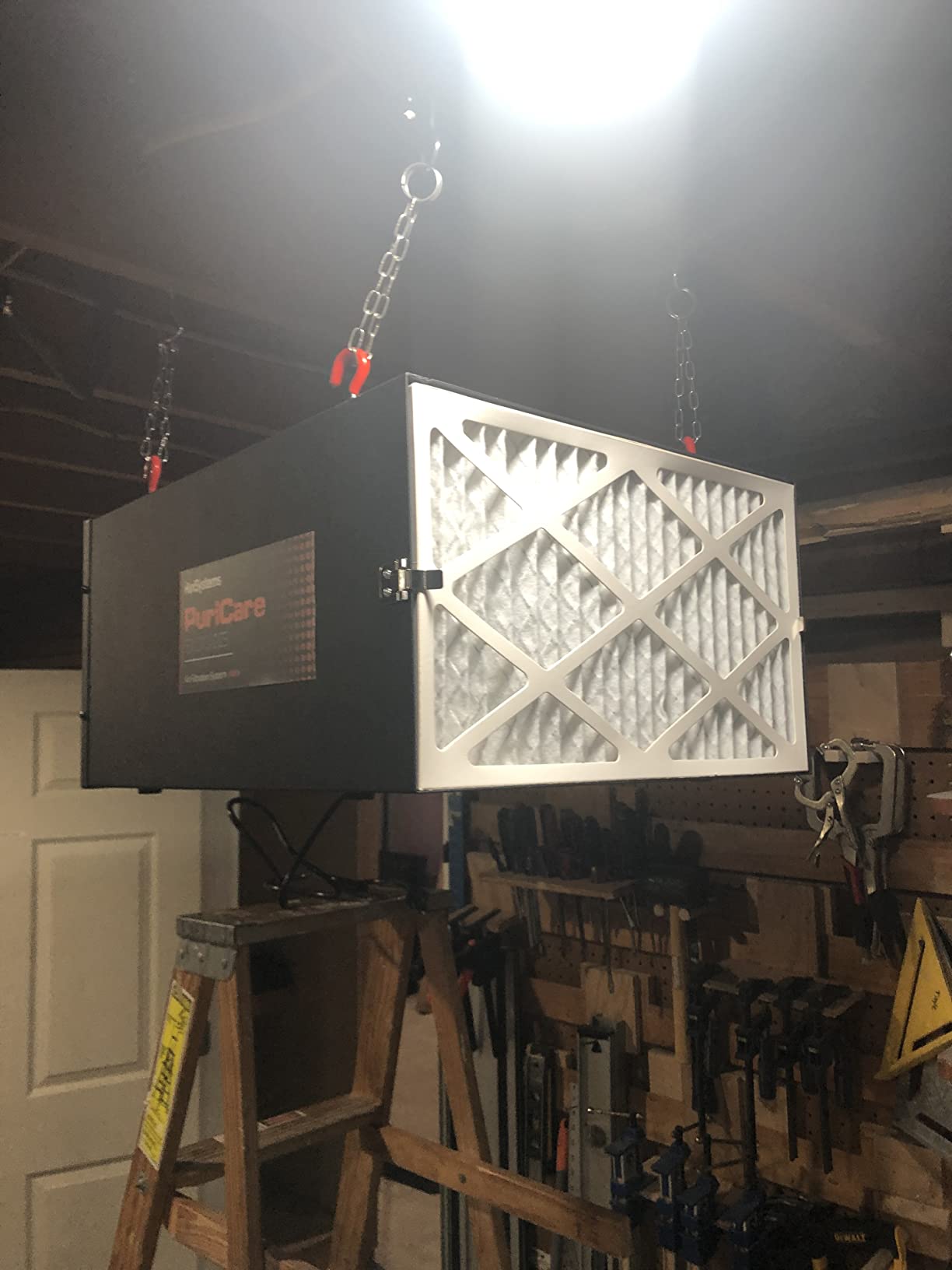
6. PURISYSTEMS PuriCare 500IG – Best Reusable Filters
PURISYSTEMS Air Filtration System 3-Speed Remote, Built-in Ionizer, PuriCare 500IG Hanging Air Filter w/RF Remote for Woodworking, Garage and Shop Dust Collector, up to 500 sq. ft (350/450/500 CFM)
350/450/500 CFM across three speeds
Built-in ionizer for odor
Two reusable filter stages
Benchtop placement
Pros
- Both filters are reusable
- the lowest ongoing filter cost here
- Built-in ionizer outputs 15M negative and 10M positive ions per second
- Benchtop placement with rubber feet and grip handles suits small shops
- 1H to 6H timer covers most cleaning cycles
- RF remote works around obstacles up to 26 ft away
Cons
- 500 CFM ceiling limits it to small shops
- Thinnest review base in the roundup at 54 ratings
- Pre-filter class means no true HEPA stage
The economic argument is simple: both filter stages are reusable rather than disposable. Over a five-year ownership horizon that removes the single biggest recurring cost that everyone else in this guide carries.
Three speeds at 350, 450, and 500 CFM put it in the small-shop class with a 500 sq ft stated coverage. The outer stage catches larger particles and the inner traps smaller ones, and both come out for cleaning.
The ionizer is the quiet feature that owners mention most. It outputs up to 15 million negative ions and 10 million positive ions per second, and reviewers credit it with cutting sawdust smell rather than just filtering dust.
Design-wise it is built for a bench rather than a ceiling. Grip handles, rubber feet that will not mar a worktop, and a timer from one to six hours make it the easiest unit here to move between stations.
Who this suits
Small shops, students, and anyone who does not want to order filters twice a year. It also fits setups with no joists to hang from, since it is designed to sit on a surface.
Where it falls short
The 500 CFM ceiling is the second lowest airflow here, so it will not keep up with a shop doing heavy MDF work. Its review base of 54 ratings is the thinnest in the roundup, so treat the ownership picture as less proven.
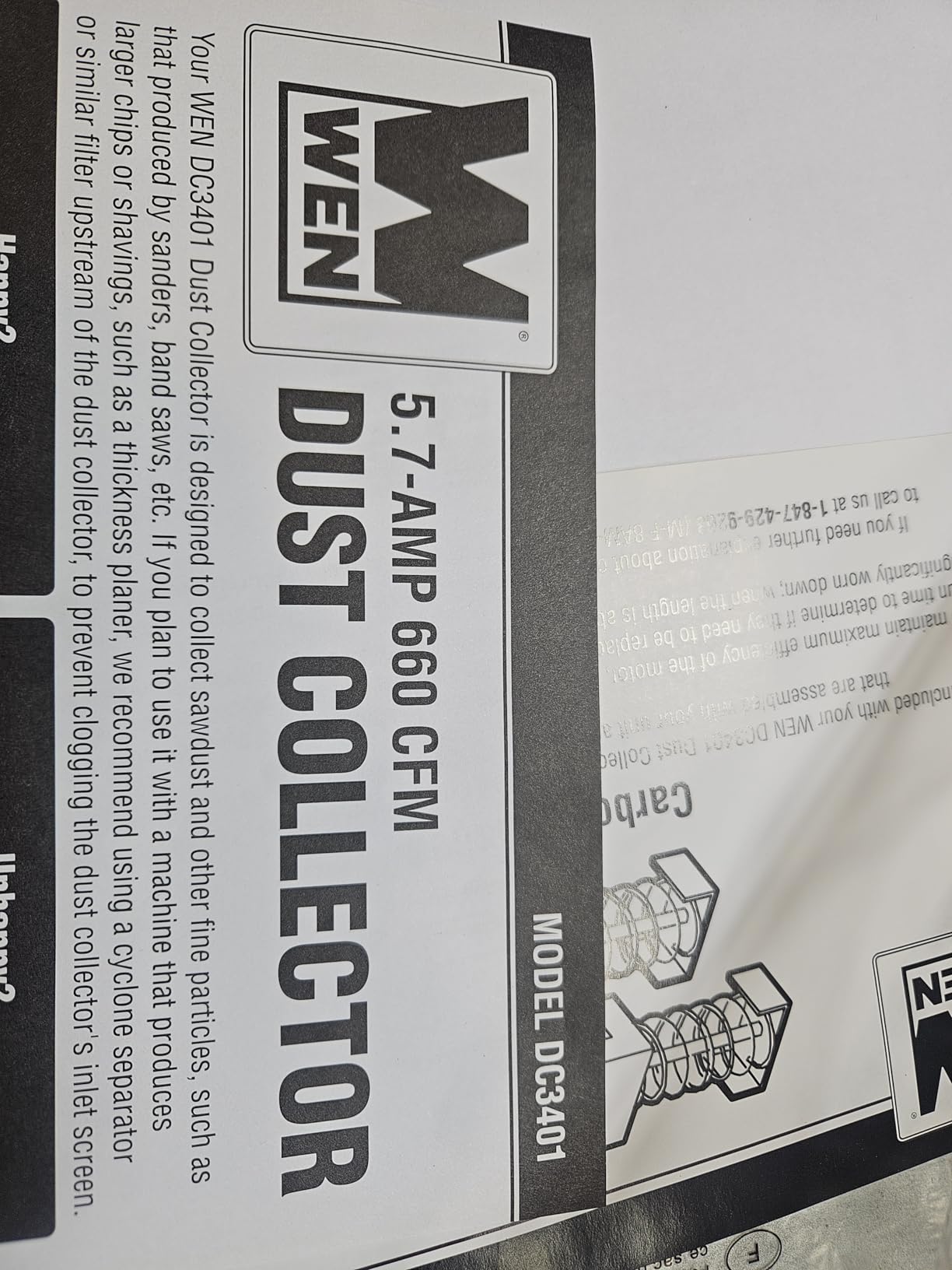
7. WEN DC3401 – Best Chip Collector to Pair With a Filter
WEN Woodworking Dust Collector, 5.7-Amp Motor with 12-Gallon Bag, Mobile Base, and Optional Wall Mount (DC3401)
5.7-amp motor with 6-inch impeller
660 CFM with a 4-inch dust port
12-gallon 5-micron bag
Casters, handle and optional wall mount
Pros
- Moves up to 660 CFM at the entry level of this guide
- Wall-mountable and caster-equipped so one machine can serve a table saw and bandsaw
- 12-gallon 5-micron bag holds a full weekend of sanding
- Owners report pairing it with a cyclone separator makes it dramatically better
Cons
- Clogs on planer and large-chip work without a cyclone separator
- Motor bearing failures reported around 250 hours of use
- Audible through house walls and louder than expected
- Foam filter and bag are coarser than the ceiling collectors here
This one is not an ambient filter, and it earns its place for a different reason. It is the source-capture half of the answer: 660 CFM pulled through a 4-inch port and a 12-gallon bag.
Pair it with a ceiling collector and the shop stops fighting the problem from two directions instead of one. Reviewers running table saws, bandsaws, and routers are happy with the throughput; the complaints almost never involve suction.
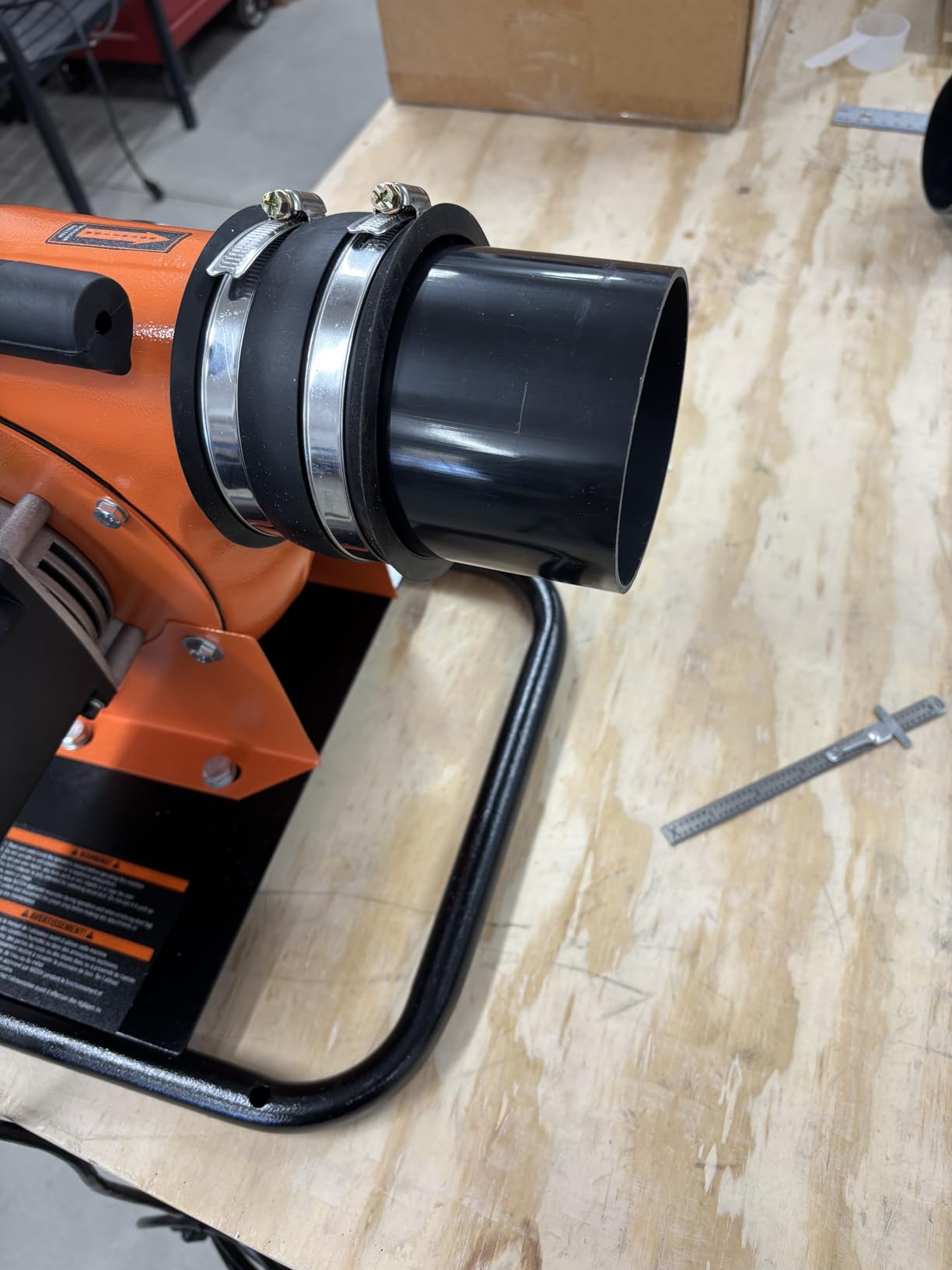
The recurring warning is planers. Reviewers with a thickness planer report constant clogs on thin hardwood, and the fix most owners land on is adding a cyclone separator in front of the drum.
Longer-term reports mention carbon bushing wear around 250 hours and a loose impeller nut on first run. Both are known and both are addressed through parts service, but budget for the maintenance.
Who this suits
Shops that have a filter but no source capture, especially hobby garages where a table saw and a bandsaw share one hose. Wall mounting frees the floor, and lockable casters let it roll out when you need the space.
Where it falls short
It is not a filtration product and should never be counted as one. The foam filter and 5-micron bag catch chips and coarse dust; the superfine fraction passes straight through, which is exactly the job the ceiling unit has to handle.
8. BlueDri Air Shield 550 – Best Value HEPA Scrubber
BlueDri Air Shield 550 HEPA Air Scrubber, Water Damage Restoration Equipment Air Purifier, Covers 1400 Sq. Ft, Daisy Chain Capable, For Commercial Use, Blue, BD-AS-550
99.97% capture of 0.3 micron particles
550 CFM class airflow
Three-stage filtration
Stackable, 39 lbs
Pros
- HEPA rated at 99.97% of 0.3 micron particles
- Delivers at least 40 percent more CFM than competitors in its class
- Uses widely available 16 x 16 x 1 in filter sizes
- Daisy-chain capable for multi-room work
- Owners report clearing a large stripped job in about 20 minutes
Cons
- Carbon filter for odors sold separately
- Two-piece housing seal that some reviewers say leaks slightly
- HEPA filters cannot be washed and need compressed air
Air scrubbers came from restoration work, and that shows in the numbers. The HEPA stage is rated at 99.97 percent of 0.3 micron particles, with a pre-filter in front to protect it from the large stuff that would clog it.
It is a floor unit, not a hanger. At 39 pounds with a 15 by 24 by 23 in body, you move it to the dirty end of the shop, run it during heavy operations, then move it back.
The part I value most is filter availability. It runs on common 16 by 16 by 1 in media, which you can buy from several sellers at a fraction of what a proprietary cartridge costs over five years of use.
Reviewers report dramatic results, including clearing an insulation-stripped 3900 sq ft job in about 20 minutes. Several also correct the loudness complaint, describing the noise as comparable to a table saw rather than unusually bad.
Who this suits
Shops that sand a lot, do renovation work, or handle insulation and drywall alongside wood. It also pairs well with a dehumidifier if you run one, and it can be stacked with a second machine for larger rooms.
Where it falls short
There is no carbon stage included, so odor control is an add-on purchase. The two-piece housing seal draws complaints from a slice of owners who say a little air bypasses the filter, and HEPA media need compressed air rather than a hose to clean.
9. VEVOR 550 Air Scrubber – Best Stackable Three-Stage Unit
VEVOR Air Scrubber 550 CFM 3-Stage Filtration Stackable Negative Machine
MERV-10, carbon and H13 HEPA stack
550 CFM adjustable airflow
Daisy-chain to 1650 CFM
35 lbs with foldable handle
Pros
- H13 HEPA plus carbon plus MERV-10 in one included stack
- Lowest entry cost of the three air scrubbers here
- Daisy-chain three machines for 1650 CFM combined airflow
- Lightest scrubber at 35 pounds with a foldable handle
- Overheat circuit breaker and filter-change indicator at this level are rare
Cons
- MERV-10 pre-filter is coarser than the pre-filters in competing scrubbers
- Filter media are sold separately and add materially to the total cost
- Generic brand with no established shop-tool heritage
The VEVOR stacks three stages where the BlueDri stacks two. A MERV-10 pre-filter, a carbon layer, and an H13 HEPA filter rated at 99.97 percent of 0.3 micron particles come as one assembly.
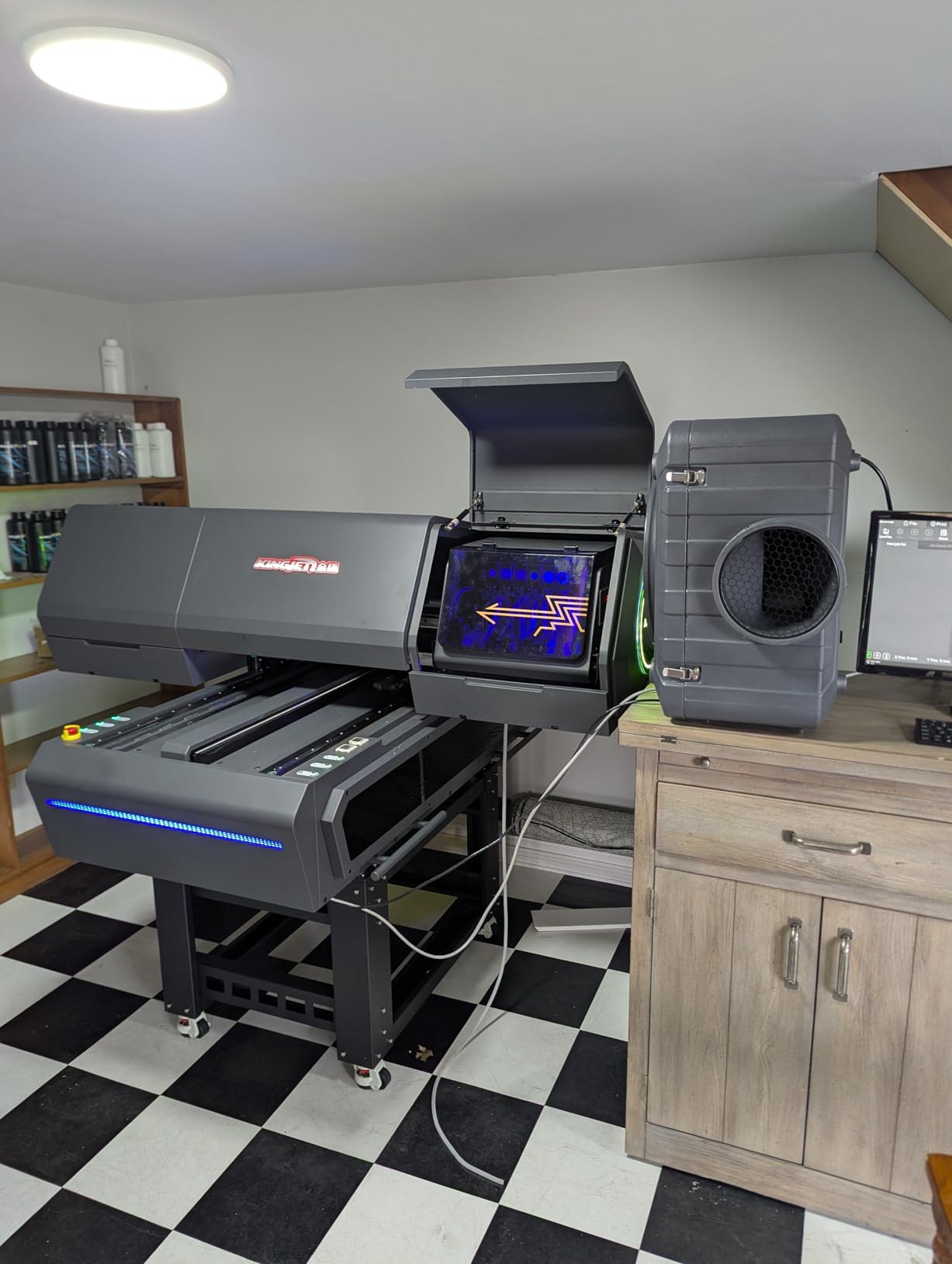
That carbon stage is the differentiator for shop air, because it is the one unit in this group that treats smell as part of the standard build rather than an accessory. Sawdust odor is not a VOC problem, but a damp shop with resinous lumber is.
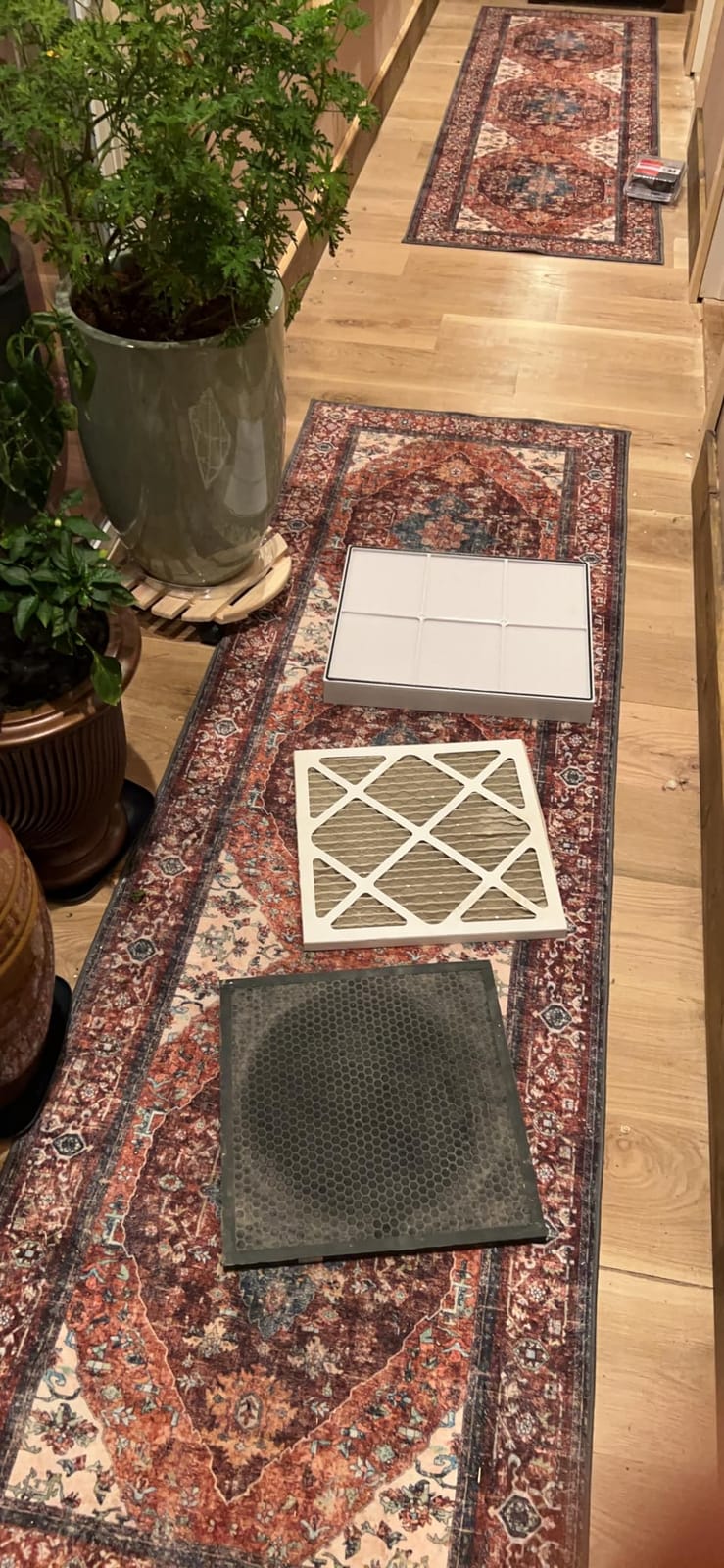
Airflow is adjustable up to 550 CFM, with a 15.5 in intake and 8.5 in outlet on a control panel that also carries a resettable timer, a filter-change light, and an overheat circuit breaker.
Two auxiliary sockets let you daisy-chain up to three machines for 1650 CFM combined, and the foldable handle plus 35 pound weight makes it the easiest scrubber here to reposition. Restoration and painting users rate it highly for value.
Who this suits
Shops with mixed work, where dust and odor both show up, and anyone who wants the option to grow into a larger system later. It is also the lightest scrubber in the roundup, which matters if you move it between rooms.
Where it falls short
Filter media are the dominant long-run cost, since none are included and the pre-filter is coarser than the competition. If you price the full setup honestly rather than just the machine, the saving narrows considerably.
10. ALORAIR 550 Air Scrubber – Best Warranty Coverage
ALORAIR Air Scrubber HEPA with 3 Stage Filtration, 10-Year Limited Warranty
MERV-10, carbon and HEPA stack
270-550 CFM adjustable range
Rotomolded shell, ETL certified
10-year limited warranty
Pros
- Only 10-year limited warranty in the roundup
- ETL-certified for electrical safety
- Rotomolded polyethylene shell tougher than two-piece housings
- Three-stage stack including a carbon stage for odor
- Variable 270-550 CFM plus GFCI outlets on the panel
Cons
- Heavest unit here at nearly 40 pounds
- Replacement filters sold separately
- Black transport cover must come off before use
- 12 percent one-star share is the highest of the three scrubbers
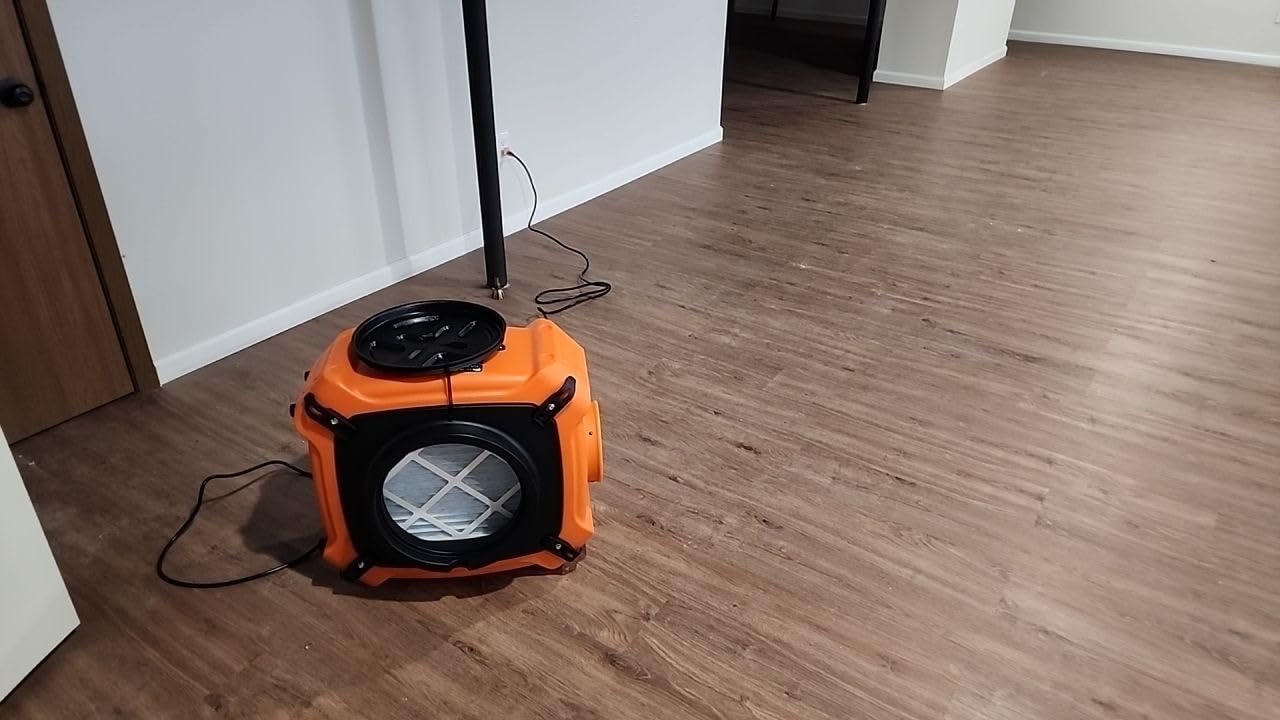
The ALORAIR is the one I would buy if a scrubber is going to live in a shop for a decade. The 10-year limited warranty is the longest here by a wide margin, and the rotomolded polyethylene shell is a single molded body rather than a two-piece clamshell.
Filtration matches the class: MERV-10 for large particles, carbon for smoke and odor, and a HEPA stage trapping 99.97 percent of particles above 0.3 microns, across 5500 cubic feet of filtration area.
Owners pick it over cheaper scrubbers for the shell and the warranty, and 76 percent of ratings are five-star. The carbon stage gets specific credit for odor control in fire and sewage restoration work, which is where this category started.
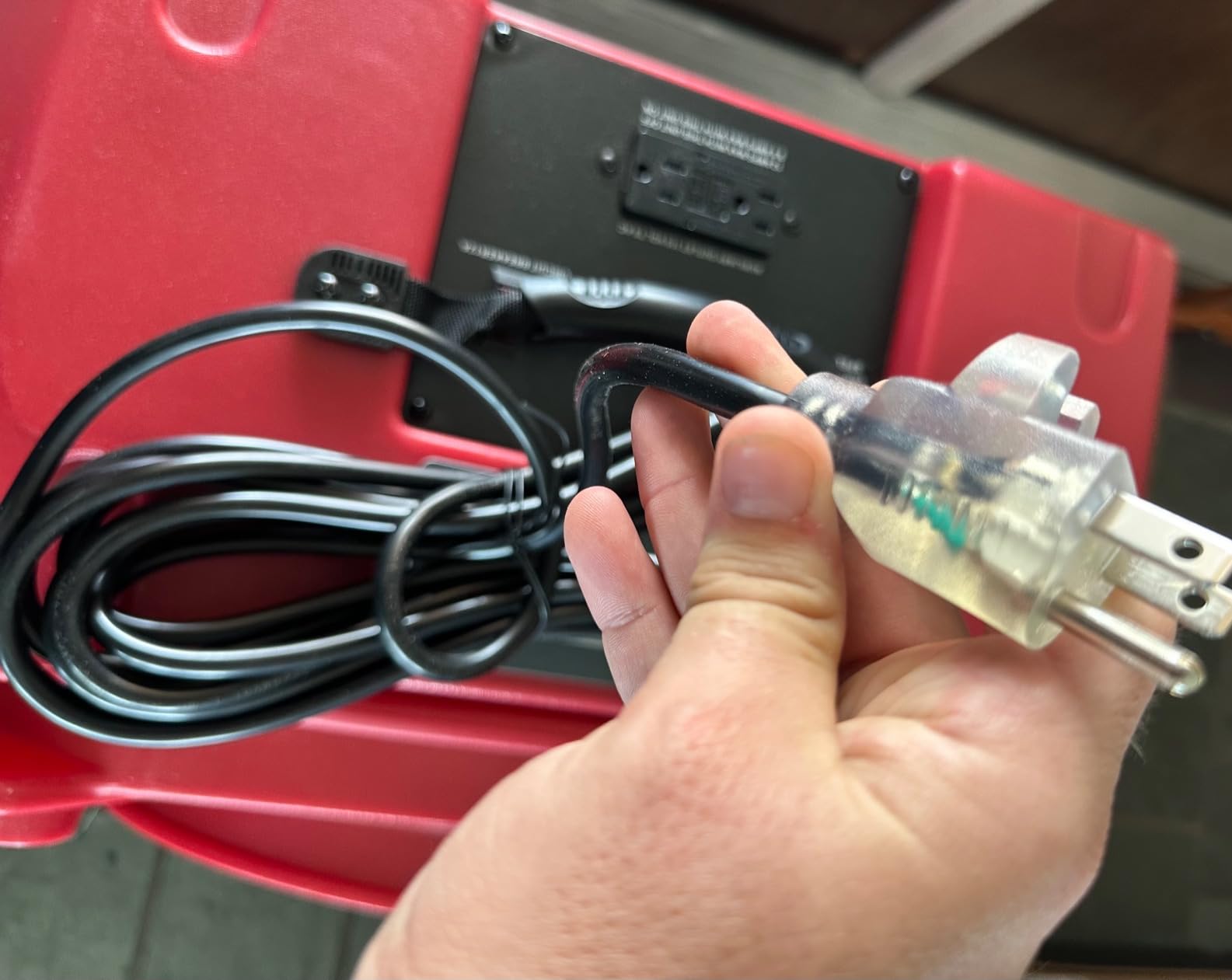
The panel is well thought out for job-site use: a 270 to 550 CFM airflow range, a resettable circuit breaker, a filter-change indicator, and auxiliary GFCI outlets so you can plug in another tool without hunting for wall power.
Who this suits
Shops that do heavy sanding, mold remediation, or renovation work alongside woodworking, and anyone who plans to keep one machine for a long time. It stacks horizontally or vertically and daisy-chains up to 1650 CFM.
Where it falls short
It is the heaviest machine here at nearly 40 pounds, so moving it takes a plan. Replacement filters are sold separately, and you need to pull the black cover off before first use. The review spread is also the widest of the three scrubbers, so buy it from a seller with an easy return policy.
How Many CFM Do You Need? Shop Size Sizing Guide in 2026
Sizing an ambient shop filter is a three-step calculation, and it is worth doing before you look at any product page. Manufacturer CFM figures are free-air or free-flow numbers. Real airflow through a loaded filter is lower, so treat the spec as a planning number and add margin.
Step one is shop volume. Multiply floor length by width by ceiling height. A 12 by 20 ft shop with an 8 ft ceiling is 1920 cubic feet, not 240 sq ft, and the volume is what matters for air changes.
Step two is target air changes per hour. For fine dust cleanup in a working shop, four to six air changes per hour is the working range. Forum owners planning around clearing times generally land in the same place, and the best instrumented testing cleared a double garage in 13 minutes.
Step three is the divide. Volume multiplied by air changes per hour gives the required hourly airflow, then divide by 60 to get CFM.
Worked example on the 1920 cubic foot shop above: 1920 x 5 air changes equals 9600 cubic feet per hour, and 9600 divided by 60 equals 160 CFM as a bare minimum. Add roughly 50 percent for loaded-filter losses and you land near 240 CFM as a realistic floor.
That number looks low against the spec sheets above, and that is the point. A 400 CFM unit turning over 1920 cubic feet gives roughly twelve air changes per hour, which is more than a small shop needs. Oversizing buys you low-noise operation at a low speed instead of full noise at a high one.
Here is how the picks map to shop volume at roughly four to six air changes per hour, with real-world margin added:
Under 250 sq ft: the WEN 3410 and the PURISYSTEMS 500IG cover this comfortably, and a single unit is enough.
250 to 500 sq ft: the WEN 3410 still works, and the DEWALT DWXAF101 or PURISYSTEMS 500IG add filtration fineness. Two units in opposite corners beats one bigger unit in a long shop.
500 to 1000 sq ft: the Abestorm DecDust 1080 and the BlueDri 550 sit in this band. Adding a second unit is more effective than chasing a higher single rating.
1000 sq ft and up: the Abestorm DecDust 1350IG at 1050 to 1350 CFM, or two scrubbers daisy-chained for 1650 CFM combined.
One realistic expectation to set: ten to fifteen minutes of running time for a typical shop to visibly clear, not the instant result marketing suggests. Plan a timer cycle, not a magic number.
Buying Guide: Filter Rating, Placement, Noise, and Filter Costs
Point of capture is the rule everything else follows
A 10-inch blade spinning at 3500 RPM throws sawdust out at more than 9000 feet per minute. A collector airstream of 5000 feet per minute cannot catch what leaves the blade faster than it moves. That fraction stays suspended, and that is the entire reason ambient filtration exists as a separate category.
Think of it as three layers. Primary collection catches chips at the machine, like the WEN DC3401. Secondary filtration is the hanging ambient collector handling airborne fines. Tertiary filtration is the HEPA scrubber for the finest fraction. Buy down the layers before you buy up.
What MERV and micron ratings actually mean
For shop wood dust, MERV 11 or a 1-micron inner filter is the practical target, and it is what most of the hanging units here specify. MERV 8 will hold chips and coarse sawdust but lets the finer fraction through.
HEPA claims need reading carefully. The JET 1-micron rating applies to a single inner filter while its outer stage works at 5 microns. BlueDri, VEVOR, and ALORAIR HEPA stages genuinely reach 0.3 micron, and the DEWALT H11 stage claims over 95 percent at that size.
MERV 13 and finer raise static pressure, which drops real airflow and raises noise. That trade-off is real, and for most shops MERV 11 with a washable pre-filter is the better balance.
Where to mount the unit
Hang it high, near the ceiling, so it pulls from the top of the room where the warm dust-laden air collects. Leave clearance from the intake face, since a unit crammed against a joist starves itself of airflow.
Center it between the dusty machines when you can, or run two units in opposite corners in a long shop. Distance matters more than brand. If clearance is tight, a benchtop unit beats a unit you cannot properly hang.
Check your joists and your circuit before ordering. Ceiling-hung models need hooks and chains screwed into framing, and high-airflow models draw real current, so a shared circuit with a compressor can trip a breaker. Our air compressor picks cover circuits worth planning around.
Noise you can live with
Ratings here run from 50 to 60 dB for the WEN 3410 up to 67 to 69 dBA for the Abestorm and JET units. The practical test is whether you can hold a conversation and whether your phone microphone picks it up during shop videos.
Owners who record audio in the shop consistently run these on low and accept slower clearing. A big unit on low speed often beats a small unit on high, which is another argument for modest oversizing.
Filter replacement and running cost
Reusable filters, like the two stages in the PURISYSTEMS 500IG, have the lowest running cost and the highest cleaning effort. Disposable 1-micron filters, like the WEN 3410 inner, are the easiest to maintain and cost the most over time. MERV-11 cartridges on the Abestorm units at two to six month intervals sit between the two.
Forum owners report pulling a lot of fine dust off a pre-filter at roughly the six month mark, and that pattern holds across brands. Washing pre-filters on a monthly schedule when you are working hard keeps airflow up and defers the expensive stage.
A shop compressor can blow dust off pleated pre-filters quickly, and it is one of the easier wins in a shop that already has one. Shops that also handle finishing work can see the same airflow logic in our hydroponic systems guide, where air exchange matters as much as it does here.
When a box-fan build makes more sense
A box fan with a furnace filter clamped to it costs a fraction of these units and works in a small shop. It is louder, needs a safe filter clamp, and has no timer or remote, but for a 150 sq ft corner shop it is a reasonable first step.
Wear the respirator anyway
Filtration reduces what is in the air. It does not eliminate exposure on a breakdown day. For MDF and heavy sanding, an RZ or P100 mask is still the right call, and forums note the real problem is comfort with glasses and hearing protection, not the mask itself.
What a Shop Air Filter Cannot Do
Particle filters do not touch volatile organic compounds. Spray lacquer, shellac, oil finishes, and solvent-based coatings release gases and vapors that pass straight through a pre-filter, a MERV 11 cartridge, and a HEPA stage without being captured.
If finishing is part of your work, an activated carbon stage is the answer. It is a different mechanism that adsorbs gases rather than trapping particles, and the VEVOR includes one in its standard stack. The BlueDri sells carbon as an accessory, and the Abestorm ionizers help with wood odor but not with chemical vapor.
The other honest limit: an air cleaner does not replace source capture. Connect a hose to the machine where you can. Filtration is the last line of defense, not the first.
Frequently Asked Questions
What is the best air filtration system for a woodworking workshop?
For most home shops, the WEN 3410 is the best starting point: 400 CFM across three speeds, a 1-micron inner filter with a washable 5-micron pre-filter, an RF remote, and a timer for clearing the shop after you stop sanding. Shops over 500 sq ft with heavy MDF work need more airflow, where the Abestorm DecDust 1080 or 1350IG fits better.
How many CFM do I need for a shop air filter?
Multiply your shop volume in cubic feet by your target air changes per hour, then divide by 60. For fine dust, four to six air changes per hour is the working range. A 12 by 20 ft shop with an 8 ft ceiling is 1920 cubic feet, so five air changes per hour works out to about 160 CFM before you add margin for loaded-filter losses.
What MERV rating should I use for wood shop dust?
MERV 11 is the practical target for ambient shop filters because it holds fine sawdust without pushing static pressure high enough to choke airflow. MERV 8 will not stop the finest fraction, and MERV 13 or HEPA adds noise and drops real CFM. Pair MERV 11 with a washable pre-filter and change the pre-filter on a schedule.
Is a dust collector enough on its own?
No. A dust collector captures chips and coarse dust at the machine, but the finest particles leave the blade faster than the airstream can catch them and stay airborne for hours. Source capture is still the first priority, and an ambient ceiling filter or HEPA scrubber is the layer that catches what escapes.
Can an air purifier remove wood dust?
A standard household purifier can reduce airborne wood dust, but it is usually sized for a living room and lacks the airflow, filter life, and mounting options a shop needs. It also has no washable pre-filter for the chip-heavy load a shop filter sees. Shop-rated units are built for that duty, and the WEN 3410 is the entry point most owners start with.
Do air filters remove paint and finish fumes?
No. Particle filters trap dust, not vapors, so lacquers, shellac, and solvent-based finishes pass straight through. An activated carbon stage is required for chemical vapor, and the VEVOR 550 scrubber includes one in its standard three-stage stack. The BlueDri sells carbon separately.
Is a box fan and furnace filter build good enough for a small shop?
For a shop under roughly 150 sq ft, yes. It costs a fraction of a purpose-built unit and works, but it is louder, has no timer or remote, and needs a proper filter clamp rather than tape. As soon as you want quiet operation, remote control, or scheduled clearing, a shop-rated unit pays for itself.
Final Verdict: The Best Air Filtration Systems for Woodworking Shops in 2026
The WEN 3410 wins this roundup for the simple reason that 5627 owners have already told us how it behaves: three speeds, a remote, a timer, and replaceable 1-micron filtration at a weight most shops can hang without drama.
Move up to the Abestorm DecDust 1080 or 1350IG when your shop runs past 500 sq ft, and to the DEWALT DWXAF101 when the finest particle capture matters more than anything else. The HEPA scrubbers here earn their place when sanding and renovation dominate the shop calendar.
Whatever you choose, capture at the source first, wear a mask on breakdown days, and set the timer so the shop clears itself while you clean up. Those three habits do more for your lungs than any single filter.