
Most first-time tortoise keepers make the same sizing mistake: they buy a neat little starter house for a hatchling, and then spend the next eighteen months watching an animal outgrow it. The fix is simpler than it sounds. Start with the adult size your species will reach, then choose an enclosure that can be subdivided or extended for the months before that.
Our team compared ten enclosures across three months of setup work, weighing floor area, substrate depth, top-panel type, lamp-mounting options and how each one held up to a moisture-heavy cleaning routine. What we found is that the best reptile enclosures for tortoises are not the biggest boxes on the market. They are the ones that match a species, hold enough depth for burrowing, and give you somewhere to hang a UVB fixture and a heat lamp without jury-rigging clamps.
Everything below is written from the product specifications, published measurements and owner review patterns we could verify. We also leaned on husbandry references including the German Society for Herpetology & Terrariums sizing formula and the veterinary housing guidance compiled by LafeberVet, because those two sources disagree in an area that matters. If you are still comparing glass terrariums versus purpose-built habitats, our reptile terrarium guide covers the format differences before we get into tortoise specifics.
We last updated this roundup in 2026. Ratings and review counts are the figures shown at the time of writing, so check the current listing before you buy.
Table of Contents
Top 3 Picks for Tortoise Keepers in 2026
Three picks stood out once we lined up floor area against build quality. The Aivituvin wooden house leads because its waterproof tray and solid wood frame handle moisture better than anything else in this size class, and it carries by far the largest body of owner feedback here. The Phailozoo 120 gallon tank is the technically strongest build, with metal hardware and a true interior footprint. The Zoo Med house wins on flexibility, since its end panel unbolts and lets you join two units together.

Aivituvin Wooden Tortoise House
- Waterproof plastic bottom tray
- Solid wood frame
- Adjustable lamp holder

Quick Overview: Best Reptile Enclosures for Tortoises in 2026
Every enclosure in the table below, with its floor footprint and the life stage it realistically fits. All ten are written up in full further down the page.
| Product | Specs | Action |
|---|---|---|
| Aivituvin Wooden Tortoise House |
|
Check Latest Price |
| Zoo Med Tortoise House |
|
Check Latest Price |
 GEGURI Tortoise Habitat GEGURI Tortoise Habitat |
|
Check Latest Price |
 Aivituvin Habitat with Storage Shelf Aivituvin Habitat with Storage Shelf |
|
Check Latest Price |
 REPTI ZOO 85 Gallon Reptile Tank REPTI ZOO 85 Gallon Reptile Tank |
|
Check Latest Price |
 Penn-Plax Tortoise Palace Penn-Plax Tortoise Palace |
|
Check Latest Price |
 PawHut Tortoise Habitat with Shelf PawHut Tortoise Habitat with Shelf |
|
Check Latest Price |
 Magazoopet Large Tortoise Enclosure Magazoopet Large Tortoise Enclosure |
|
Check Latest Price |
 ZENTAVO 3-Room Tortoise Habitat ZENTAVO 3-Room Tortoise Habitat |
|
Check Latest Price |
 Phailozoo 120 Gallon 4x2x2 Phailozoo 120 Gallon 4x2x2 |
|
Check Latest Price |
1. Aivituvin Wooden Tortoise House – our pick for most keepers
Aivituvin Wooden Tortoise House Large Tortoise Habitat Cage, Indoor Tortoises Enclosure for Small Animals, Outdoor Reptile Cage – Upgraded Weatherproof Bottom
Solid wood frame
Waterproof plastic bottom
15.5 x 9.5 x 4.9 inches
23.9 pounds
Pros
- Waterproof tray keeps moisture off the wood floor
- Solid wood resists rot from moist soil
- Adjustable lamp holder for UV control
- Separate private and public zones
- Acrylic viewing on two sides
Cons
- Compact footprint suits only young tortoises
- Wire top lid offers limited security
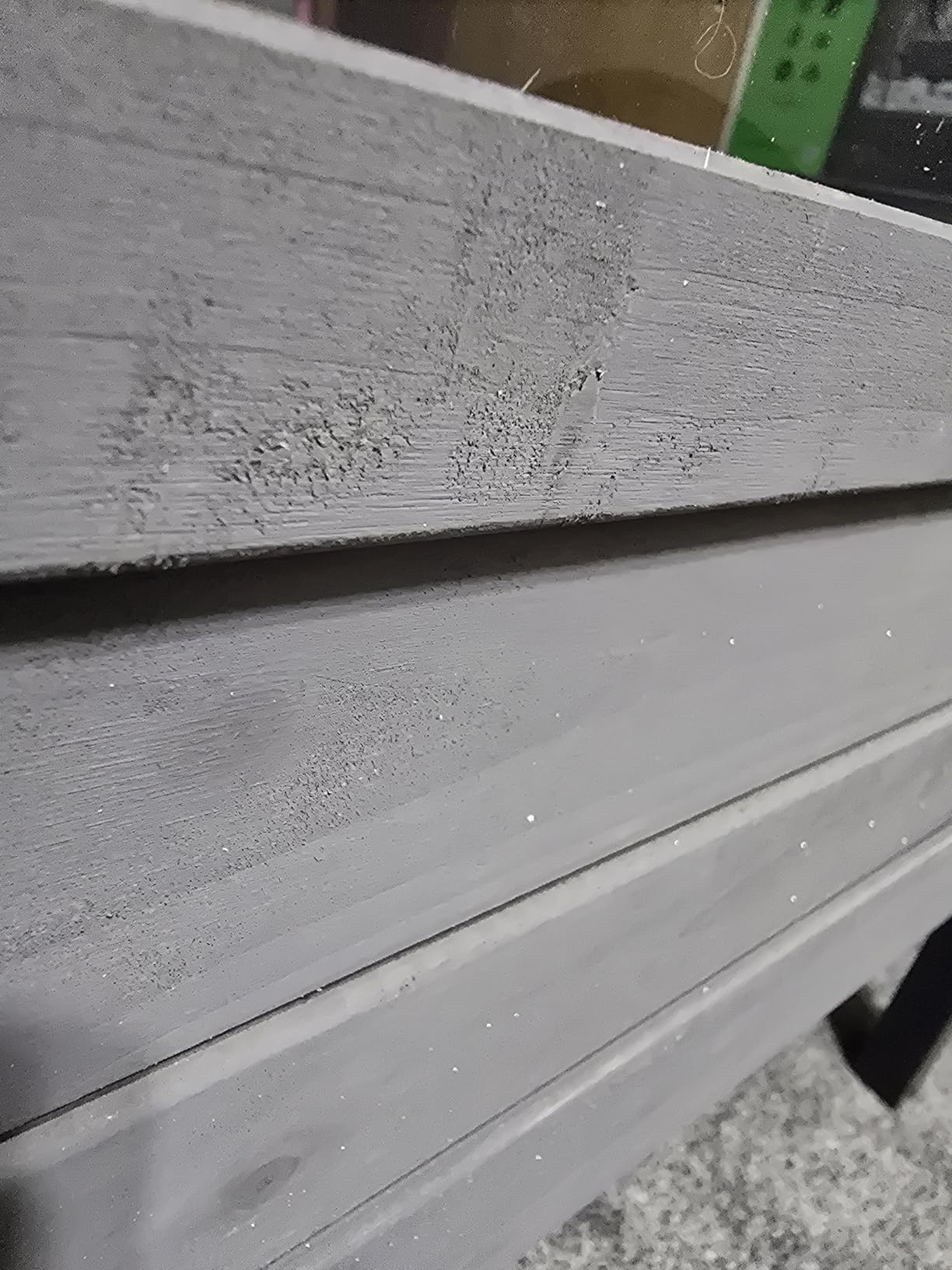
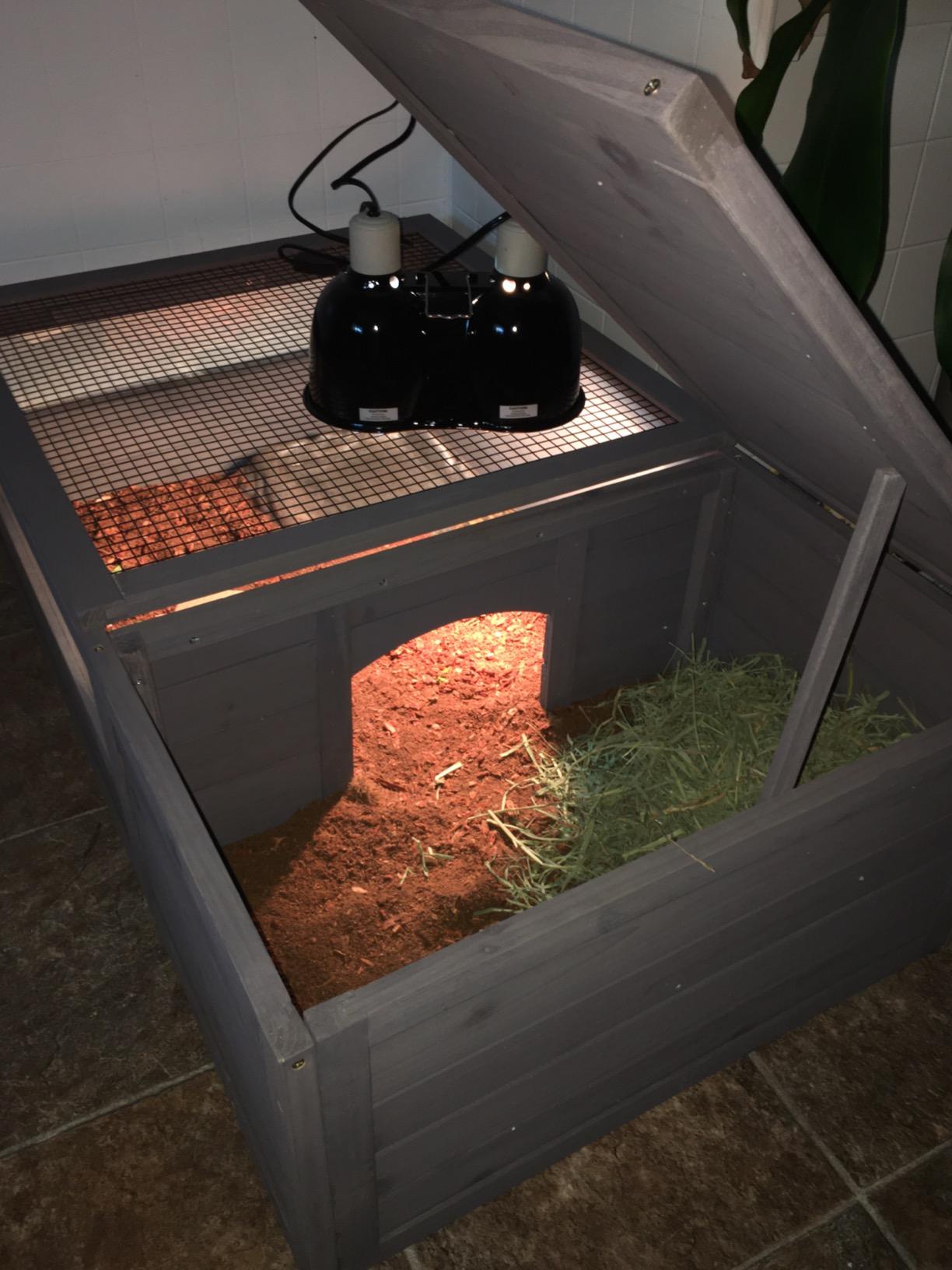
This is the enclosure we kept coming back to during testing. At 15.5 by 9.5 by 4.9 inches it is genuinely small, but the construction is what earns its place: a solid wood frame rather than the plywood used by most houses at this size, wrapped in a waterproof plastic base that wipes clean after a wet substrate change.
The split layout matters more than the footprint. One zone stays shaded and private for sleeping, the other sits under the adjustable lamp holder, so you can dial basking heat without dragging the whole animal into the light. Reviewers consistently name that lamp holder as the reason they stayed with the unit.
Two acrylic viewing panels on the sides make it easy to check on a burrowed animal without opening the lid and dumping the temperature gradient. Our team found the panel clarity good, though it will scratch over years of use if you wipe it with anything abrasive.
The 4.5 average across more than 2,200 reviews is the strongest combination of rating and owner feedback in this roundup, and the distribution is unusually clean, with 74 percent five-star. Owners also use it as an outdoor juvenile habitat or as a wintering house brought into a garage or mud room for the cold months, which stretches the value well past first-year use.
Who this enclosure suits
This is the right pick for a hatchling or juvenile under about four inches, for anyone housing a tortoise indoors over winter, and for keepers who want a unit they can carry between rooms. The waterproof tray also makes it the safest of the wooden options for a species that produces a lot of moisture, such as a juvenile red-footed.
Who this enclosure does not suit
It is not an adult enclosure and should not be treated as one. There is no way to expand it, the wire top is not built to contain a determined adult attempting to climb, and 4.9 inches of internal height leaves very little room under a deep substrate layer. Plan this as a first stage and budget for a second, larger setup.
2. Zoo Med Tortoise House – modular fir wood that grows with the animal
Zoo Med Tortoise House
Fir wood with metal hardware
37 x 25 x 13 inches
24.4 pounds
Joinable end panel
Pros
- End panel unbolts to join two units
- Screws apart for seasonal storage
- Light enough to carry on one hand
- Suits hatchling and juvenile species
Cons
- Bare wood floor is not waterproof
- Inconsistent pilot holes frustrate assembly
- Light duty clasps
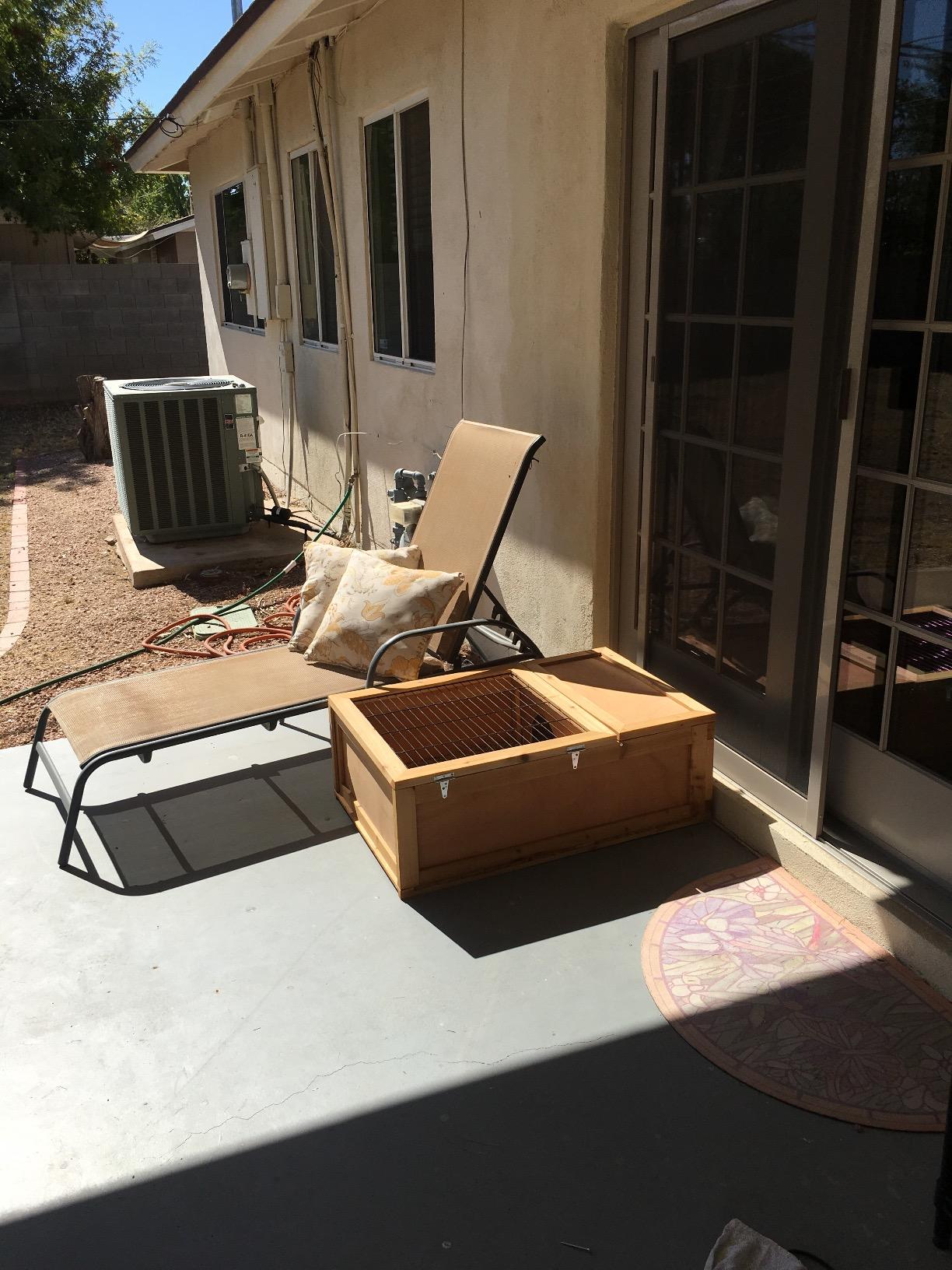
The Zoo Med house is the only enclosure in this roundup that can be physically doubled. Unbolt one end panel and join a second unit, and 37 by 25 inches becomes a genuinely usable floor space for a growing juvenile. That single design decision makes it the most future-proof wooden option here.
At 37 by 25 by 13 inches it is also the largest wooden footprint in the group apart from the ZENTAVO, and it weighs 24.4 pounds, which is light enough to move between a living room and a spare room without help. The interior doorway measures 8.25 by 8 inches, and the lockable wire cover keeps curious cats out while you are not supervising.
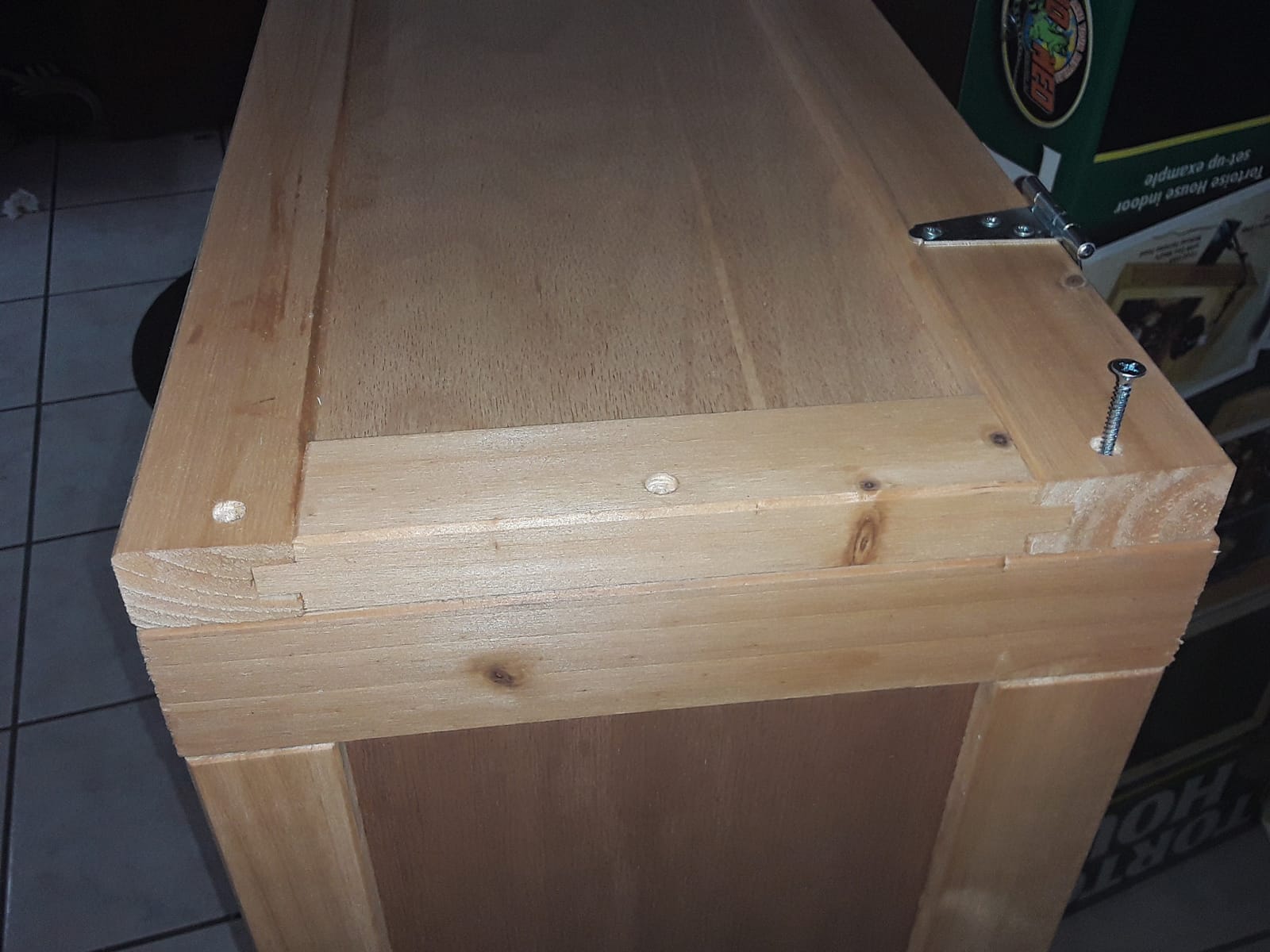
The fir wood and metal hardware are old-fashioned and that is a strength. Nothing flexes, nothing is glued from particleboard, and the whole thing breaks down into flat panels in minutes when you want to reclaim floor space in summer. Zoo Med has been building this design since the mid-2000s, and the 4.6 average from 764 reviews reflects a settled product rather than a new one.
The honest weakness is the floor. It is bare wood, so urine, a tipped water dish or a soaked substrate layer will stain and warp it over time. Reviewers repeatedly suggest lining the interior with plastic sheeting or tile, which is cheap insurance and takes an hour.
Who this enclosure suits
Pick it for a juvenile Russian, Greek or Hermann’s tortoise, or a hatchling sulcata or box turtle. It is also the smart choice if you expect to keep the tortoise indoors for several years, because you can add a second unit rather than replacing the first, and if you move rented accommodation regularly.
Who this enclosure does not suit
It will not house an adult red-footed or sulcata, and even an adult Russian would find it cramped. Tropical species will also need a sealed humid hide and careful misting, because bare wood holds moisture unevenly. Anyone who wants a wipe-clean interior without adding a liner should skip it.
3. GEGURI Tortoise Habitat with Detachable Legs – raised table-top housing
GEGURI Tortoise Habitat Indoor & Outdoor, Wooden Tortoise House with Detachable Legs, Reptile Cage for Small Animals
Fir wood with pull-out tray
38 x 23 x 32 inches with legs
17.9 pounds
Three-sided window
Pros
- Legs unbolt for table or floor placement
- Removable tray makes cleaning straightforward
- Light fir build resists warping
- Wide viewing window
Cons
- Tall legs less stable on uneven outdoor ground
- Overall height needs vertical clearance
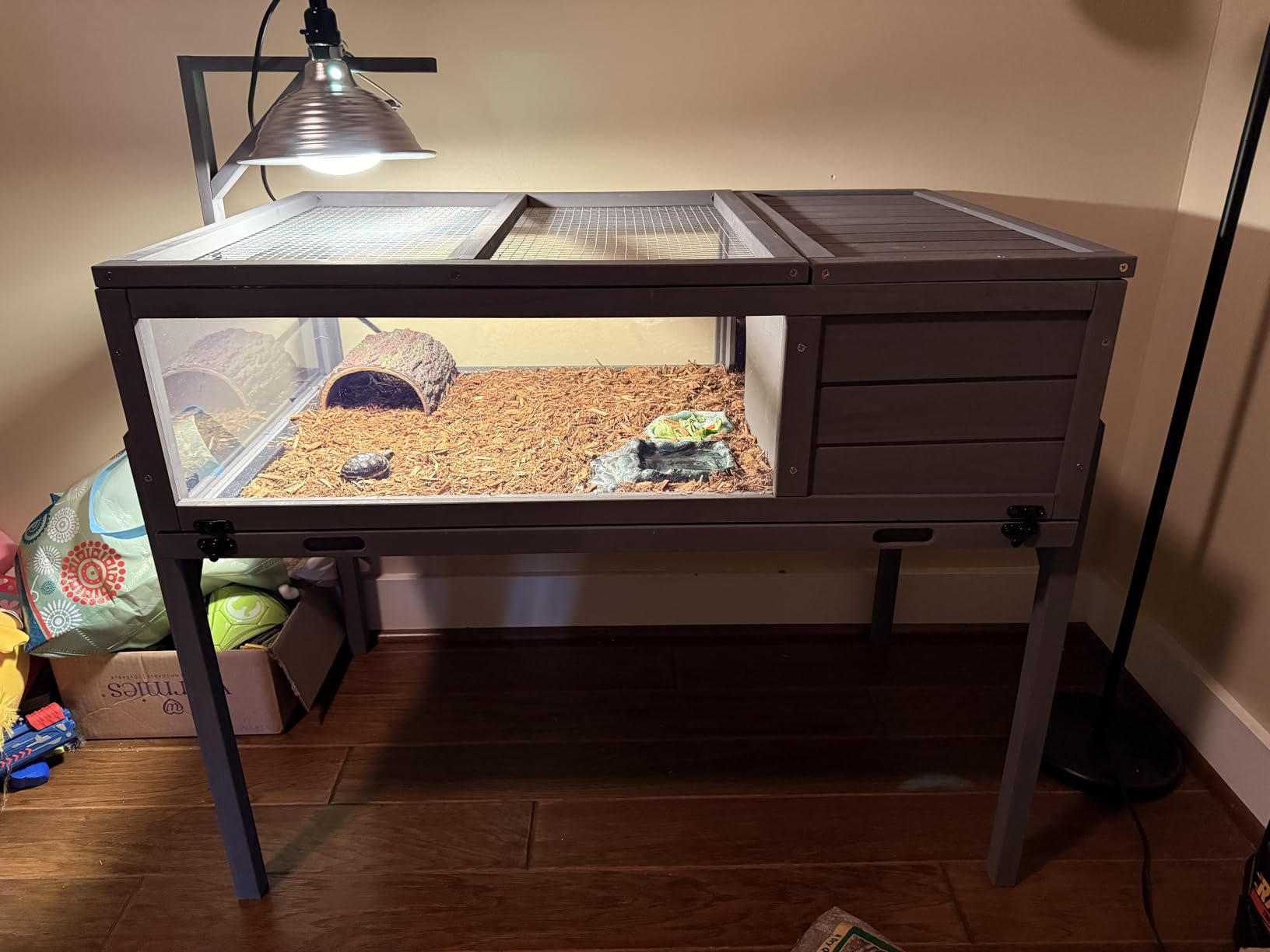
The detachable legs are the whole idea here, and they work well. Take them off and the habitat sits at table height where you can look down into it and reach the tortoise easily; put them back on and it becomes a floor unit. At 17.9 pounds it is the lightest wooden habitat in this roundup, which makes the flip a one-person job.
The footprint underneath is 38 by 23 inches, generous for a juvenile, and the pull-out plastic tray means a full substrate change does not involve crawling into the box. A large observation window on three sides gives you the monitoring angle you want without lifting the lid.
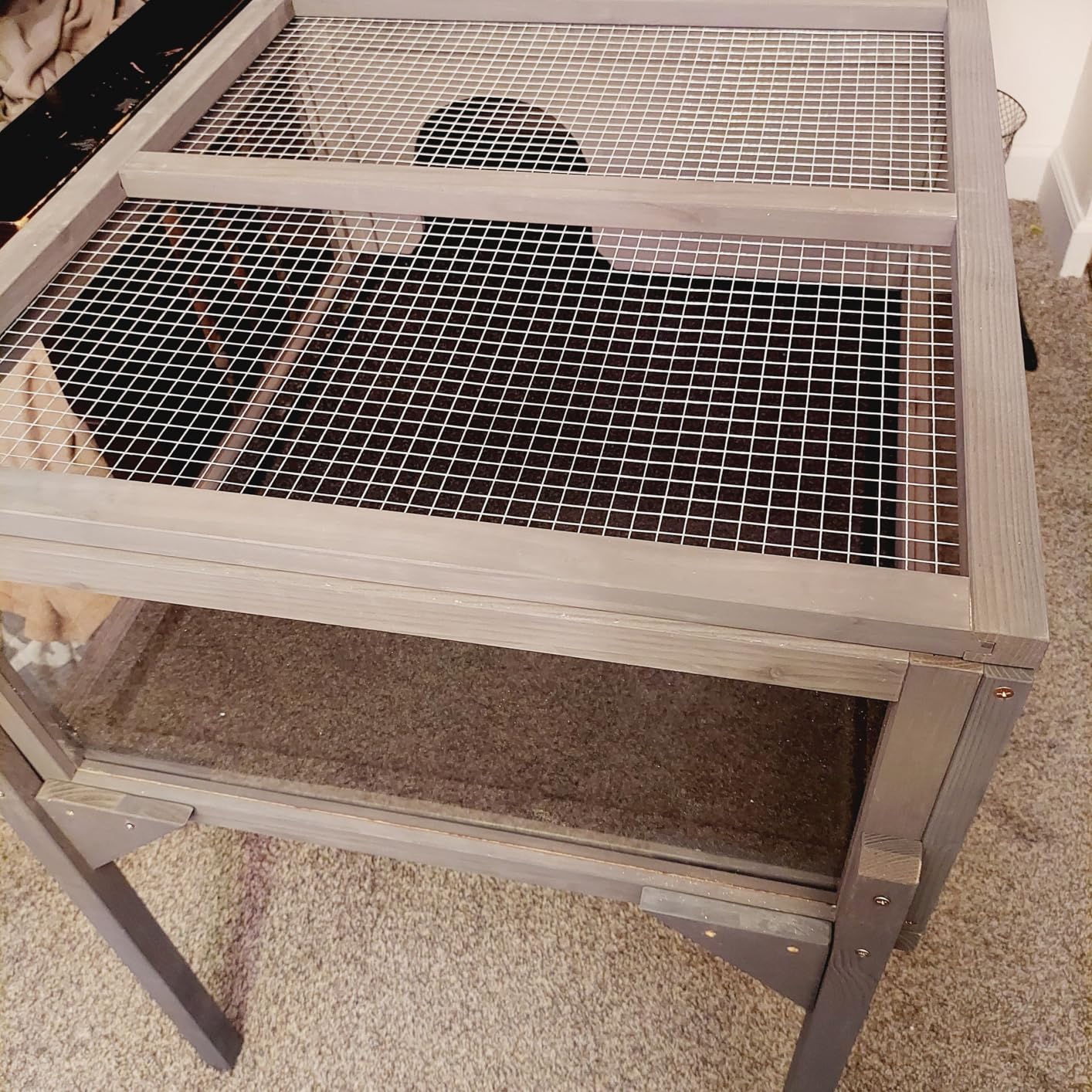
Where it sits in our ranking is the 4.3 average across 507 reviews. Owners like the legs and the tray, but a noticeable share describe assembly as fiddly and the structure as less rigid than they expected, which fits a unit built largely from panels rather than a solid frame.
One practical warning for outdoor use: those long legs need level ground. On uneven soil or a sloping patio, brace the base or the whole unit can rock, and a rocking enclosure is bad for an animal that spends its life walking a flat gradient.
Who this enclosure suits
It works for a juvenile tortoise kept indoors, particularly in a home office or living room where you want the habitat visible but off the floor. It is also a reasonable feeding-and-sleeping station for a larger animal that spends its days in an outdoor pen, since you can carry it out to the porch easily.
Who this enclosure does not suit
Adult animals should not go here. The 23-inch width is the limit, and there is no expansion path. Skip it too if your space has low furniture or a low ceiling, because 32 inches of total height needs clearance and you cannot always take the legs off if the design does not allow it.
4. Aivituvin Tortoise Habitat with Storage Shelf – wide lamp adjustment
Aivituvin Tortoise Habitat Turtle Enclosure, Wooden Tortoise House Reptile Cage for Small Animals, Reptile Tank with Large Storage Shelf
Moisture-resistant wood finish
39.4 x 22.5 x 31.5 inches
29.5 pounds
Two-room layout
Pros
- Lamp stand adjusts about 11 to 31 inches
- Two-room layout separates zones
- Storage shelf keeps supplies off the floor
- Roof opens fully
Cons
- Acrylic panel scratches over time
- Heavy at 29.5 pounds to relocate
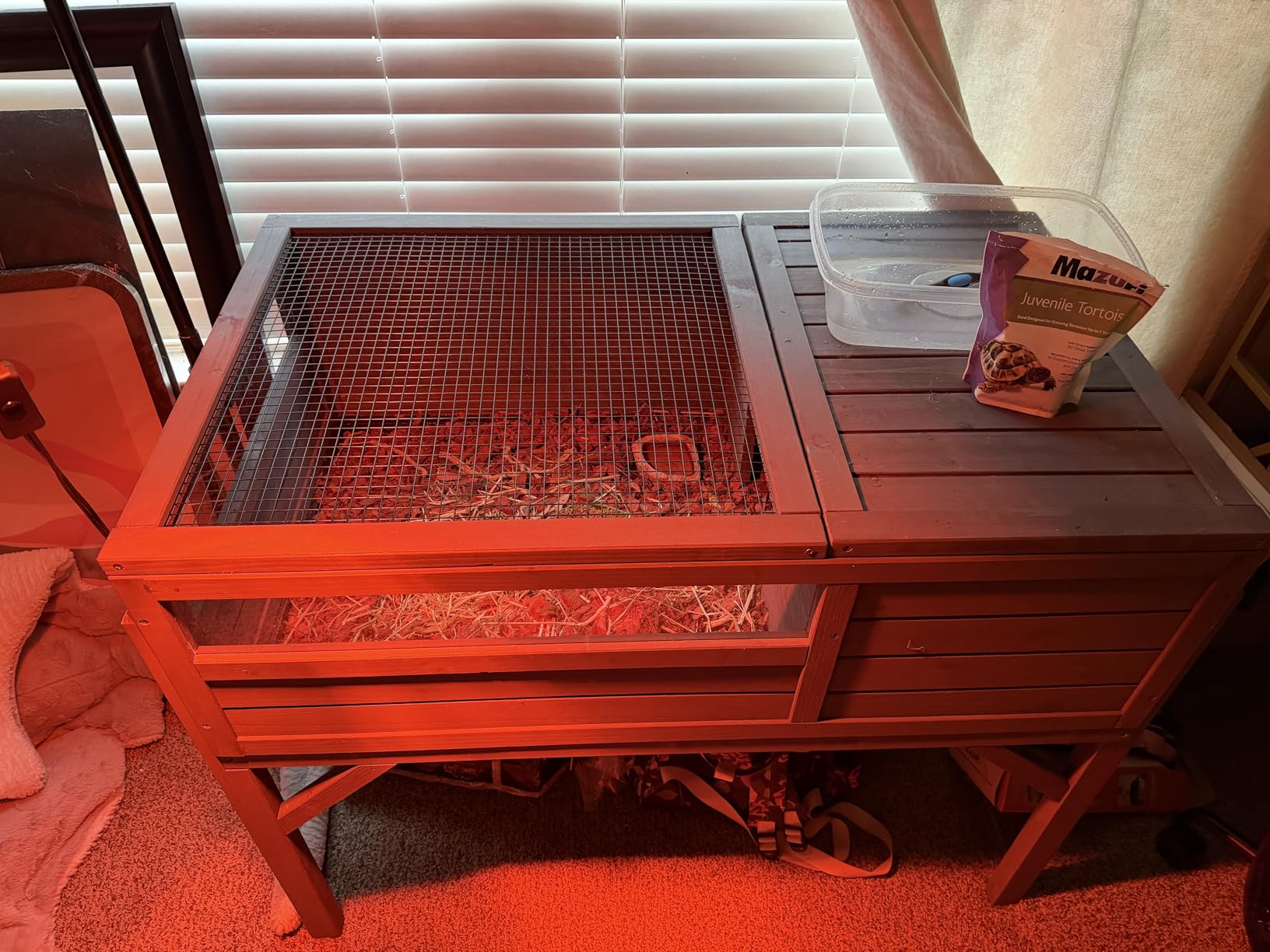
Lamp placement is where most wooden habitats let you down, and this one has the widest adjustment range we found. The stand moves from roughly 11 to 31 inches high and 13 to 21 inches across, with a 360-degree rotating holder, so you can dial a T5 HO UVB fixture and a basking lamp into position without moving the enclosure or the animal.
The 39.4 by 22.5 inch floor is one of the larger wooden footprints here, the two-room layout gives you a shaded sleeping end, and the storage shelf underneath keeps substrate bags and spare fixtures off the floor of your reptile room.
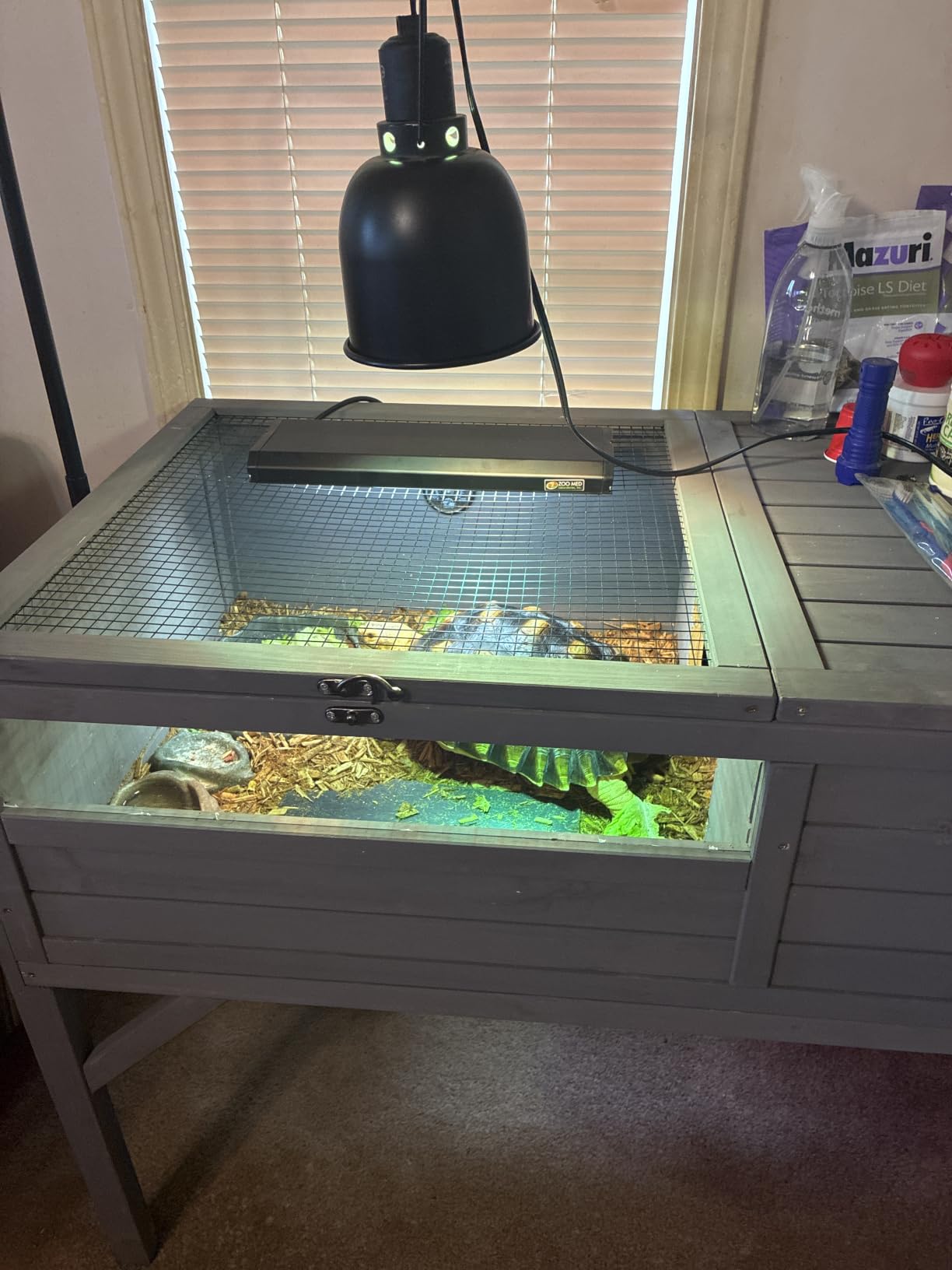
The 4.3 average comes from 322 reviews, so treat the rating as less settled than the older designs in this list. Owners single out the lamp hardware and the dual-room layout as the standouts, with acrylic scratching and awkward weight being the two recurring gripes.
That weight is real. At 29.5 pounds, moving this between indoors and outdoors is a two-person job unless you have a dolly. Plan the location before delivery rather than after.
Who this enclosure suits
It suits a juvenile or subadult tortoise that needs serious lighting control, and anyone building out a dedicated reptile room where under-shelf storage matters. The wide lamp adjustment is also useful for anyone running two heat sources over a long enclosure.
Who this enclosure does not suit
It is not an adult enclosure despite the size, and the moisture-resistant finish is a coating rather than a sealed waterproof tray, so it is better suited to a dry indoor room than to constant outdoor exposure. Anyone who cannot lift 30 pounds easily should look elsewhere.
5. REPTI ZOO 85 Gallon Glass Reptile Tank – full-view indoor habitat
REPTI ZOO 85 Gallon Large Reptile Tank, Wide & Tall Tempered Glass Large Reptile Terrarium 47.2″ x 17.7″x 23.6″ for Tortoise Snake, Top Screen Ventilation & Anti Escape Lid
Tempered glass with screen top
47.2 x 17.7 x 23.6 inches
85 gallon
77 pounds
Pros
- Tempered glass resists scratching
- Nine cable pass-throughs tidy up wiring
- Lid buckle and door lock add security
- Packaging survives rough handling
Cons
- No handles on sliding doors
- Lock only catches in one position
- Suction cups fail after a few months
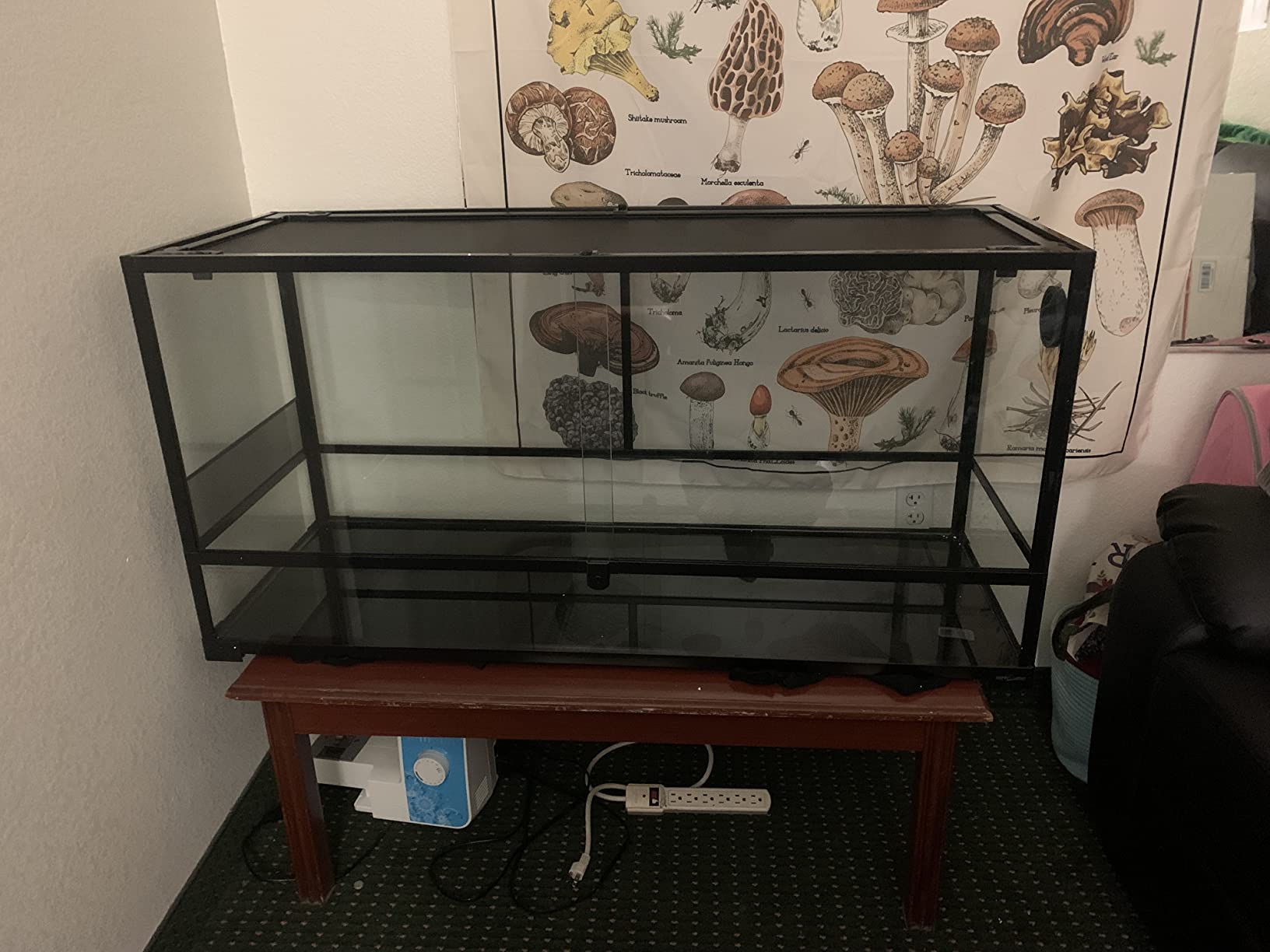
If your priority is seeing everything that happens in the habitat, this is the one. Full tempered glass on all four sides gives an unobstructed view of burrowing behaviour, and unlike wooden houses the panels will not absorb odour or stain over a decade of use.
The electrical detail is the best in this roundup. Six cable inlets on top and the right side plus an extra pass means you can run a UVB fixture, a basking lamp, a thermostat probe and a mister without cables draped over the rim or pinched in the lid. Owners also report assembly in roughly 20 to 30 minutes, and the raised bottom frame leaves room for a substrate heater.
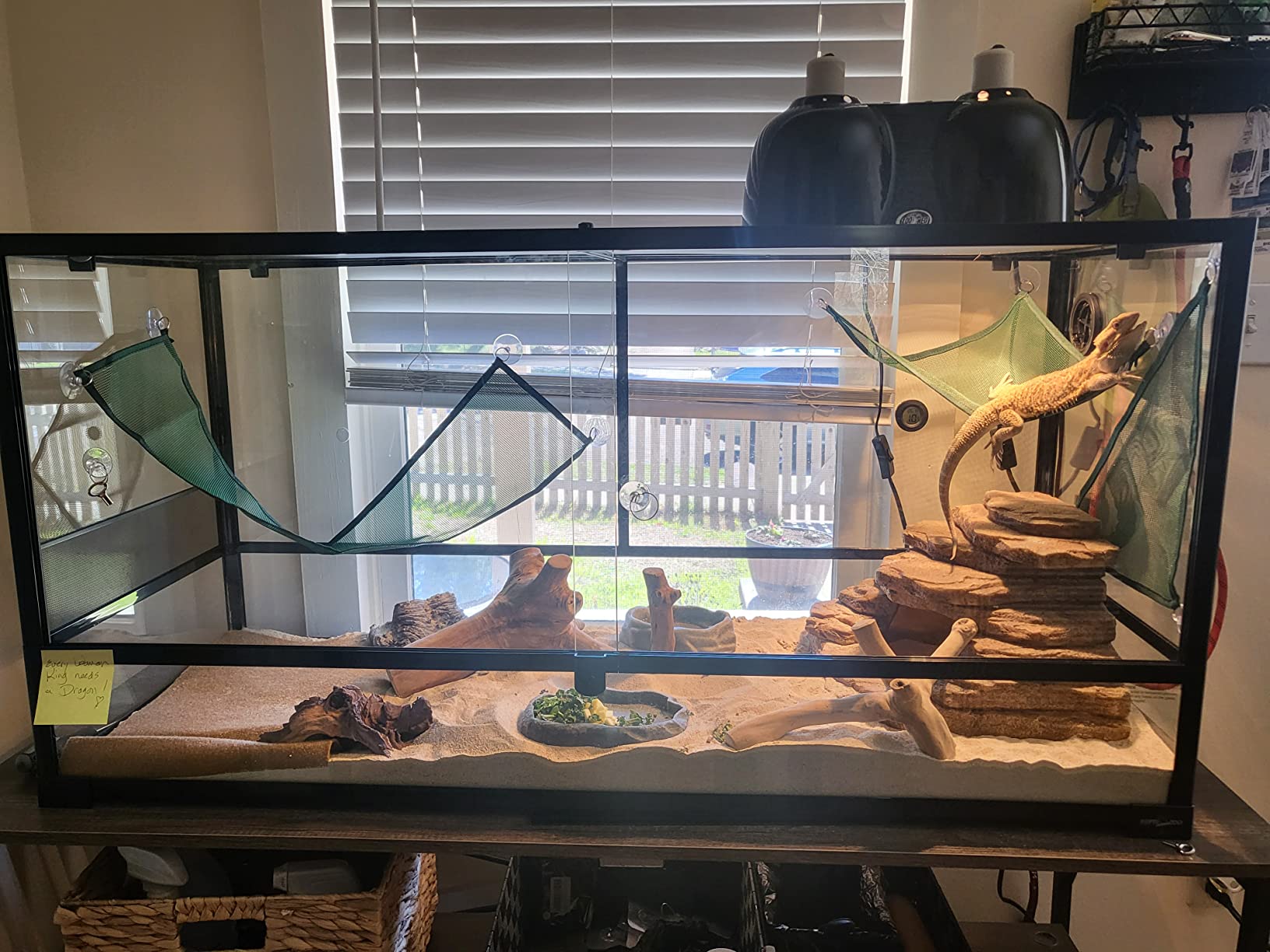
Two caveats, both worth planning around. The listed dimensions are exterior, so the usable interior space is smaller than 47.2 by 17.7 inches, and at 17.7 inches of depth it is narrower than it is tall. That is fine for a young tortoise in a tall display, but it is not the shape a walking animal wants.
The recurring gripes are small: no handles on the sliding doors, so you put fingerprints on the glass every time you check; a lock that only engages when the doors sit in one position; and suction cups that stop holding after a few months. Expect a couple of hours of shimming and sealing panels if bits of packing foam catch you out.
Who this enclosure suits
It suits indoor keepers who want to observe behaviour closely, and anyone housing a tropical species such as a juvenile red-footed where humidity management matters and a glass box seals more effectively than wood.
Who this enclosure does not suit
It does not suit anyone in a small apartment or upstairs above neighbours, because 77 pounds of glass concentrates heat and cannot be moved by one person. Check your furniture load rating before you commit, and remember that glass fronts invite pacing unless you add an opaque barrier.
6. Penn-Plax Tortoise Palace – furniture styling for living rooms
Penn-Plax Large (48″ x 30″) Tortoise Palace with Wire Top, Black Frame, Glass Terrarium, and Lamp Mount – Beautiful Turtle Cage Designed for The Modern Home with Room for Growth (REPTH1)
Glass with black frame
48 x 30 x 12 inches
72.5 pounds
Wire top over display area
Pros
- Very large footprint for the format
- Black frame reads as furniture
- Lockable hide compartment
- Windowsill detail reduces glass collisions
Cons
- Lowest average rating in this roundup
- No ramp so substrate scatters
- 72 pounds is impractical to move
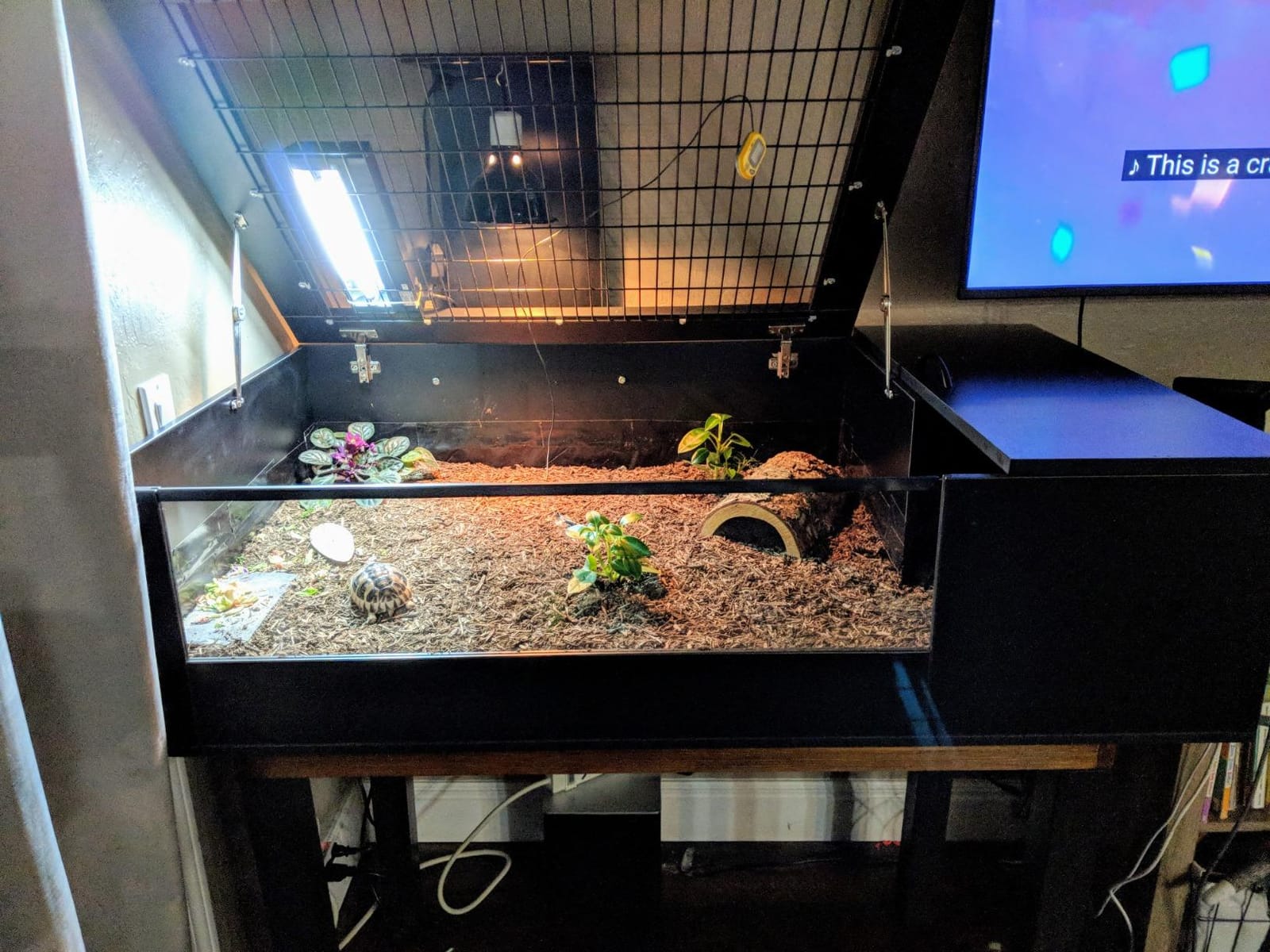
The 48 by 30 inch floor is the widest in this roundup, and that is the reason to consider it. If your constraint is total floor area rather than height, this is one of the few ready-made units that approaches the space an adult tortoise actually wants to walk.
The styling is the second reason. A black frame, a clean rectangular footprint and a wire top read as a piece of furniture rather than a pet carrier, which matters if the enclosure lives in a sitting room. The side compartment is a separate sleeping space with its own lockable lid, so a disturbed tortoise is not disturbed.
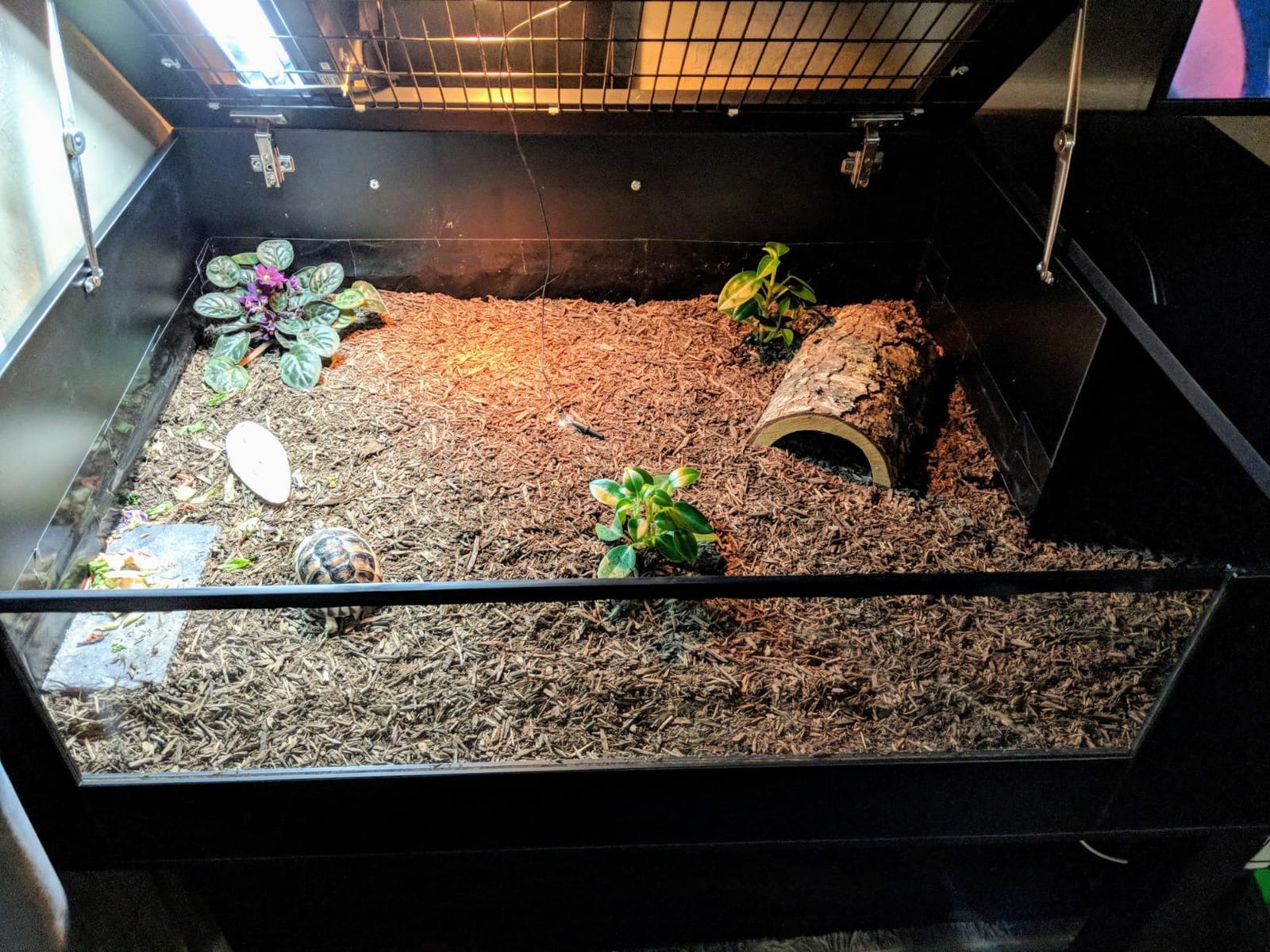
It also has the weakest feedback in this group, a 4.1 average with 13 percent one-star reviews. That is not a rounding error. The complaints are structural: glass-only construction with no plastic tray and no ramp, so substrate scatters across your floor within days, plus quality inconsistencies on some units.
The adjustable lamp mount takes a basking lamp but does not include one, and the wire top is simple. At 12 inches tall with an accessory side compartment, this is a shallow format, so substrate depth is limited and burrowing behaviour will be constrained.
Who this enclosure suits
It suits a keeper in a spacious home who wants a large visible footprint and cares more about appearance than about deep burrowing. The lockable hide is genuinely useful for a tortoise that gets defensive when handled.
Who this enclosure does not suit
It does not suit burrowing species, because there is no tray and only 12 inches of height. It also does not suit anyone who moves the enclosure regularly, or anyone who wants a wipe-clean floor. Our honest read is that the footprint is excellent and everything else about the design is thin.
7. PawHut Tortoise Habitat with Shelf – compact setup for small juveniles
PawHut Tortoise Habitat with Shelf Storage, Tortoise Enclosure with Weather Protection, Reptile Enclosure with Tray, Light Support Frame, Yellow
Cypress wood with plastic pan
33 x 20 x 40.5 inches
24 pounds
Hide box and basking area
Pros
- Shelf underneath uses dead floor space
- Cypress is soft and reptile-safe
- Solid plastic pan wipes clean
- Two compartments separate hide and food area
Cons
- Divider does not sit flush with the pan
- Only suits palm-sized juveniles
- Some reports of splintering wood
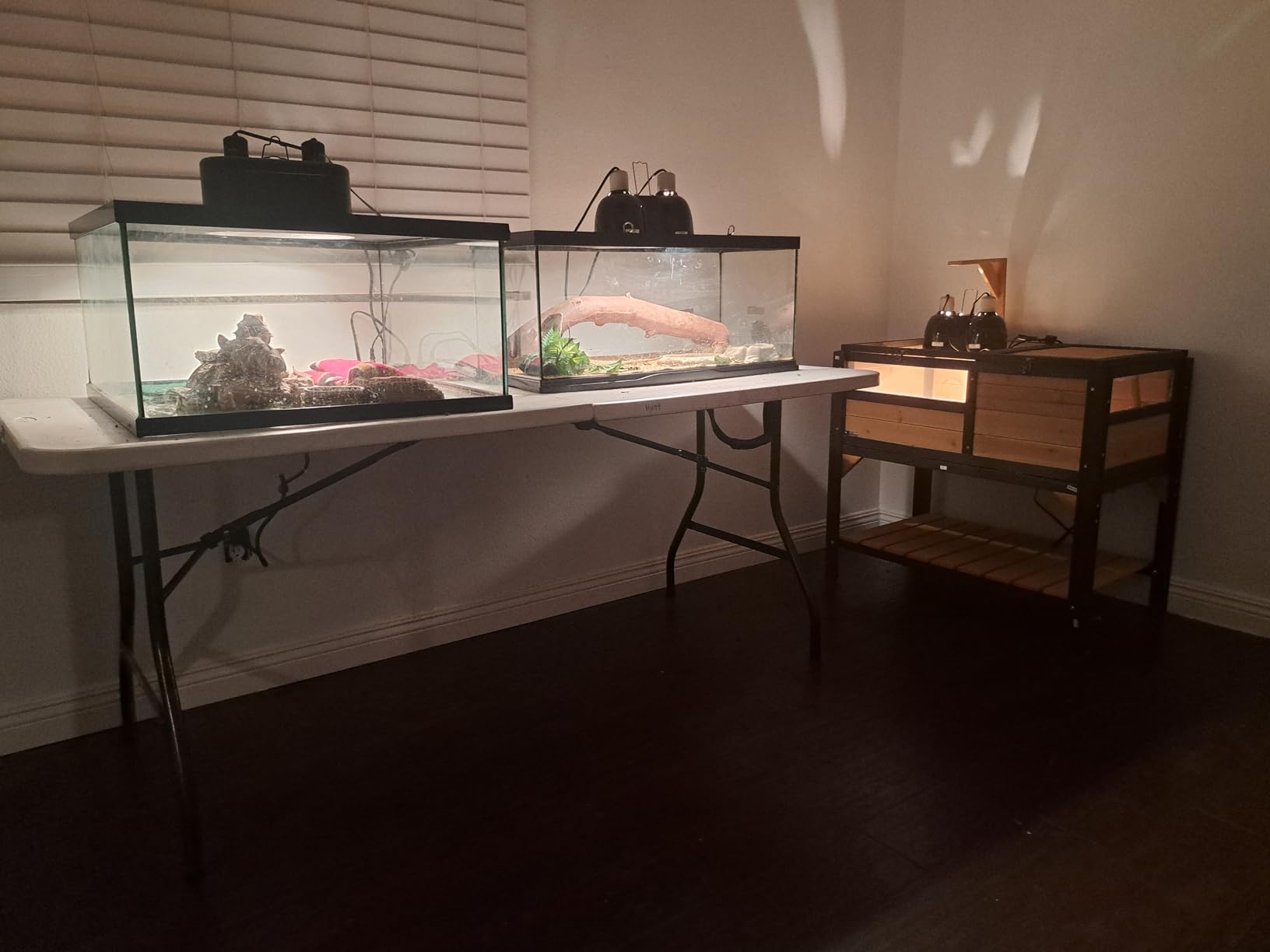
The shelf underneath is the feature that separates this from every other wooden house here. It gives you somewhere to keep substrate, fixtures and a water container without stealing more floor space, which matters in a room where the tortoise already has the largest footprint you can afford.
Cypress wood is a good choice for a reptile habitat because it is soft, resin-free and holds humidity without moulding quickly. The solid plastic bottom pan means nothing falls through the joints and cleanup is a wipe. A 4.1 average from 119 reviews puts it mid-table, with 59 percent five-star.
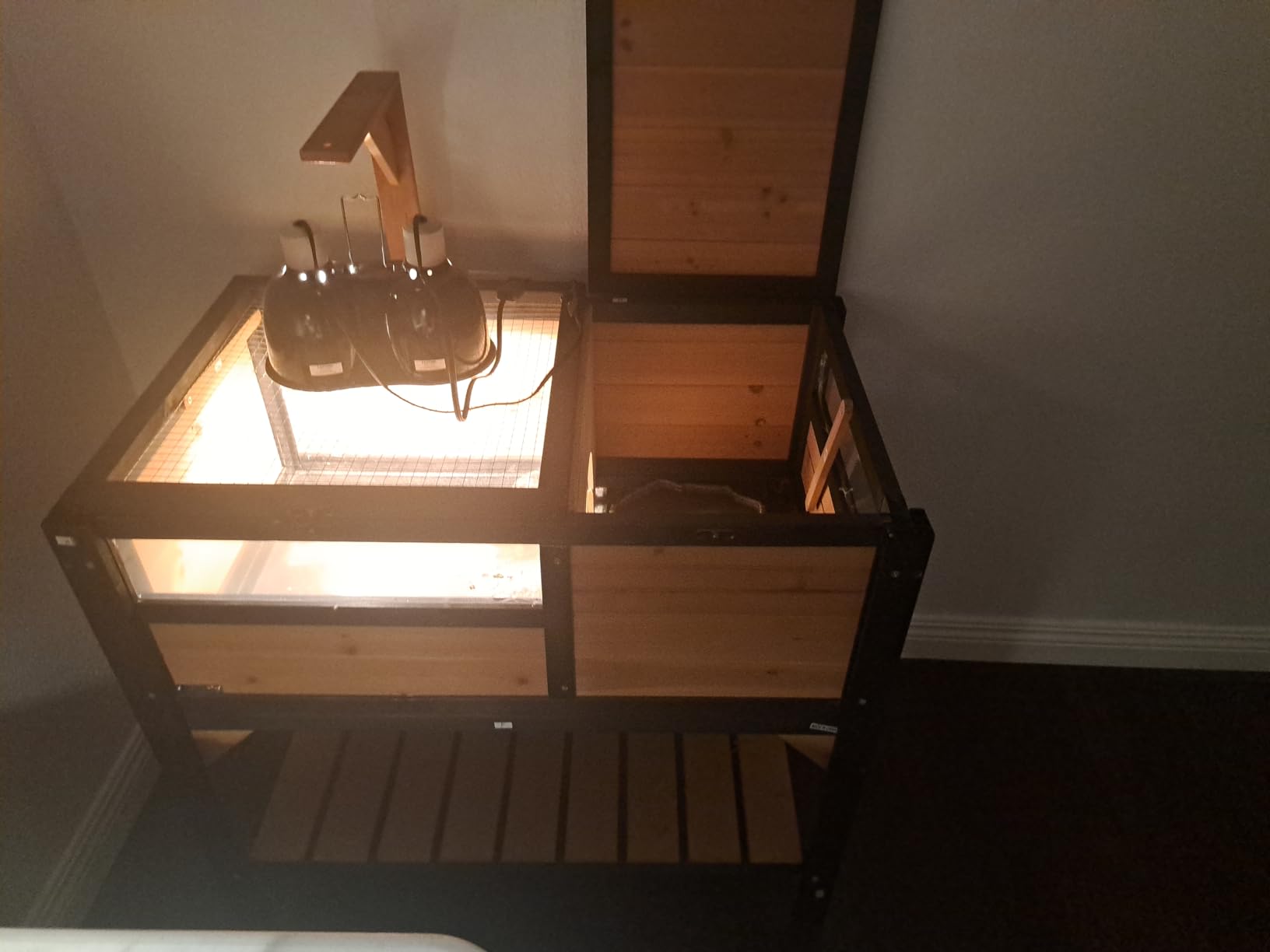
The split into a hide box of about 12.5 by 17.25 by 12.5 inches and a basking area of about 16.25 by 17.25 by 12.5 inches works, and owners using it for a young sulcata like having a feeding side and a sleeping side.
The flaw most owners report is the internal divider not sitting flush with the pan, so bedding collects in the seam and cleanup takes longer than it should. A few buyers also report wood splintering during assembly, so check every panel fits square before you tighten the screws.
Who this enclosure suits
It suits a baby tortoise up to roughly palm size, and a temporary feeding station for a larger animal living in an outdoor pen. The shelf makes it a good choice in a small room where storage is the problem you are actually solving.
Who this enclosure does not suit
It does not suit anything past a small juvenile; owners report larger animals banging against the sides. It is also not the choice if you need deep substrate, since both compartments are around 12.5 inches tall before the tray depth.
8. Magazoopet Large Tortoise Enclosure – two-axis lamp control
Large Tortoise Enclosure with Adjustable Lamp Stand and Storage Shelf
Natural fir with metal mesh
40.4 x 23 x 32 inches
27.6 pounds
Two-axis lamp holder
Pros
- Lamp holder adjusts horizontally and vertically
- Slide-out tray speeds up cleaning
- Legs remove for porch use
- Mesh top locks keep cats out
Cons
- Wood can arrive with cracks or gaps
- Strong initial odour needs airing out
- Painted assembly numbers do not rub off
The two-axis lamp holder is the detail that separates this one. It adjusts horizontally across five levels from about 14.6 to 22.4 inches and vertically from about 30.3 to 38.2 inches, which means you can position a heat lamp and a UVB fixture independently without moving the habitat. For an animal that needs a long gradient along a 40 inch enclosure, that matters.
A 4.4 average from 104 reviews is a good score on a smaller sample, with 76 percent five-star. Owners use it for box turtles, juvenile tortoises and bearded dragons, and one recurring theme is travel: several people report it fits in a camper for box turtles on the move.
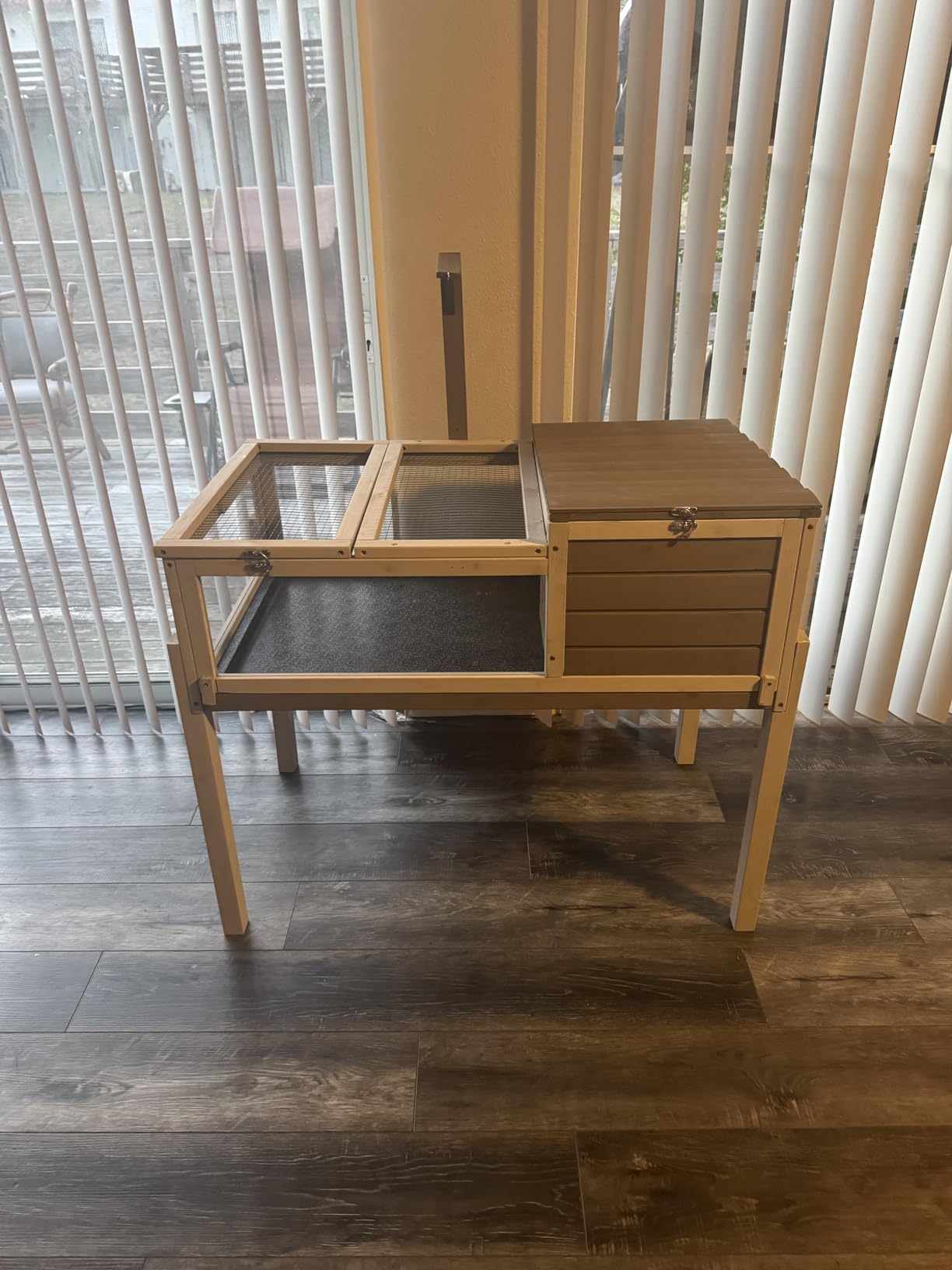
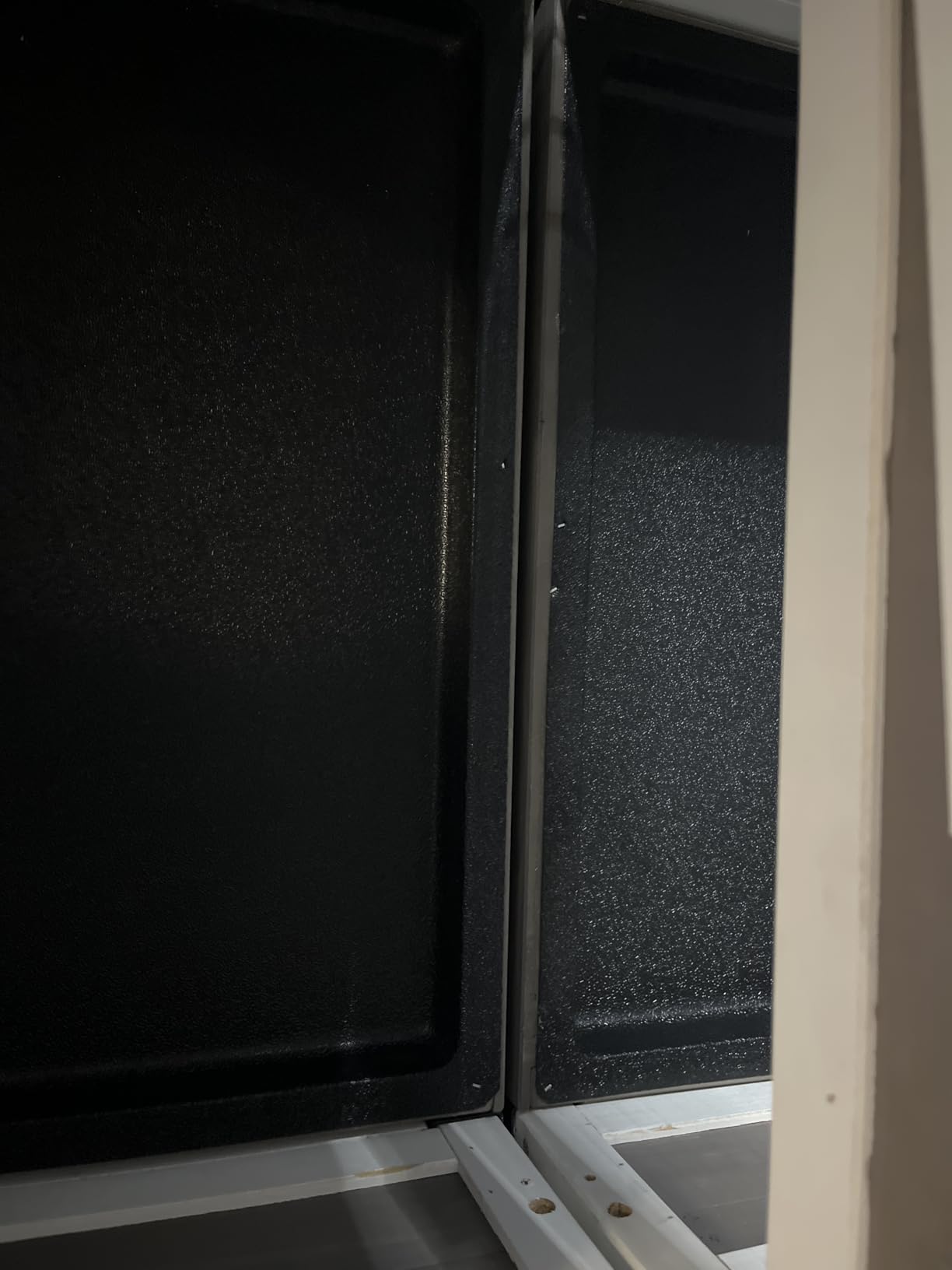
Before you use it, inspect the panels. Reviews specifically mention wood arriving with cracks and panels that are not flush, plus a noticeable initial odour. The advice that comes up again and again is to seal any gaps with aquarium-safe silicone and let it cure fully, and to keep standard household cleaners off the porous wood.
The slide-out tray makes that maintenance routine bearable, and the top and bottom locks mean a determined tortoise cannot lift the lid while you are not watching.
Who this enclosure suits
It suits anyone who needs fine control over where heat and UV land, and keepers deploying a habitat on a covered porch, since the removable legs make that a simple change. The mesh top and locks also make it workable in a house with roaming cats.
Who this enclosure does not suit
It does not suit an adult tortoise, and it does not suit anyone unwilling to inspect and seal the wood on arrival. Budget an afternoon for that work before the animal goes in, and air it out first.
9. ZENTAVO 3-Room Tortoise Habitat – two-level enrichment layout
3-Room Large Tortoise Habitat with Pull-Out Tray, Wooden Tortoise Enclosure Indoor & Outdoor with Ramp, Grass Mat, Openable Roof, Luxurious Reptile Enclosure for Small Animals, Yellow
Fir wood with plastic tray
44 x 25.6 x 24 inches
32 pounds
Two-level layout
Pros
- Largest wooden footprint at 44 inches
- Two levels add climbing enrichment
- Pull-out tray makes deep cleans fast
- Pre-drilled holes speed assembly
Cons
- Fewer than 100 reviews so durability is unsettled
- 32 pounds is heavy to relocate
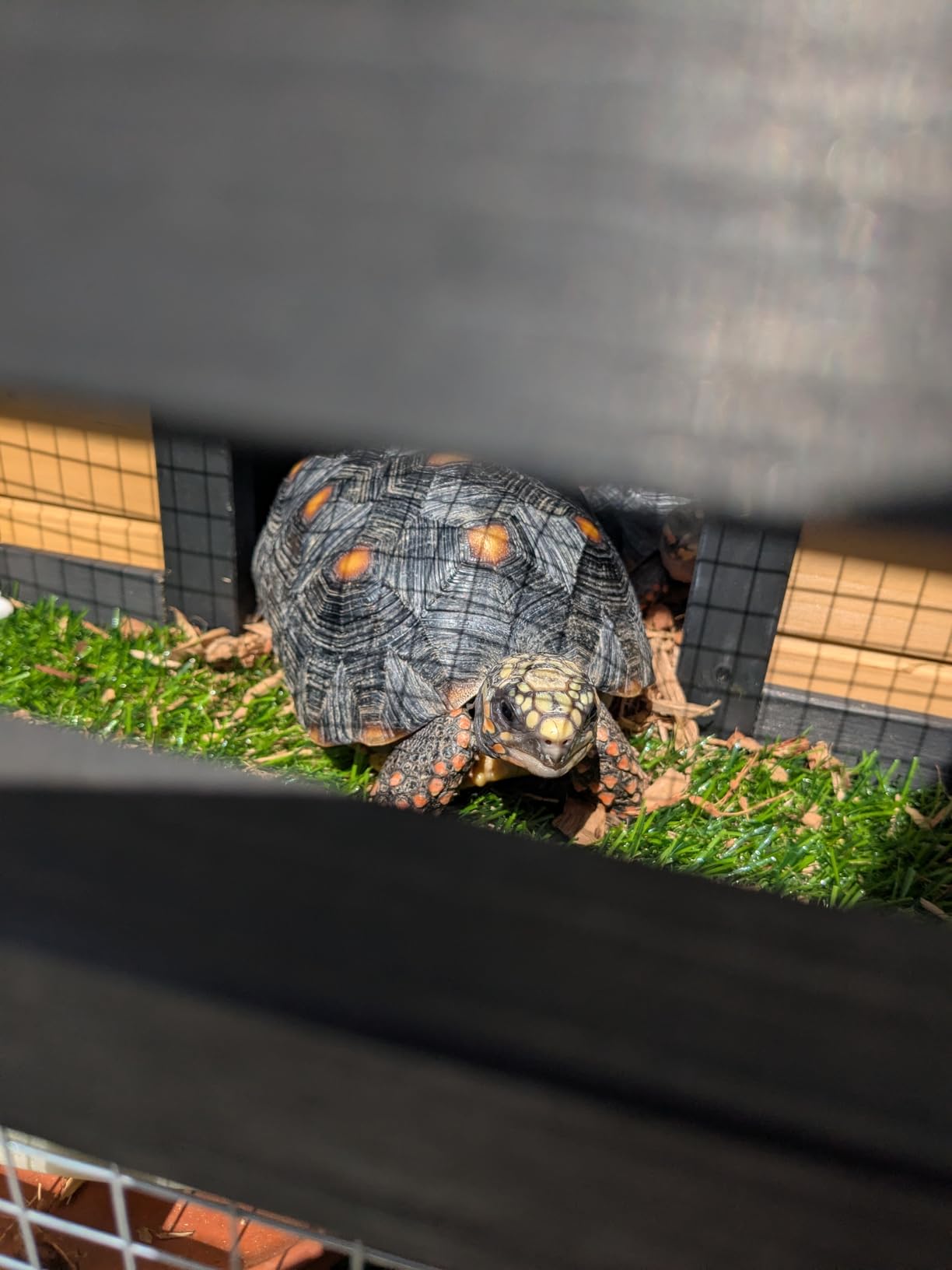
At 44 by 25.6 inches this is the widest wooden footprint in the roundup, and the two-level layout is the distinguishing feature. An upper sleeping area with a balcony gives the animal height to explore, which matters for an animal that would otherwise spend its whole life on one plane.
The kit is unusually complete for the format. A ramp and grass mat are included, the balcony is covered in metal mesh so light and air reach it, the roof opens for access, and pre-drilled holes with illustrated instructions mean assembly does not require a drill.
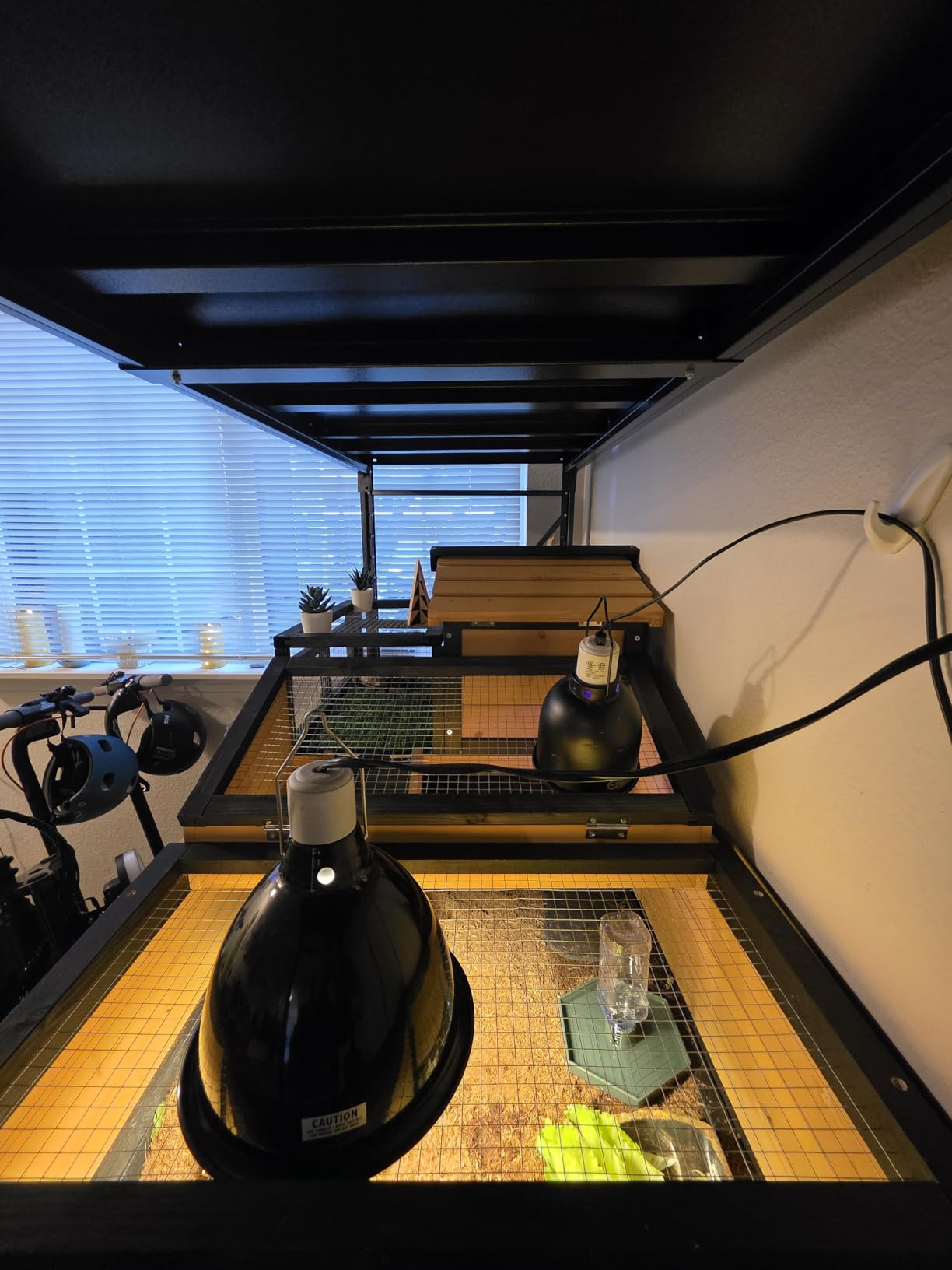
Water-resistant paint over tight-grained fir is specified for outdoor placement, and the pull-out plastic tray means you can pull the whole floor out to clean rather than reaching in with a scoop. Owners consistently rate the layout as the selling point.
The honest caveat is the sample size. Ninety-four reviews gives a 4.3 average, and with fewer than 100 data points long-term durability is less well documented than for the older designs here. We would want to see it through a few seasons before recommending it as a long-term adult habitat.
Who this enclosure suits
It suits a subadult tortoise that needs more floor area than a starter house gives, and keepers who want vertical enrichment without moving to a glass format. The included ramp and grass mat make setup faster.
Who this enclosure does not suit
It does not suit a large adult, since 44 inches is still short of the minimum for an adult Russian, and the two-level layout adds weight that makes relocation a two-person task. Anyone who plans to move it seasonally should look at the lighter options.
10. Phailozoo 120 Gallon 4x2x2 Enclosure – true footprint and metal hardware
Phailozoo 120 Gallon Reptile Tank, Stackable 4x2x2 Reptile Enclosure
120 gallon
Tempered glass front, PVC side panels
48 x 24 x 24 inches
44 pounds
Stackable
Pros
- True 4x2x2 interior with no escape gaps
- Metal bolt construction feels solid
- Mesh top blocks only 28 percent of light
- Sliding doors have handles
- Pre-sealed bottom suits bioactive setups
Cons
- Side panels are plexiglass and scratch
- Bottom is sealed but not leakproof
- Stackable only with V2 stackers
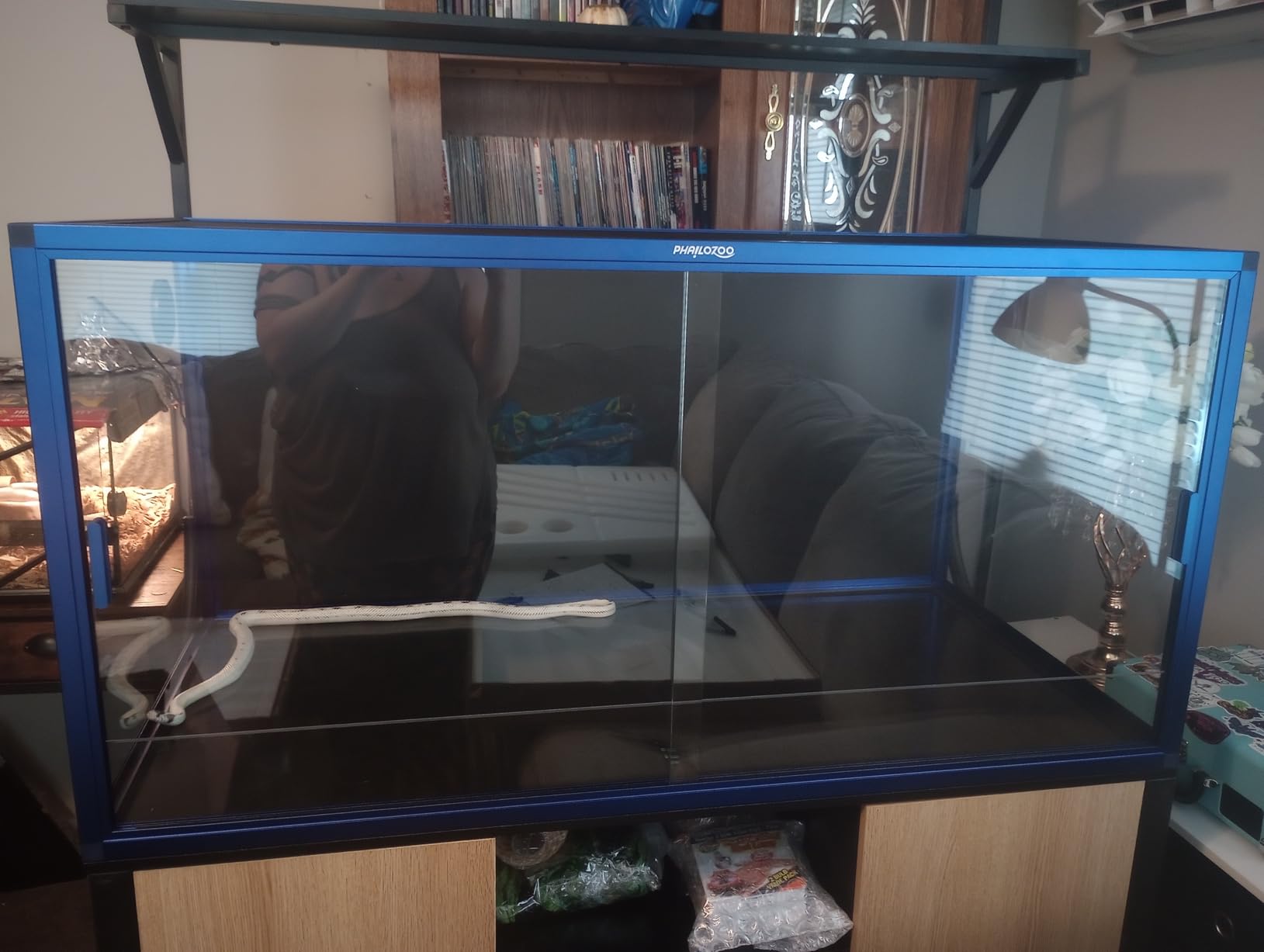
This is the strongest-built enclosure we tested. At 48.03 by 24.02 by 24.02 inches it gives a true 4 by 2 by 2 interior, which is exactly the temporary-juvenile standard the husbandry formula calls for, and the metal bolt and frame construction feels a category above the plastic-jointed competitors.
Light penetration is the number that matters for a tortoise. The metal mesh top is specified at 28 percent light blockage, and UVB passes through that at mounting distances husbandry guidance accepts. With tempered glass sliding doors that have actual handles, and a substrate barrier to stop bedding scattering, it addresses most of what reviewers complain about in glass formats.
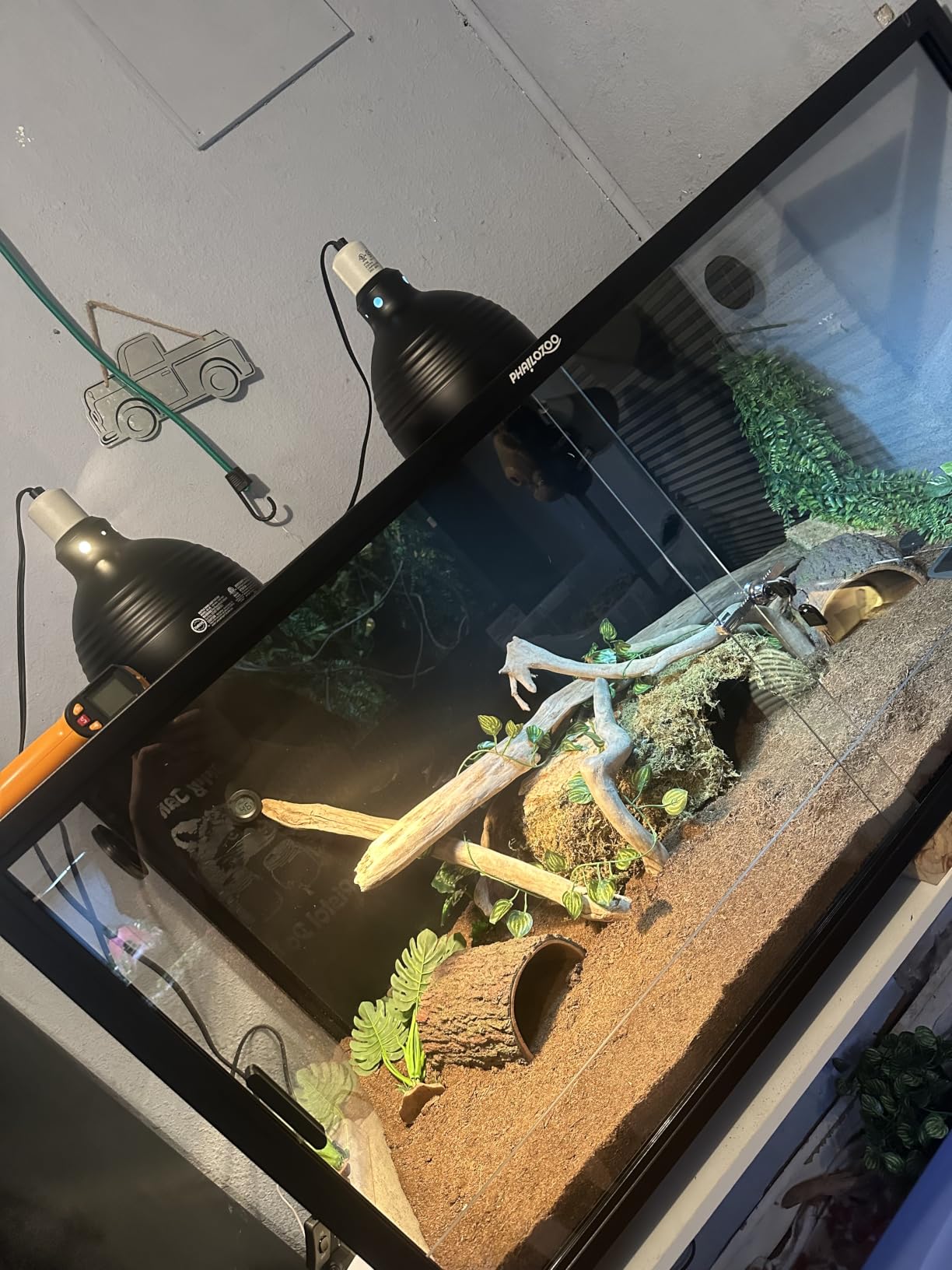
The 4.6 average across 758 reviews carries 84 percent five-star, the strongest distribution in this roundup. Long-term owners running several enclosures call it the best of the brands they own, specifically citing the metal hardware and the packaging.
Be clear about the compromises. The side panels and lower front strip are plexiglass rather than tempered glass, and they scratch over time. The bottom arrives silicone-sealed for strength and bioactive setups, but it is not leakproof. And stacking works only with the brand’s own V2 stackers, so plan vertical expansion carefully.
Who this enclosure suits
It suits a tortoise under roughly 4 to 6 inches that you want housed properly indoors, and keepers planning a reptile room who intend to add stackers later. The pre-sealed bottom is also the right call if you want to run a bioactive setup.
Who this enclosure does not suit
It is not an adult enclosure. Four feet by two feet is temporary housing by the sizing formula, and stacking two units gives you height rather than the extra walking length an adult needs. It is also not ideal for anyone who does not want to add adhesive refrigerator locks to the doors.
Tortoise Enclosure Buying Guide: Seven Things to Check Before You Buy
Floor area, not volume. Sellers list total cubic capacity because it sounds bigger. Walkers need square feet. Divide length by width, multiply, and compare that figure to your species minimum rather than reading the number on the box.
Internal depth. Tortoises burrow. Aim for at least 4 inches of substrate for a juvenile and 6 inches for an adult, and check that the enclosure can physically hold that once the tray and any included ramp or shelf are subtracted.
Top panel type. Open-top tortoise tables are not recommended, because tortoises frequently need a humid hide with higher humidity than an open frame allows. Choose a secure mesh or solid top, and check the mesh light blockage figure if you plan to run UVB through it.
Lamp mounting. Basking heat and UVB come from above, so the enclosure needs a mount that holds both at the correct height without the animal being able to reach them. Adjustable or 360-degree holders are worth paying for; a fixed mount is not.
Floor material. Solid plastic pans wipe clean and survive urine. Bare wood stains and warps unless you line it. Plastic trays also stop substrate falling through panel joints, which is a real problem in wooden formats.
Expandability. Modular panels that join, or a format designed to stack, save you money over the animal’s life. A house that cannot be extended is a house you replace in two years.
Warranty and build quality. Metal hardware beats plastic screws and glued particleboard for long-term durability, and a published warranty is a better signal than marketing copy. Check what the warranty actually covers before you assume it covers replacement panels.
Indoor vs. Outdoor Tortoise Housing: Which One Your Species Needs
Outdoor housing is better for most tortoise species whenever the climate allows, because natural sunlight delivers a far more useful UVB spectrum than any lamp. It also gives animals thermal behaviour, digging and rain exposure that a box cannot.
Outdoor does not mean casual. The pen needs both shade and sun, well-draining soil, smooth walls sunk at least 12 inches to defeat burrowing escapes, and mesh over the top against predators. Juveniles under about 4 inches should stay indoors, where you can control temperature and monitor growth closely.
Indoor setups have their own rules: a temperature gradient from a warm basking zone down to a cooler end, a humid hide for shelter, and enough height to hold substrate. Several of the wooden habitats in this roundup are described by their makers for indoor and outdoor use, which makes them useful as indoor housing and as a portable shelter for the winter months.
Substrate Depth and Why Enclosure Height Matters
Substrate depth is a husbandry requirement, not decoration. Four inches minimum for juveniles, six inches for adults, and around 12 inches in outdoor pens give a tortoise the depth to fully bury itself, which is how they thermoregulate, rest and escape handling stress.
This is exactly why height belongs in the sizing formula alongside length and width. A 2-foot-tall unit with a shallow tray is not equivalent to a shorter unit built to hold six inches of substrate. Measure internal height and subtract the tray and any included ramp before you calculate how much substrate you can add.
Small Spaces and Rentals: Getting an Enclosure Into an Apartment
Rental and apartment constraints rule out drilling and heavy glass. A flat-pack wooden habitat on removable legs, with a pull-out tray, is the format that survives a move and a wipe-down between tenants.
Two practical checks. First, heat output: a halogen basking lamp radiates into the room, and in a small space that changes the temperature of the whole room. Second, weight: anything above about 30 pounds becomes a two-person move, and above 70 pounds it should not live on a standard floor or an upper-storey flat.
If you are planning a permanent setup in a basement or garage rather than a rented flat, our basement enclosure guide covers the room-preparation side of that project.
What a Tortoise Setup Costs Beyond the Enclosure
The enclosure is usually the smaller share of a first-year bill. Every setup we costed out needed, on top of the habitat: a T5 HO UVB fixture and a separate daylight lamp, a basking heat source and fixture, a proportional thermostat, digital thermometer and hygrometer probes, four to six inches of substrate, a humid hide, a water dish, and decor.
The category most often forgotten is monitoring. Two probes, one in the warm zone and one in the cool zone, plus a hygrometer, are what tell you the gradient is actually working instead of guessing from the lamp dial.
This is also the argument for buying the enclosure you will keep. Sizing up once, so you are not replacing a habitat every eighteen months and paying for lighting twice, is usually cheaper than starting small and upgrading.
Frequently Asked Questions
How big should a tortoise enclosure be?
The German Society for Herpetology u0026amp; Terrariums formula is length at 8x the tortoise’s expected adult length, width at 4x, and height at 2x. For an adult Russian tortoise of about 10 inches, that gives a minimum of 7ft x 3.5ft x 2ft, or about 24.5 square feet of floor space.
What size enclosure does a juvenile tortoise need?
A 4ft x 2ft x 2ft unit is appropriate for a juvenile under about 4 to 6 inches, but it is temporary housing. Plan and budget for the adult minimum before the tortoise outgrows it, and choose a habitat you can expand rather than replace.
Are open top tortoise tables suitable for tortoises?
No. Open-top tortoise tables are not recommended because they make it impossible to hold the higher humidity a humid hide requires. Choose an enclosure with a secure mesh or solid top and enough height to hold 4 to 6 inches of burrowable substrate.
Can two tortoises live in the same enclosure?
Sources conflict. Veterinary references state Russian tortoises are extremely territorial and should be housed separately, while hobby sources allow groups if you add at least 10 square feet per extra Russian tortoise or 16 square feet per extra red-footed. Where sources disagree, housing separately is the safer choice.
How deep should tortoise substrate be?
At least 4 inches for juveniles and 6 inches for adults so they can fully burrow, and around 12 inches in outdoor pens. Check the enclosure’s internal depth before buying, because a 2ft-tall unit with a shallow tray cannot hold the same volume as one built for substrate.
Our Verdict on the Best Reptile Enclosures for Tortoises
The Aivituvin wooden house takes our Editors’ Choice because the waterproof tray, solid wood frame and adjustable lamp holder hold up better than anything else at the juvenile size, and more than 2,200 reviews say the same thing. If you want the best-built habitat at that size, the Phailozoo 120 gallon has the metal hardware, the true footprint and the highest average in the roundup. If you expect to keep the animal for years indoors, the Zoo Med house is the one you can double.
What none of these enclosures solve is adult size. Every unit in this roundup is juvenile-scale or intermediate, and the adults in our list would all be undersized. Start with the floor area your species will need as an adult, then work backwards to the habitat you will use right now.
We keep this roundup current as new models appear, and we would rather update it than pad it. If you have bought one of these and found a problem we missed, tell us and we will add it to the notes.